
94V0 FR4 Fiberglass Sheet Supports Reliable Insulation in High-Voltage Industrial Equipment
2026-10-09 17:30:17
When engineers select insulation materials for high-voltage industrial equipment, the stakes are high. A single material failure can trigger arc faults, equipment fires, or costly downtime. The 94V0 FR4 fiberglass sheet addresses these risks directly. Built from woven fiberglass cloth impregnated with brominated epoxy resin, this NEMA-grade laminate carries the UL 94 V-0 flame rating — meaning it self-extinguishes within 10 seconds on a vertical burn test with no flaming dripping. At JingHong, we produce over 43,000 tons per year under ISO 9001 and UL compliance, supplying engineers across electrical, power, automotive, and industrial sectors worldwide.
Understanding 94V0 FR4 Fiberglass Sheet: Properties and Performance
Mechanical and Structural Integrity
The sheet has a flexural strength of more than 340 MPa (lengthwise), which makes it stiff enough to be used as structural insulation in switchgear, motor frames, and busbar supports. Between 1.85 and 2.08 g/cm³ is how dense it is. These numbers make it one of the strongest glass-epoxy laminates in its class. It can handle big mechanical loads without cracking or bending while it's being used.
Electrical Insulation Performance
The dielectric strength is about 50 kV/mm, and the breakdown voltage is usually more than 40 kV when tested perpendicular to the layers of the laminate. It is important for PCB substrates, transformer coil barriers, and phase separators in medium- and high-voltage switchgear to have this level of electrical isolation. These numbers have been checked against ASTM D149 and IPC-4101 standards, which gives buying teams a good way to make sure that specifications are met.
Thermal Stability and Low Moisture Absorption
Standard grades of FR4 work at 130°C (Class B insulation) all the time, and their glass transition temperature (Tg) is between 130°C and 140°C. For tough jobs like wave-solder pallets, high-Tg versions boost performance to 170°C–180°C. According to ASTM D570, water absorption stays below 0.2%. This keeps the dielectric properties safe in wet work settings. For precise high-frequency uses, it is still best to store things in a dry environment to avoid effects caused by leftover dampness.
Comparing 94V0 FR4 Fiberglass Sheet with Other Insulation Materials
FR4 vs. 94HB and CEM-1 Grades
The 94HB grade only says that the material must put out the fire when the source of fuel is taken away; it does not have to put out the fire on its own. CEM-1 has a paper core with fiberglass layers on top of it. This lowers the cost, but it also lowers the strength and resistance to water.
FR4 vs. Polyester and Paper-Phenolic Substrates
94HB and CEM-1 grades pose real fire spread risks in sealed electrical panels or near arc-prone parts, but FR4's brominated resin is designed to remove these risks.
Where FR4 Delivers the Best Value?
Polyester laminates are less expensive, but they aren't stable enough in terms of size for tight-tolerance cutting. Paper-phenolic grades (FR-1 and FR-2) easily soak up water and lose their ability to conduct electricity when they're wet. Independent ASTM tests consistently show that 94V0 FR4 Fiberglass Sheet has better flexural modulus and electrical properties that stay the same after thermal aging. This is something that paper-based laminates can't do for high-voltage insulation jobs.
Practical Applications in High-Voltage Industrial Equipment
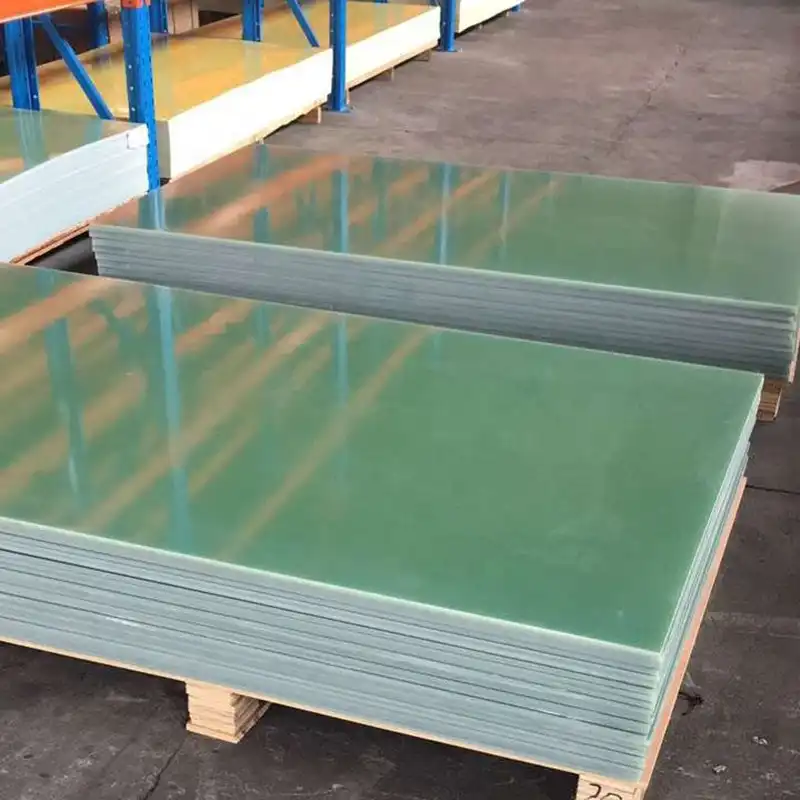
One of the most common types of insulation used in North American factories is the light-green epoxy fiberglass laminate. JingHong's FR4 sheets come in a range of thicknesses, from 0.3 mm to 100 mm, so they can meet a lot of different structural and electrical needs.
The main places where this information consistently works well are listed below:
- PCB Substrates: FR4 is the foundational base for single-sided, double-sided, and multilayer printed circuit boards. It withstands soldering temperatures and provides electrical isolation between copper layers, which is why it remains the default substrate in electronics manufacturing globally.
- Switchgear Arc Barriers and Phase Separators: In medium-voltage electrical panels, FR4 sheets act as arc shields and busbar supports. Their UL 94 V-0 compliance is a non-negotiable safety requirement where arcing faults can cause catastrophic equipment damage or personnel injury.
- Transformer Coil Insulation and Barriers: Power distribution companies use FR4 sheets for coil-to-coil separation and thermal protection layers inside dry-type and oil-cooled transformers. The low water absorption and thermal stability ensure long service intervals.
- Automotive Battery Pack Barriers: Tier-1 automotive suppliers specify FR4 for thermal separation within EV battery modules, where both flame resistance and dimensional precision across production batches are critical.
- Precision Machining Jigs and Wave-Solder Pallets: The dimensional stability of FR4 under repeated thermal cycling makes it the preferred material for automated test equipment fixtures and solder pallets, where component alignment tolerances are tight.
For single-sided, double-sided, and layered printed circuit boards, FR4 is the base material that they are built on. Because it can handle high temperatures during soldering and keeps the copper layers from touching each other electrically, it is still the standard material used to make electronics around the world.
Arc barriers and phase separators in switchgear: FR4 sheets protect against arcs and hold up busbars in medium-voltage electrical panels. Meeting UL 94 V-0 standards is an important safety requirement in places where arcing faults can seriously damage equipment or hurt people.
Procurement Guide: How to Choose and Buy FR4 Epoxy Laminate Sheets
Verify Certifications Before Ordering
Any 94V0 FR4 Fiberglass Sheet provider you can trust should show you proof that they are certified by a third party to meet UL 94 V-0 flame rating and ISO 9001 quality management standards. Do not accept self-declared compliance that does not come with test reports. Ask for details of the flammability test, the dielectric breakdown voltage, and the dimensional error. These papers keep your engineering team safe from missing specifications and make the approval process easier for regulators.
Understand MOQ, Lead Time, and Custom Options
Standard MOQ for JingHong is 500 kg, and sheet sizes are 1030 mm × 1230 mm. You can get custom sizes, such as 1220 mm × 2440 mm and 1030 mm × 2070 mm, to fit your business needs. It can be anywhere from 0.3 mm to 100 mm thick. When shipments go by sea, land, or air, pallet protection is usually used to keep them safe. The payment is made through T/T. It is always a good idea for OEM sourcing managers and procurement specialists who are in charge of planned production to ask for samples before committing to a full order.
Evaluate the Supplier's Production Capacity and Trade Experience
A supplier that makes 43,000 tons of goods every year shows that they have the scale to support stable batch quality and consistent lead times. With more than 20 years of experience making things and more than 10 years of experience trading internationally, JingHong has built up a logistics system, including an in-house logistics section, that makes it possible to buy everything from one place and have it delivered.
Ensuring Long-Term Reliability: Maintenance and Performance Optimization
Handling and Installation Best Practices
Cutting tools covered with tungsten carbide or diamond can be used to shape FR4 sheets. The rough glass fibers quickly wear down normal high-speed steel tools and can cause delamination at the edges of cuts. To keep workers safe from fine glass particles, always use high spinning speeds, feed rates that are right for the thickness of the laminate, and good dust extraction.
Routine Inspection Parameters
At regular service times, check installed FR4 insulation parts for surface darkening, micro-cracks, or edge delamination. These signs show that the machine is overloaded or thermally worn out. If the part is in a place with a lot of dampness, keep an eye on any changes in the surface resistance values. Over time, even small amounts of wetness can affect how well the high-frequency dielectric works.
When to Plan Replacements
FR4 parts that are used in high-cycle or high-temperature settings should be replaced before damage can be seen. For switchgear uses, make sure that replacement times are in sync with planned repair shutdowns to avoid unplanned downtime. For longer service life without having to be replaced in the middle of a cycle, components that will be used continuously above 130°C should be made of High-Tg FR4 from the start of the design process.
Conclusion
The 94V0 FR4 Fiberglass Sheet is the standard insulation material in high-voltage industrial equipment because it reliably puts out fires on its own, stays true to its dimensions, and keeps its dielectric strength even when it is heated or strained mechanically or electrically. The material's approved performance takes the guessing out of safety compliance, whether it's for a PCB assembly, a transformer barrier, an arc shield in a switchgear panel, or a battery module separator. JingHong's production capacity, OEM freedom, and multi-modal shipping choices make it easy for procurement teams working on complicated projects with tight deadlines to find the products they need.
FAQ
What is the difference between G10 and 94V0 FR4?
G10 and FR4 share the same woven fiberglass and epoxy resin construction, but G10 does not contain flame retardant additives. FR4 adds bromine to the resin system to achieve the UL 94 V-0 rating. This makes FR4 the required grade for most electrical and electronic applications, while G10 is limited to mechanical applications where flame compliance is not a specification.
Can FR4 epoxy laminate handle continuous high temperatures?
Standard FR4 is rated for continuous operation at 130°C. High-Tg variants handle up to 170°C–180°C and are preferred for wave-solder pallets and components in high-heat industrial environments.
Does FR4 fiberglass sheet absorb moisture?
Water absorption is below 0.2% per ASTM D570. For standard industrial insulation, this is negligible. However, for high-frequency circuit applications, dry storage prevents trace moisture from affecting dielectric performance.
How should FR4 sheets be machined correctly?
Use tungsten carbide or diamond-coated tools at high spindle speeds. Dust extraction is required to prevent glass fiber particulate inhalation. Improper tooling causes delamination and rough cut edges that can compromise insulation performance.
Is the green color a requirement for UL 94 V-0 certification?
No. The light-green appearance comes from the epoxy resin system, but FR4 sheets are also available in black, yellow, and other colors. The UL 94 V-0 rating depends entirely on the resin chemistry, not the colorant used.
Partner with J&Q for Your FR4 Fiberglass Sheet Supply
J&Q sells high-quality 94V0 FR4 Fiberglass Sheet all over the United States to makers, OEM buying managers, and engineering procurement teams. With the ability to produce 43,000 tons per year, quality processes that are ISO 9001 and UL-certified, custom sizes from 0.3 mm to 100 mm, and an in-house logistics team that handles ocean, land, and air freight, we are your one-stop shop from specification to delivery. You can email our team at info@jhd-material.com or go to jhd-material.com to get samples or talk about your project needs right away.
References
1. IEEE Transactions on Dielectrics and Electrical Insulation — IEEE, 2021
2. IPC-4101E: Specification for Base Materials for Rigid and Multilayer Printed Boards — IPC, 2017
3. UL 94 Standard for Tests for Flammability of Plastic Materials for Parts in Devices and Appliances — Underwriters Laboratories, 2013
4. ASTM D149: Standard Test Method for Dielectric Breakdown Voltage and Dielectric Strength of Solid Electrical Insulating Materials — ASTM International, 2020
5. NEMA LI 1: Industrial Laminating Thermosetting Products — National Electrical Manufacturers Association, 2019
6. Electrical Insulation Materials: Global Market Analysis and Industry Outlook — MarketsandMarkets Research, 2022
