
Is Bakelite Thermosetting or Thermoplastic?
2025-12-24 16:20:51
Bakelite is definitely not a flexible material; it is a thermosetting plastic. This basic difference comes from its chemical makeup and the cross-linked polymer chains that form links that can't be broken during the curing process. Thermoplastics can be melted and reshaped over and over again, but Bakelite sheet has a permanent chemical change in the manufacturing process that gives it great heat protection and stability. It is important for procurement workers to understand this system of classification because they need to get materials that can withstand high temperatures in difficult industrial applications without changing shape or losing their strength.
Understanding Bakelite: Thermosetting vs Thermoplastic
Leo Baekeland's groundbreaking work in 1907 made the era of man-made plastics possible by creating the first ever fully manufactured polymer. Bakelite is a phenol-formaldehyde resin whose molecular behavior and reaction to heat are completely different from those of thermoplastics. It is chemically known as polyoxybenzylmethylenglycolanhydride.
Chemical Structure and Cross-Linking Process
Bakelite's unique cross-linking process during polymerization gives it a thermosetting nature. If phenol and formaldehyde are mixed together at a certain temperature and pressure, they will make a 3D network through covalent bonds. Because of these cross-links, the structure can't be broken down by heat alone, which is different from thermoplastic polymers that have straight or twisted chains and can be melted and reformed multiple times.
Heat Response Characteristics
When thermoplastic materials are heated, they become soft, and when they are cooled, they become hard. This makes it possible to use them in several processing processes. Bakelite, on the other hand, behaves the opposite way. It stays hard after its first setting and keeps its shape even in very hot or cold temperatures. Because phenolic resin materials harden when heated and cannot be softened or reshaped by heating, they are very useful for things like electrical switchgear and car heat shields that need to work the same way even when they are under thermal stress.
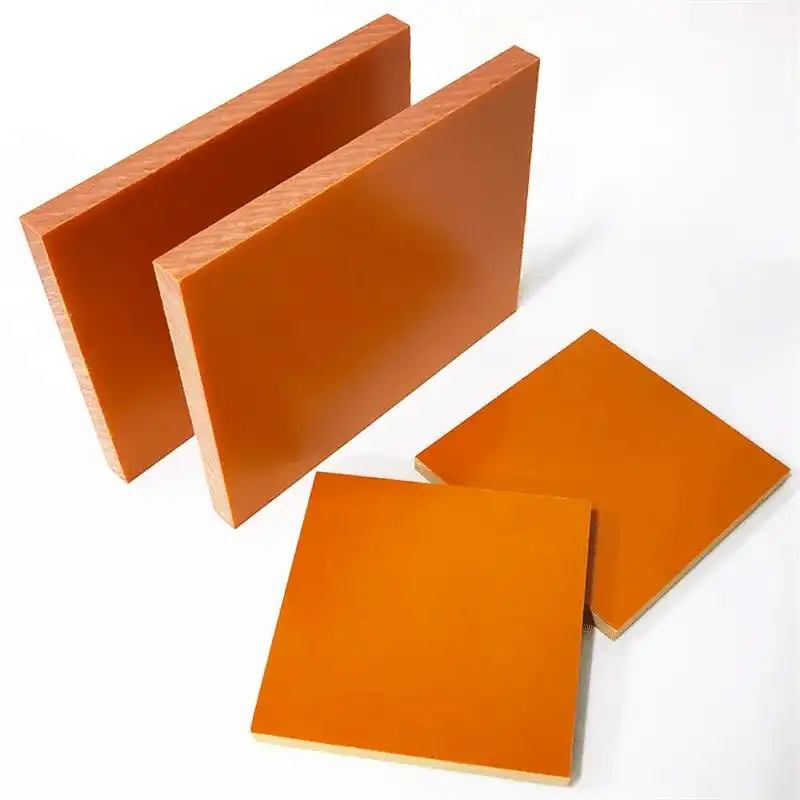
Bakelite Sheet Properties and Their Relevance to B2B Procurement
Today's industries need materials that work well no matter what conditions are present. Even though newer materials have been created, Bakelite sheets are still used because they work well in situations where normal plastics don't, thanks to the way they combine electrical, thermal, and mechanical qualities.
Electrical Insulation Performance
The dielectric strength of good Bakelite sheet is usually between 12 and 16 kV/mm. This means that it can be used in power distribution equipment and transformer systems for high-voltage situations. This material is made of a non-conductive polymer that works like electrical shielding, stopping current from flowing through it even when a lot of electricity is applied. For important safety uses, this dependability is especially appreciated by procurement managers in the electricity field.
Thermal Stability and Heat Resistance
Bakelite keeps its strength at temperatures up to 150°C for long periods of time and up to 180°C for short periods of time. This thermal stability is very important for car parts that are exposed to engine heat or industry machines that work in hot conditions. The thermal expansion rate of the material is low, so it keeps its shape when the temperature changes. This lowers the risk of part failure because of thermal cycling.
Mechanical Durability and Machinability
The compressive strength of phenolic laminates is usually more than 170 MPa, which is enough to support the structure of mechanical uses. With modern CNC machining methods, Bakelite pieces can be cut, drilled, and shaped very precisely without much wear on the tools or damage to the material. This machinability benefit makes it possible to produce custom parts cheaply while keeping the tight dimensional limits needed for precision manufacturing.
Comparing Bakelite Sheets with Other Materials: Making the Right Choice
When industries buy materials, they need to carefully consider performance, cost, and the needs of the specific purpose. Insulation materials like Bakelite have to be both technically good and budget-friendly. Procurement workers can make smart decisions when they know how Bakelite stacks up against the competition.
Performance Comparison Analysis
Bakelite has better dimensional stability but worse impact strength than fiberglass reinforced plastics. While epoxy-based materials might be better at chemical protection, Bakelite sheet is better at electrical insulation in cases where consistent dielectric properties are very important. Mica sheets have poor mechanical strength and can't be used for structures. Instead, they should be used in situations where thermal resistance is important, and phenolic laminates are a better choice.
The cost-effectiveness of Bakelite is clear in uses that need long-term dependability. Even though the first cost of the material might be higher than that of regular thermoplastics, the longer service life and lower upkeep needs usually make the investment worth it. This economic gain is especially good for procurement teams that look at the total cost of ownership instead of just the cost of buying something.
Application-Specific Material Selection
When arc resistance and flame retardancy are important, electrical equipment makers usually use Bakelite for parts of circuit breakers and switchgear systems. Automotive uses prefer phenolic materials for transmission parts and brake system parts that need to work the same way every time, even when they are under a lot of heat and pressure. Bakelite's resistance to wear and steadiness in size are useful for bearing housings and structural supports in industrial machines.
How Bakelite Sheets Are Made and Machined - Technical Insights for Buyers
Procurement workers need to know how Bakelite sheets are made in order to judge what their suppliers can do and set reasonable standards for quality. The way something is made affects its material qualities and the way it works in tough situations.
Phenol-Formaldehyde Resin Curing Process
The first step in making the product is to carefully mix phenol and formaldehyde in an alkaline environment, which makes a liquid glue system. This resin is used to saturate reinforcement materials like paper or cloth, which are then stacked in the appropriate thickness. The assembly is shaped under pressure and heat in the range of 150–180°C, which starts the cross-linking process and gives the piece its final thermosetting shape.
The quality control in this curing step decides what the final material will be like. A steady spread of temperature and pressure across the sheet helps keep the density even all the way through its thickness. Statistical process control is used by reputable makers to keep an eye on cure rates and ensure consistency from one batch to the next. This is important for procurement teams that need to be able to predict how the material will perform in every order.
Machining Techniques and Best Practices
If you want to machine Bakelite without hurting it or making it delaminate, you need to use the right tools and cutting settings. During cutting activities, carbide cutting tools with sharp edges lower the amount of heat that is made. The recommended cutting speed is usually between 200 and 400 surface feet per minute. The feed rate depends on how thick the material is and how smooth you want the surface to be.
Proper chip removal is important to keep heat from building up and damaging the material. Many makers use climb milling methods with enough coolant flow to keep the best cutting conditions. Machining standards that procurement teams know how to talk to suppliers about custom size needs and surface finish details.
Procurement Guide for Bakelite Sheets: Buying Smart in a B2B Context
If you want to get Bakelite sheets, you need to know about quality standards, foreign supply chains, and how these affect the budget and schedule for your project. These days, B2B buying settings have a lot of different ways to get things, and each one has its own pros and cons for people who are in charge of buying.
Supplier Evaluation Criteria
Trustworthy sellers of Bakelite have credentials like ISO 9001 for quality management systems and UL recognition for when the material is used in electrical applications. These certifications show that products can be traced back to the parts used to make them and that the same steps are taken to make them every time, which is important for critical uses. Procurement teams need to make sure that their suppliers can do things like check electrical properties and test mechanical strength. This will make sure that the materials meet the performance standards that have been set.
For long-term projects that need material properties to stay the same, the stability of the Bakelite sheet supply line is very important. When demand changes, established providers can usually handle it because they have enough raw materials on hand and extra production capacity. Checking a supplier's production capacity and financial stability helps keep the risk of supply issues that could affect the project plan to a minimum.
Order Quantity and Logistics Considerations
The least amount that needs to be ordered for standard thickness For common sizes, Bakelite sheets usually start at 100 pieces, and better prices are offered for bigger amounts. Because of the costs involved in setting up special production, higher minimum amounts may be needed when custom thicknesses are called for. Understanding these quantity breaks helps procurement teams make the best decisions about when to order things and how to handle their inventory.
When you ship Bakelite sheets internationally, you need to package them correctly so they don't get damaged on the way. Reputable sellers use protective wrapping and rigid palletizing to keep the integrity of the materials they ship over long distances. For standard products, lead times are usually between 2 and 4 weeks. Depending on when materials are in stock and when the production plan allows, custom products will need 4 to 8 weeks.
J&Q: Your Trusted Partner for High-Quality Bakelite Solutions
J&Q is a top maker and seller of high-quality Bakelite sheets for a wide range of uses in the fields of industrial insulation, automotive parts, and machinery. Our wide range of products includes both standard and custom sheet configurations designed to meet the exact needs of demanding uses.
Manufacturing Excellence and Quality Assurance
J&Q has strong methods for checking the quality of their work because they have more than 20 years of experience making insulating materials and more than 10 years of experience in international trade. Before shipping, our manufacturing processes include strict tests that confirm mechanical strength, dimensional accuracy, and electrical qualities. Every batch gets a full quality check to keep up with the high standards that buying experts expect.
Working with both US-based and foreign companies has helped us learn more about what customers want and what markets need. Because we have this much experience, we can offer custom solutions that deal with specific problems in applications. At the same time, we can keep our prices competitive so that people who need to buy a lot of products can afford them.
Comprehensive Service Capabilities
J&Q's unified service model for Bakelite sheet includes our own logistics business, which lets us provide all services from manufacturing to delivery at the final location in one place. This vertical integration makes it easier to control delivery times and how products are handled. This makes sure that materials get there in the best shape and are ready to be used right away. Our experienced customer service team helps people with technology issues during the buying process by helping them choose materials, come up with specifications, and learn how to use what they buy.
Conclusion
Since Bakelite is a thermosetting plastic, it has certain performance properties and can be used in a wide range of industries. The cross-linking process in production that can't be undone makes materials that have great thermal stability, electrical insulation, and mechanical durability—better than any thermoplastic. Procurement workers in the automotive, electrical, and industrial machinery sectors can make better choices about which materials to use when they understand this thermosetting property. This leads to better technical performance and long-term value. The special mix of qualities in good Bakelite sheets keeps making them a good choice for important uses where dependability and steady performance under stress are major concerns.
FAQs
Can Bakelite sheets be recycled or remolded like other plastics?
No, Bakelite cannot be recycled or remolded due to its thermosetting nature. The cross-linked polymer structure formed during manufacturing creates permanent chemical bonds that cannot be broken down by heating. Unlike thermoplastics that can be melted and reshaped multiple times, Bakelite maintains its rigid structure even at high temperatures, making it unsuitable for traditional plastic recycling processes.
What thickness options are typically available for bulk purchasing of Bakelite sheets?
Standard Bakelite sheet thicknesses range from 0.5mm to 50mm, with common industrial sizes including 1mm, 2mm, 3mm, 5mm, and 10mm options. Custom thickness specifications can be manufactured to meet specific application requirements, though minimum order quantities may be higher for non-standard dimensions. Most suppliers maintain inventory of popular thicknesses to support quick delivery requirements.
Is Bakelite suitable for high-temperature automotive applications?
Yes, Bakelite performs excellently in high-temperature automotive applications with continuous operating temperatures up to 150°C and short-term resistance to 180°C. Its thermosetting structure maintains dimensional stability under thermal cycling, making it ideal for transmission components, brake system parts, and engine bay applications where heat resistance and mechanical strength are required.
Partner with J&Q for Premium Bakelite Sheet Solutions
Ready to secure reliable Bakelite sheet supply for your critical industrial applications? J&Q combines decades of manufacturing expertise with comprehensive logistics capabilities to deliver consistent, high-quality materials that meet your exact specifications. Our experienced technical team stands ready to assist with material selection, custom sizing, and application guidance tailored to your specific requirements. Whether you need standard inventory items or specialized custom formulations, our proven track record serving global B2B clients ensures dependable service and competitive pricing. Contact us at info@jhd-material.com to discuss your Bakelite sheet requirements with our knowledgeable team and discover why leading manufacturers choose J&Q as their trusted Bakelite sheet supplier for demanding applications.
References
Baekeland, L.H. "The Chemical Constitution of Resinous Phenolic Condensation Products." Industrial & Engineering Chemistry Research, vol. 5, no. 6, 1913, pp. 506-511.
Knop, A. and Scheib, W. "Chemistry and Application of Phenolic Resins." Springer-Verlag Berlin Heidelberg, 1985.
Martin, R.W. "The Chemistry of Phenolic Resins." John Wiley & Sons, New York, 1956.
Pilato, Louis A. "Phenolic Resins: A Century of Progress." Springer Science & Business Media, 2010.
Skeist, Irving. "Handbook of Adhesives." 3rd Edition, Van Nostrand Reinhold, 1990.
Walker, J.F. "Formaldehyde." 3rd Edition, American Chemical Society Monograph Series, Reinhold Publishing Corporation, 1964.
 拷贝_1755500211555.jpg)
