Sourcing 94V0 FR4 Fiberglass Sheets: Thickness and Certification Guide
2026-10-19 17:26:11
If you are sourcing flame-retardant insulation materials for PCB manufacturing, switchgear, or industrial equipment, this guide covers everything you need to know about 94V0 FR4 fiberglass sheets — from thickness selection to certification verification. Whether you are an engineering manager, OEM sourcing specialist, or technical procurement lead, understanding these details helps you make confident material decisions that protect both your production line and your end product.
Understanding 94V0 FR4 Fiberglass Sheets: Properties and Certifications
What Does the 94V0 Rating Actually Mean?
The number "94V0" comes from UL 94, which is the Standard for the Safety of Polymers That Can Catch Fire. If a specimen is on fire and gets the highest vertical burn grade (V-0), it must put out the fire itself within 10 seconds. Flames must not drip. When a fire spreads quickly, it would be very bad, so FR4 epoxy fiberglass laminate is the best material for electrical and high-voltage uses.
Core Material Properties Worth Knowing
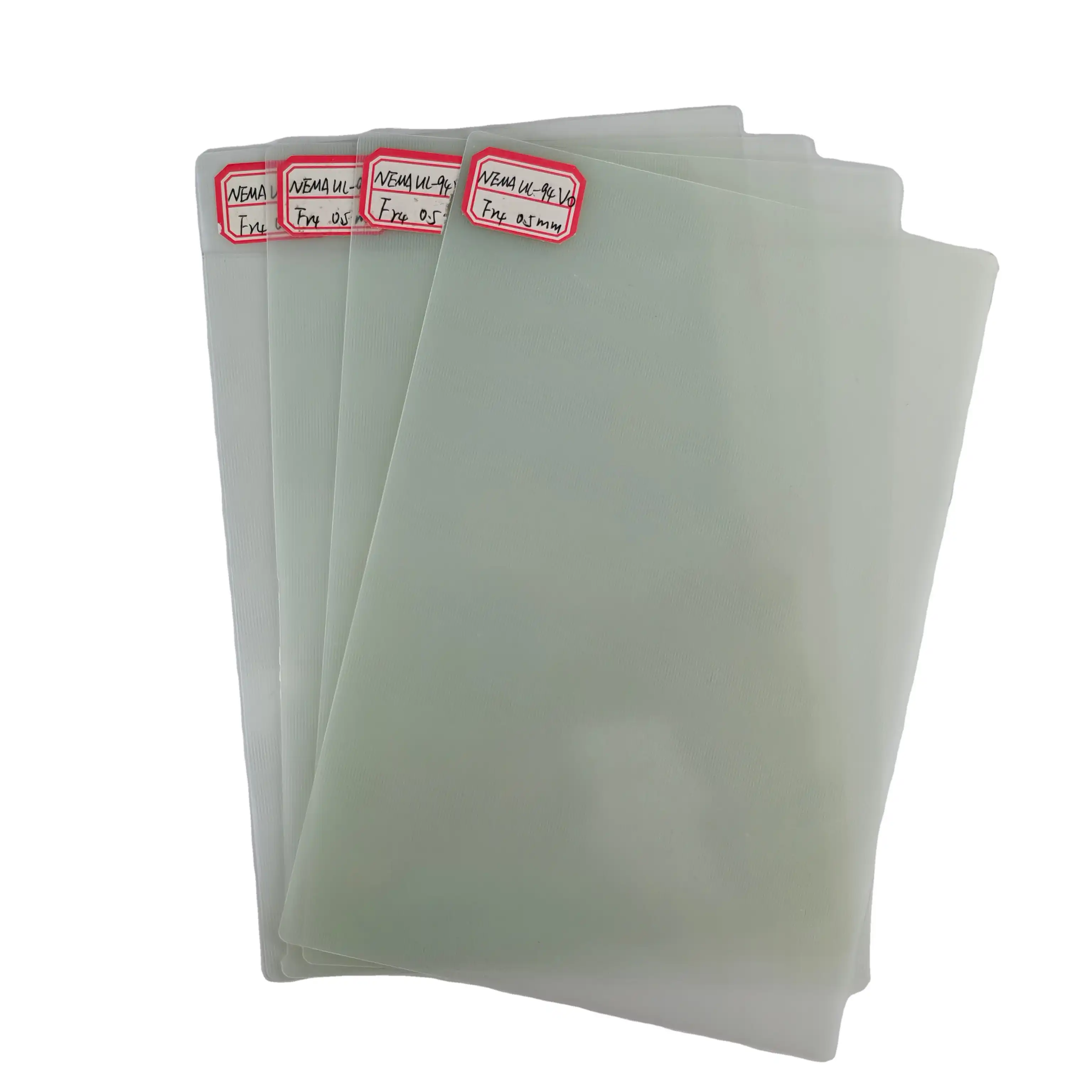
FR4 is a NEMA-grade laminate made from brominated epoxy glue mixed with fiberglass cloth that has been woven together. With this, you get a material that can withstand more than 340 MPa, has a dielectric strength of about 50 kV/mm, and usually breaks down at more than 40 kV parallel to the layers of the laminate. The temperature at which it turns into glass (Tg) is between 130°C and 140°C for standard grades. When temperatures are very high, High-Tg models can reach 170°C to 180°C.
Certifications You Should Verify Before Purchasing
When you look at a seller, make sure that the following checks have been done by a third party and are up to date:
- UL 94 V-0: Confirms self-extinguishing flame performance — non-negotiable for electrical safety compliance.
- RoHS Compliance: Restricts hazardous substances, including certain brominated compounds; required for most U.S. and EU markets.
- ISO 9001: Signals a documented quality management system covering production consistency and traceability.
"RoHS Compliance" limits harmful chemicals like some brominated compounds; this is needed for most US and EU markets. – ISO 9001: A written quality control method that covers output accuracy and being able to track it back to its source.

Thickness Options and Their Impact on Performance and Applications
What width to choose isn't just a technical matter; it also affects how well the material moves heat and power and how easily it can be machined in many cases.
Standard Thickness Range and What It Covers
When you buy a 94V0 FR4 Fiberglass Sheet from JingHong, you can choose sheets that are between 0.3 mm and 100 mm thick. The standard sheet size is 1030 mm × 1230 mm. There are thin PCB boards in this range that need to keep signals safe, and there are also heavy industrial insulation blocks that are used in transformer coil barriers and arc suppression structures.
Matching Thickness to Application Requirements
This is how thickness selection relates to real-life use groups:
Standard PCB boards, motor insulation film, and small electrical cases are all between 0.3 mm and 1.6 mm thick. This is because thickness and weight are important. Switchgear phase barriers, insulator spacers in machinery systems, and battery pack gaps in cars are all things that are between 2 mm and 6 mm thick.– Blocks of structural insulation, wave solder pallets, ATE test fixtures, and heavy mechanical parts that need to stay the same size between 10 mm and 100 mm thick.
- 0.3 mm – 1.6 mm: Standard PCB substrates, motor insulation film, and compact electronic enclosures where weight and layer density matter.
- 2.0 mm – 6.0 mm: Switchgear phase barriers, insulating spacers in machinery assemblies, and battery pack separators in automotive applications.
- 10 mm – 100 mm: Structural insulation blocks, wave solder pallets, ATE test fixtures, and high-load mechanical components requiring dimensional stability.
For that, you need to know what your working power, thermal load, and mechanical stress needs are. When making a high-frequency PCB, thinner sheets can handle more mechanical force without deforming, while smaller sheets can handle less electrical force.
Custom Sizes Available for OEM Orders
For jobs that need non-standard sizes, we can make sheets 1030 mm × 2030 mm, 1220 mm × 2440 mm, and 1030 mm × 2070 mm. You can ship orders by sea, air, or land freight, so they can handle both big jobs and ones that need to be done fast.
Comparing FR4 94V0 to Alternative Laminate Materials
You don't always have to use material with a V-0 rating. You can make sure you don't say too much or too little for your insulation material if you know the differences.
FR4 vs. FR2 and CEM-1
When the application is low-risk, it is cheaper to use FR2 (paper-phenolic) and CEM-1 (composite epoxy) instead of single-sided PCBs. However, they are not as good as fiberglass epoxy laminates when it comes to fire safety, protection to water, or mechanical power. FR4 is clearly the better choice for places where it will be wet or under a lot of stress.
FR4 vs. 94HB-Rated Materials
If you look at UL 94, 94HB is the lowest level of horizontal burn rating. 94HB sheets don't need to self-extinguish as V-0 sheets do, and they shouldn't be used near live electrical parts. Things made from 94HB won't work if your product needs to be listed with UL or meet NEC fitting standards.
When High-Tg FR4 Makes Sense
FR4 that is made to the standards always works up to 130°C (Class B insulation). High-Tg FR4—which can withstand temperatures between 170°C and 180°C—maintains its shape over many thermal cycles and doesn't delaminate when lead-free soldering is used, when temperatures change quickly, or when parts are placed close to heat-generating elements.
Procurement Strategies for FR4 Epoxy Fiberglass Laminates
It's not enough to just compare prices to find a lot of 94V0 FR4 Fiberglass Sheet. How well the batches are controlled, how stable the suppliers are, and how adaptable the operations are all affect how long production can go on.
Evaluating a Supplier's Production Capability
JingHong can make 43,000 tons of goods every year, so they don't have to worry about lead times for either big orders or small projects. Supply chains with more than one plant should make sure that the thickness tolerances are uniform (usually ±0.1 mm for thin sheets) and that the surface is solid and free of holes or dry spots before placing an order. The technical data sheets can help them with this.
Logistics and Payment Terms to Plan Around
With T/T, you can make a payment, and JingHong gives you a number of shipping choices, such as ocean freight for big orders and air freight for quick restocking. When sheets are moved over long distances, palletized shipping keeps them together. This cuts down on damage claims and waste at the other end. If your provider, like JingHong, handles transportation in-house, you won't have to wait as long for the goods to be sent to a third-party freight service.
Building a Long-Term Supply Agreement
In the case of industrial buyers who have regular needs, long-term purchase deals with agreed-upon price bands, set thickness tolerances, and priority production scheduling lower the risk of buying things. JingHong has been making things for more than 20 years and trading internationally for more than 10 years. They have the operational track record to support sourcing relationships that last longer than one year.
Maximizing Value and Ensuring Long-Term Satisfaction
Post-Purchase Technical Support
People who are good at what they do give you more than just sheets. They also give you paperwork. You should ask for full material test records (MTRs) that include results from tests on how well the material absorbs water, flammability, and dielectric breakdown voltage. This is what ASTM D570 says you should do. A very low water absorption rate (less than 0.2%) is important for high-precision electronic uses because even a small amount of water can change how high-frequency signals work.
Quality Audit Practices That Protect Your Supply Chain
Before you choose a service, you should ask to see examples of past batches to see how good the surface is, how accurate the sizes are, and how long the certification is good for. A third-party lab's check of UL 94 V-0 compliance adds an extra layer of safety, especially for goods going into the very strict U.S. market.
A Real-World Sourcing Outcome
A power distribution OEM sourcing manager moved to a certified FR4 provider who offered full paperwork, uniform batch quality, and quick contact throughout the order cycle. As a result, 30% less material was rejected. This directly helped them meet their production schedule and compliance needs further down the line.
Conclusion
To find the right FR4 epoxy laminate sheet, check that the certifications are up-to-date, make sure that the properties of the material match the needs of the job, and work with a supplier whose production scale and logistics network match your number of sheets needed. Your 94V0 FR4 Fiberglass Sheets from JingHong can be used for all kinds of insulation jobs in factories, homes, and other places. They come in both standard and custom sizes, and their thicknesses range from 0.3 mm to 100 mm. UL and ISO 9001 have also approved them. Getting these things right the first time will protect both your production plan and the safety record of the finished product.
FAQ
What is the difference between 94V0 and 94HB flame ratings?
For the 94V-0 grade, specimens that have been burned vertically must put out the fire on their own within 10 seconds without dripping with flames. The horizontal fire doesn't have to go out on its own for the 94HB rating; it just needs to slow down below a certain rate. For anything that needs to be UL rated or is near live electrical parts, 94V-0, not 94HB, is the standard that must be used.
Can thickness and sheet dimensions be customized?
JingHong lets you get sheets in any size you want, from 1030 mm × 2030 mm to 1220 mm × 2440 mm. They can also make sizes to order from 0.3 mm to 100 mm. The least amount that can be ordered is 500 kg. Lead times change based on how many orders there are and how they are set up. To make sure about the schedule, you should call the team directly.
How do I verify that a supplier's certifications are genuine?
Check it in UL's Product iQ database after getting the original UL certificate number. In order to follow RoHS rules, you should get test reports from third parties that come from approved labs. ISO 9001 certificates should have the name of the company that issued them and an expiration date so that they can be checked by more than one party.
Does FR4 absorb moisture, and does that matter?
ASTM D570 says that FR4 only absorbs less than 0.2% of its weight in water. For most business uses, this doesn't matter much. Keep the sheets dry for high-frequency PCB designs or accurate electrical testing gear so that any trace absorption doesn't change how the dielectric works.
Is green the only color available for certified FR4?
Not at all. A lot of epoxy FR4 laminates are a light green color. This color is caused by the resin system and not by any certification rules. UL 94 V-0 is a score that is only based on how flammable something is, not on its color. There are different colors of black, yellow, and natural-tone that can all have the same point value.
Get Certified FR4 Epoxy Fiberglass Sheets from J&Q
Anyone in the US or anywhere else in the world can buy UL-certified 94V0 FR4 Fiberglass Sheet from J&Q, which is also known as JingHong. We help OEM sourcing teams find a reliable source of materials that don't skimp on quality. We have been in business for more than 20 years, can make 43,000 tons of products every year, offer unique sizes, and ship using a variety of methods. Send us an email at info@jhd-material.com or visit jhd-material.com right away to get a price quote or a scientific data sheet.
References
1. UL Standards & Engagement. UL 94: Standard for Flammability of Plastic Materials for Parts in Devices and Appliances. Underwriters Laboratories, 2021.
2. IPC — Association Connecting Electronics Industries. IPC-4101: Specification for Base Materials for Rigid and Multilayer Printed Boards. IPC, 2017.
3. NEMA (National Electrical Manufacturers Association). LI 1: Industrial Laminating Thermosetting Products. NEMA, 2020.
4. ASTM International. ASTM D709: Standard Specification for Laminated Thermosetting Materials. ASTM, 2021.
5. ASTM International. ASTM D570: Standard Test Method for Water Absorption of Plastics. ASTM, 2018.
6. European Chemicals Agency (ECHA). RoHS Directive 2011/65/EU: Restriction of Hazardous Substances in Electrical and Electronic Equipment — Implementation Guidance. ECHA, 2019.