
Bakelite Sheet Remains a Reliable Choice for Industrial Applications
2026-09-16 17:27:35
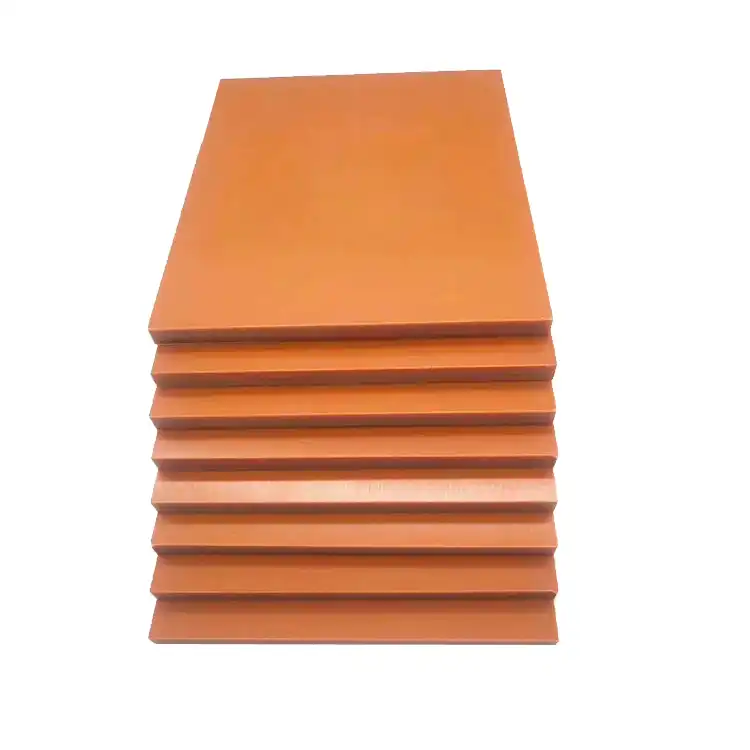
Bakelite sheet continues to prove itself as a reliable insulator and building material in tough industrial settings. This thermoset laminate is made of phenolic resin bound with paper or cloth support under heat and pressure. It has uniform temperature resistance, electrical insulation, and physical stability at a price that other materials find hard to beat. Epoxy laminate sheet has been used in real engineering for decades and has proven to be useful for everything from motor clamps and mechanical spacers to switchgear systems. This book tells people who work in buying what it is, how to choose the right grade, and how to confidently find it.
Understanding Bakelite Sheets: Composition, Properties, and Manufacturing Process
What Bakelite Sheet Is Made Of?
Bakelite Sheet, which is also known as phenolic paper laminated sheet, is made by stacking layers of woven fabric or cellulose paper that is saturated with phenol formaldehyde resin. After that, these layers are put through a multi-daylight press that controls the heat and hydraulic pressure so that the glue cures in a way that can't be undone. In the end, a stiff, dense composite is made that won't soften, warp, or melt again at normal working temperatures. Up to 120°C is the standard constant working temperature, and the material keeps its insulating properties at all of those temperatures.
Grades, Thickness Options, and Machinability
The sheet comes in grades with paper reinforcements (Grade X, XX, XXX) and grades with cloth reinforcements (Grade C, CE, L). Each grade is designed to withstand a different amount of mechanical stress and wetness. Because it has more resin, Grade XXX is better at resisting humidity and is usually used for electrical insulation in high-voltage switchgear. Fabric-reinforced grades are better for gears, wear pads, and structural spacers because they can handle more impact.
The thickness usually ranges from 0.5 mm to 50 mm, and the material works well with CNC machining—high-speed spindles with carbide-tipped tools make clean, accurate-in-dimension parts without delamination as long as dust extraction is running during the process.
Advantages of Bakelite Sheets Over Other Materials: In-Depth Comparative Analysis
Why Phenolic Laminate Outperforms Common Alternatives?
It is common for engineering managers to compare Bakelite Sheet to other materials like FR4 fibreglass, epoxy laminates, mica board, PVC, and standard thermoplastics. Each material has pros and cons that you need to be aware of in order to make smart purchasing decisions.
Here's how phenolic laminate stacks up against the most important factors for industrial buyers:
- Compared to PVC and other common plastics, phenolic sheet has a stable dielectric strength (10–14 kV/mm for Grade XXX) over a wide temperature range. PVC gets soft above 60°C and stops insulating well in places like motors or switchgear where phenolic sheet works perfectly.
- Mechanical endurance vs. mica board: Mica is very stable at high temperatures, but it is fragile and hard to shape into structural parts. It is better for phenolic cotton sheet to handle mechanical shock and can handle cutting and making holes that would break mica components.
- FR4 and epoxy laminates are more expensive, but FR4 and glass-epoxy boards are better at resisting flames and are usually used for PCBs. But for structural insulation braces, spacers, and terminal boards that don't need to meet UL 94 V-1 standards, phenolic sheet works just as well at a much lower cost, which is something that OEM sourcing managers really like.
These differences show that Bakelite Sheet is exactly in the middle of flimsy consumer plastics and expensive scientific ceramics, and it stays there.
How to Choose and Procure Bakelite Sheets for Industrial Needs?
Defining Requirements Before Contacting a Supplier
Before asking for a price, buying teams should make sure of three things: the highest temperature that the product can work at, the dielectric class that it needs, and whether it needs paper-grade or fabric-grade support. Most of the time, Grade XXX paper phenolic is used to insulate generator coils or make arc barrier structures. Cotton fabric phenolic, which is sometimes called Grade CE, is used for mechanical gears, bearing housings, or wear plates.
Evaluating Supplier Credentials and Sourcing Strategy
Suppliers you can trust should give you material certificates, batch records that can be tracked, and proof that they meet the standards that apply. When buying from a company in another country, make sure they have a proper quality control system and can offer regular thickness limits, which are usually ±0.2 mm for sheets thicker than 3 mm.
Established Bakelite Sheet makers offer a range of standard services, such as custom cuts, precise forms, and large-format sheet supply. When you sign a bulk purchase agreement, you can often get better unit prices and guaranteed lead times, which are important to tier-1 automotive and appliance supply chains. We don't use third-party freight middlemen at J&Q because we work directly with our own transportation network. This means that we coordinate shipping from production to your building.
Real-World Industrial Applications Demonstrating Bakelite Sheet's Reliability
Many buying workers are surprised to learn that Bakelite Sheet works in more fields than they first think. Because it is insulating, easy to work with, and strong, it can be used in a lot of different areas.
Paper-grade phenolic sheet is used to make electronics. It is used as a support material for PCBs, a base for terminal strips, and an insulator for switchgear panels. Electrical engineers use it for spark shields inside distribution boards because it chars instead of igniting, which stops the fault from spreading.
Fabric-reinforced phenolic sheet is cut into gears, thrust washers, and guide pads that are used in industrial machinery. Its self-lubricating surface under pressure means that it needs less upkeep than metal options. Because it doesn't pollute process lines, OEM machinery makers often ask for it when making food-grade equipment.
In the power and energy industry, phenolic laminate is used for coil spacers and wound supports by transformer makers. The material doesn't absorb much water—usually less than 0.8% by weight for Grade X—so it stays the same size inside generator housings for a long time.
Automotive research and development engineers use it to make flame-resistant barriers and insulation brackets for battery packs in electric vehicle assemblies. Its ability to hold its shape accurately and consistently is a direct safety concern.
Manufacturers of home appliances use phenolic sheet for parts like motor brackets, insulation frames, and thermal separation components that need to be of consistent quality and can be restocked quickly.
Conclusion
Bakelite Sheet has stayed useful in industry for a good reason. It has a unique mix of electrical insulation, mechanical toughness, chemical resistance, and CNC machinability, and it doesn't cost more than other materials in the same category. The material's performance profile is well known and fully confirmed through decades of recorded use. This is true whether you are selecting insulation boards for a transformer assembly, wear-resistant pads for heavy machinery, or thermal shields for EV battery packs. When procurement teams match grade selection with application standards, they always get the results they want.
FAQ
What is the maximum operating temperature for standard phenolic sheet?
Standard Bakelite Sheet works successfully at temperatures up to 120°C all the time. After this point, the material starts to turn into carbon and stops insulating properly. If you need to work with higher temperatures, glass-epoxy or mica-based laminates are better.
How does phenolic sheet compare to fiberglass for electrical insulation?
UL 94 V-0 ratings show that FR4 fibreglass is more resistant to flames and works better in damp places. When UL 94 V-1 compliance is enough and direct PCB-level flame retardancy is not needed, phenolic sheet is a good, low-cost option.
What thickness options are available, and can custom sizes be ordered?
Thicknesses should be between 0.5 mm and 50 mm. The sizes of the sheets can be changed to fit your engineering plans. On request, you can get CNC-machined blanks, precision-cut panels, and certain tolerance classes.
Is phenolic laminate sheet suitable for outdoor use?
Long-term UV exposure breaks down phenolic glue, which changes the colour of the surface and makes it less insulating. Most of the time, you shouldn't use something outside without protecting it from UV light.
How should phenolic sheet be machined without chipping?
Keep the spinning speed high and use cutting tools with carbide or diamond tips. Also, make sure the feed rate is slow and steady. Turn on dust extraction all the way through—phenolic dust is a respiratory irritant that needs to be contained properly.
Source Your Bakelite Sheet Directly from J&Q — Trusted Manufacturer and Supplier
J&Q brings over 20 years of insulation sheet manufacturing experience and more than a decade of international trade expertise to every order. As a dedicated Bakelite Sheet manufacturer and supplier, we maintain our own logistics infrastructure, enabling one-stop service from production through delivery. Our team supports custom sizing, bulk orders, and technical consultation tailored to your application. Reach our procurement team at info@jhd-material.com or visit jhd-material.com to request a quote.
References
1. Plastics Technology — "Thermoset Laminates in Industrial Electrical Applications," 2021.
2. IEEE Transactions on Dielectrics and Electrical Insulation — "Performance Evaluation of Phenolic Laminates Under Thermal Stress," 2019.
3. Materials Science and Engineering: A — "Mechanical Properties of Fiber-Reinforced Phenolic Composites," 2020.
4. IEC 60893 Standard: Specification for Industrial Rigid Laminated Sheets Based on Thermosetting Resins — International Electrotechnical Commission, 2019.
5. Journal of Applied Polymer Science — "Moisture Absorption and Dielectric Behavior of Phenol Formaldehyde Laminates," 2018.
6. Reinforced Plastics — "Cost-Performance Analysis of Phenolic vs. Epoxy Laminates in OEM Applications," 2022.
