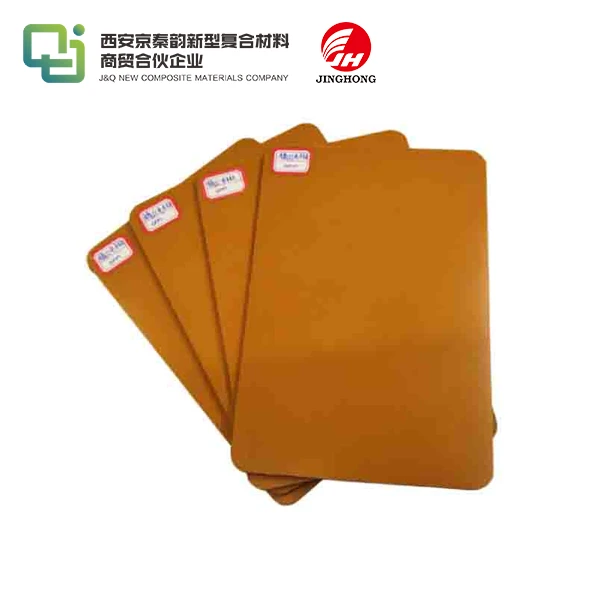
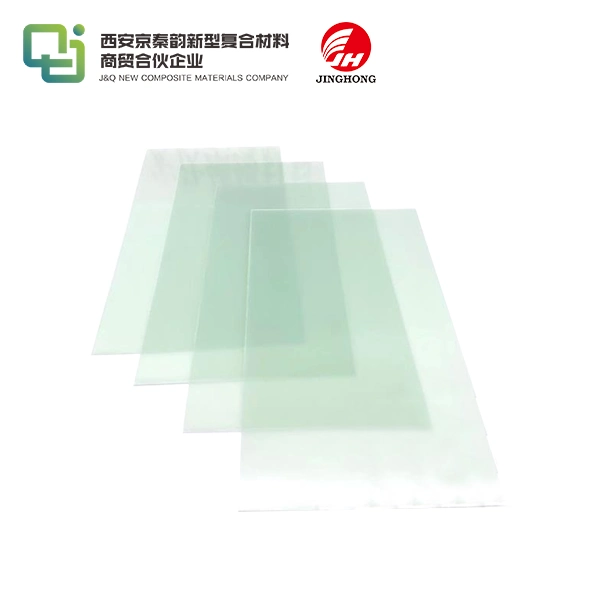
FR4 Epoxy Sheet Ensures Reliable Insulation in High Voltage Equipment
2026-08-07 16:30:13
When selecting insulation materials for high-voltage applications, FR4 Epoxy Sheet stands out as a premium glass-reinforced epoxy laminate that delivers exceptional electrical isolation, thermal stability, and mechanical durability. This comprehensive guide explores why electrical engineers, procurement managers, and OEM sourcing professionals across industries trust this material for critical insulation tasks where safety and performance cannot be compromised.
Introduction
When it comes to high-voltage equipment, the insulation materials need to be able to withstand a lot of electrical stress, high temperatures, and mechanical loads. Working with companies that make electronics, distribute electricity, and build industrial machinery for over twenty years has taught us that the choice of material has a direct effect on the safety of operations and the longevity of equipment. FR4 Epoxy Sheets have become the best choice for many uses, from PCB boards and switchgear barriers to transformer coil insulation and motor component protection. This guide tells technical buyers what they need to know about the qualities of materials, their relative benefits, how to choose them, and how to buy them in a way that meets UL, ROHS, and NEMA standards and project-specific needs quickly.
Understanding FR4 Epoxy Sheet and Its Core Properties
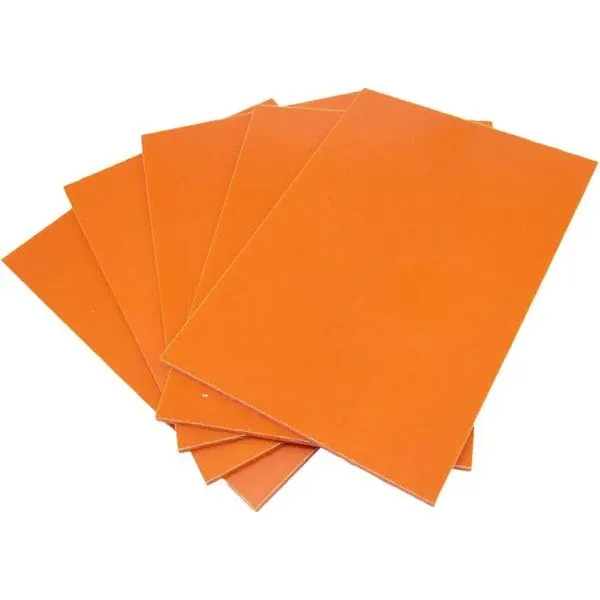
FR4 Epoxy Sheet is a grade of high-pressure thermoset plastic laminate approved by NEMA. It is made from continuously spun fiberglass cloth that has been soaked in flame-resistant epoxy glue. Multiple prepregs are stacked on top of each other under controlled heat and pressure during the production process. This makes a uniform composite structure that performs very consistently in electrical, mechanical, and thermal areas.
Material Composition and Manufacturing Excellence
Alkali-free glass threads are melted at high temperatures and pulled into fine strands. These are the building blocks of FR4 Epoxy Sheets. These threads are made into fabric and then treated with organosilane coupling agents to improve the bonding between artificial glass and organic resin systems. The fabric is then filled with epoxy resin that has curing agents, brominated flame retardants, and fillers that improve performance. When needed, copper foil cladding is stacked on top of multiple prepreg layers. These layers are then pressed together under pressures of over 1000 psi and temperatures close to 170°C. This managed lamination process makes sure that the dimensions stay the same and gets rid of any holes that might affect the dielectric strength.
Electrical Performance Parameters
Dielectric strength is an important property for high-voltage shielding, and quality FR4 Epoxy Sheets can withstand voltages higher than 40 kV perpendicular to the laminates. Volume resistivity usually exceeds 10^14 ohm-cm, which means that the insulation stays very good even in damp places where water absorption stays below 0.2% according to ASTM D570 testing guidelines. ASTM D495 says that arc resistance must be greater than 60 seconds. This keeps tracking failures that happen with lower-quality materials from happening. Because these electrical properties don't change much at different temperatures, these laminates can be used in places where temperatures change during operation.
Mechanical Strength and Dimensional Stability
Its flexural strength is more than 340 MPa along its length, which makes it strong enough for mechanical spacers, gears, and load-bearing insulating parts, and for FR4 Epoxy Sheet, the density of the material is between 1.85 and 2.10 g/cm³, which gives it a great strength-to-weight ratio that engineers in the transportation and automotive industries like, and precision CNC machining of complex geometries is possible because of the tight thickness tolerances that are maintained during manufacturing, but carbide or diamond-tipped tools are needed because the glass reinforcement is rough, and professional cutting shops use HEPA dust capture systems because glass particles are dangerous to your lungs and need to be handled safely. Its flexural strength is more than 340 MPa along its length, which makes it strong enough for mechanical spacers, gears, and load-bearing insulating parts. The density of the material is between 1.85 and 2.10 g/cm³, which gives it a great strength-to-weight ratio that engineers in the transportation and automotive industries like. Precision CNC machining of complex geometries is possible because of the tight thickness tolerances that are maintained during manufacturing. However, carbide or diamond-tipped tools are needed because the glass reinforcement is rough. Professional cutting shops use HEPA dust capture systems because glass particles are dangerous to your lungs and need to be handled safely.
Thermal Ratings and Flame Retardancy
The glass transition temperature for normal grades is between 130°C and 140°C, and the highest temperature at which they can be used continuously is 130°C, which is Class B according to IEC standards. High-Tg versions can handle temperatures of 170°C or higher, making them suitable for lead-free soldering and places where temps stay high for a long time. The "FR" designation means that the material is flame retardant and meets UL94 V-0 standards for flammability. This is made possible by brominated epoxy formulations that put out fires on their own when they are taken away from sources of ignition. This important safety feature sets FR4 Epoxy Sheets apart from G10 laminates that don't resist fire, so it has to be used in situations where NEMA LI 1-1998, IEC 60893, and MIL-I-24768/27 standards for fire safety must be met.
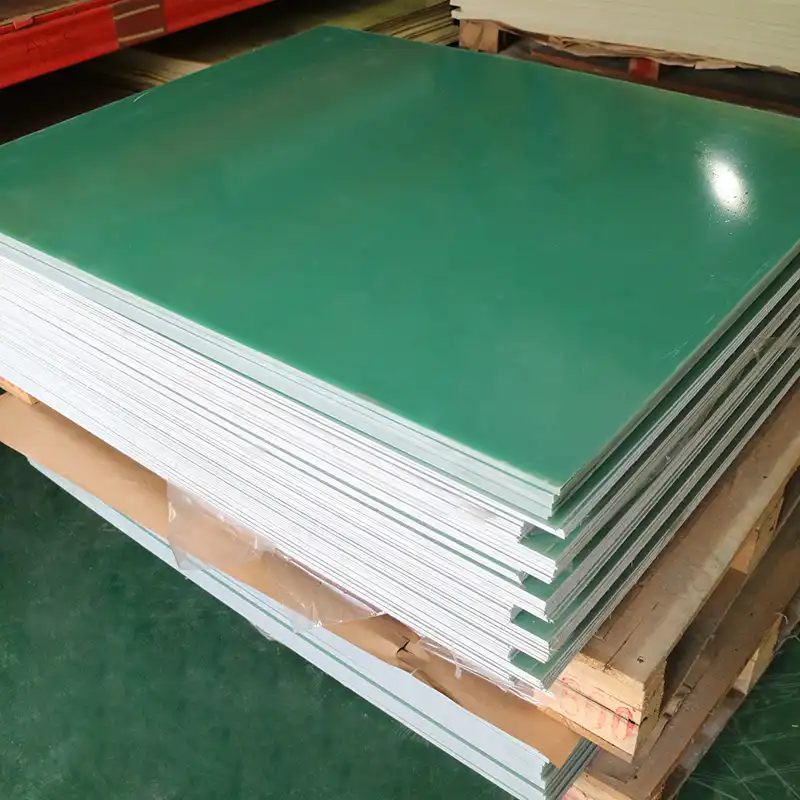
Why FR4 Epoxy Sheet Excels in High Voltage Equipment Insulation?
When choosing a material for high voltage insulation, it's important to think about how well it blocks electricity, how it handles heat under load, how strong it is mechanically, and how well it meets safety standards in the industry. When you look at the different choices, you can see that FR4 Epoxy Sheets have clear benefits that have made them the standard in many industries.
Superior Performance Versus Alternative Materials
G10 laminates have similar electrical and mechanical qualities, but they are not flame retardant, so they can't be used in places where safety is important. FR5 variants have better resistance to high temperatures, but they are much more expensive and don't improve performance by much for most uses. Phenolic laminates are cheap, but they don't fight moisture well and their mechanical features break down after being exposed to humidity for a long time. Aluminum and carbon fiber reinforced polymers are great at transferring heat, but they also create electrical paths that aren't good for insulation. FR4 Epoxy Sheets have a balanced set of properties that make them useful for a wide range of applications without the problems that come with other materials.
Real-World Application Performance
Here are some real-world examples of high-voltage shielding that works reliably:
• Power Distribution Equipment: FR4 Epoxy Sheets are used by transformer makers for coil insulation barriers, arc shields, and structural supports. These materials must keep their dielectric integrity at voltages above 35 kV while also being able to handle the heat from constant operation.
• Switchgear and Circuit Breaker Components: Arc barriers made from flame-resistant FR4 Epoxy Sheets stop electrical faults from spreading between phases. UL94 V-0 approval makes sure that they meet the safety standards for commercial and industrial systems.
• PCB Substrates for Power Electronics: High-current circuit boards use thicker FR4 Epoxy Sheets (1.6mm to 6.0mm) that protect the copper layers from electricity and support heavy parts like heat sinks and transformers.
• Electric Vehicle Battery Pack Insulation: To keep high-voltage battery cells from touching each other and transferring heat, automotive engineers use precisely cut FR4 Epoxy Sheets. These sheets must be dimensionally accurate and consistent from batch to batch.
Certification and Standards Compliance
Quality control for high voltage insulation materials depends on making sure they meet established industry standards, and for FR4 Epoxy Sheet, reliable manufacturers provide test certificates that show their products meet UL standards for electrical safety, ROHS standards for environmental protection, NEMA grade standards for consistent performance, and MIL standards for military or aerospace uses that need higher reliability, and procurement pros should make sure that sellers have ISO 9001 quality management systems in place and can include material certifications with every shipment, and this makes sure that the whole supply chain can be tracked and people are held accountable. Reliable manufacturers provide test certificates that show their products meet UL standards for electrical safety, ROHS standards for environmental protection, NEMA grade standards for consistent performance, and MIL standards for military or aerospace uses that need higher reliability. Procurement pros should make sure that sellers have ISO 9001 quality management systems in place and can include material certifications with every shipment. This makes sure that the whole supply chain can be tracked and people are held accountable.
How to Choose the Right FR4 Epoxy Sheet for Your Procurement Needs?
To choose the right material, you need to make sure that the product specs meet the needs of the application in a number of different performance areas. To find the best solutions, technical buyers have to look at things like electrical needs, temperature exposure, mechanical loads, space limitations, and budget limits for their FR4 Epoxy Sheet requirements.
Defining Performance Requirements
Electrical applications set the minimum dielectric strength and volume resistivity based on the voltages used and the distances between the insulation layers. When figuring out thermal requirements, you need to think about both the constant working temperatures and the high temperatures that happen during changes in conditions or processing steps like solder reflow. For parts that need to be made with great accuracy, mechanical specifications talk about things like bending strength, impact resistance, and the ability to be machined. Some environmental factors include exposure to humidity, chemicals, and flame resistance levels that are required by installation rules or customer requests.
Thickness, Size, and Customization Options
Standard sheet thicknesses range from 0.2 mm for PCB laminates to 50 mm for heavy-duty insulation parts for buildings. 1020mm x 1200mm and 1020mm x 2040mm panels are common sizes, but suppliers who offer CNC cutting services can make panels to any size. Pigments added during production cause color changes like natural green, black, and yellow. These changes usually don't affect the electrical or mechanical qualities, but natural green is still the standard for unaltered electrical grades. Custom manufacturing services can cut parts precisely to CAD specs, which cuts down on wasteful materials, lowers the cost of in-house machining, and speeds up production plans.
Evaluating Supplier Credibility and Capabilities
When choosing a supplier, it's not just about price per unit; it's also about technical support, consistent quality, reliable delivery, and the chance to work together for a long time. Established manufacturers show their skills by offering responsive engineering advice when choosing materials, detailed technical datasheets that cover all relevant test standards, samples for validation testing, and documented quality systems that make sure consistency from batch to batch. Procurement workers should look at how much experience the supplier has working with their industry, how well they can grow production to meet volume needs, how close the supplier is geographically, which can affect lead times, and how willing they are to work together on custom solutions that solve specific application problems.
Streamlining Procurement: How to Buy FR4 Epoxy Sheet Efficiently?
Total cost of ownership goes down when procurement methods are optimized, and production plans are met by making sure FR4 Epoxy Sheets are available on time. When using strategic sourcing, you weigh the value of price, supply chain reliability, and expert help.
Distribution Channels and Purchasing Strategies
When you need a lot of products or have specific needs that need engineering help, working directly with the manufacturer can be helpful. Industrial wholesalers make it easy to get smaller amounts and faster delivery, but they usually charge more. Online markets let you compare prices and get quotes from many sellers, but they may not offer a lot of technical help. Using annual volume commitments in bulk purchasing strategies can get you better prices and make sure you get what you need when supplies are low. Having ties with several qualified suppliers lowers the chance of output delays caused by relying on a single source.
Pricing Dynamics and Cost Management
Material costs include the cost of raw materials, the difficulty of making the product, quality control rules, and the supplier's overhead costs, and for FR4 Epoxy Sheet, most of the time, bulk discounts are offered at certain minimum quantities, and the percentage discounts get bigger as the volume level goes up, and custom cutting services cost more in labor, but they get rid of wasteful sheets that are too big, which can save money in the long run for complicated part shapes, and lead times change depending on whether goods are in stock or need to be produced in large quantities. Material costs include the cost of raw materials, the difficulty of making the product, quality control rules, and the supplier's overhead costs. Most of the time, bulk discounts are offered at certain minimum quantities, and the percentage discounts get bigger as the volume level goes up. Custom cutting services cost more in labor, but they get rid of wasteful sheets that are too big, which can save money in the long run for complicated part shapes. Lead times change depending on whether goods are in stock or need to be produced in large quantities. Faster delivery costs more. To make accurate cost comparisons, procurement professionals should ask for detailed quotes that include unit prices, tooling costs for custom fabrication, minimum order quantities, payment terms, and delivery schedules.
Technical Support and Value-Added Services
In addition to providing materials, experienced makers offer advice services to help customers make choices about which materials to use, how to create parts so they can be manufactured, and how to fix performance problems that come up during application development. Some providers keep testing tools to make sure samples are correct, give material certifications that show they meet certain standards, and work with customers to make special formulations that meet specific performance needs. These value-added services can lower project risk and speed up time-to-market, which means that overall value should be used to choose a seller instead of just unit price.
Ensuring Long-Term Performance and Partnering with the Right Supplier
To keep insulation working well for as long as the equipment lasts, it needs to be carefully checked for FR4 Epoxy Sheet quality before it is bought and regularly managed by a supplier who can adapt to new technical needs.
Quality Assurance and Testing Protocols
When inspecting new materials, they should be measured accurately using precise tools, looked at visually for delamination or surface flaws, and samples should be taken for electrical testing if the application requires it. You can be sure that the material meets the requirements by asking for certificates that show test results for dielectric strength, flame resistance, and mechanical features. Setting up lists of accepted suppliers based on their past quality performance makes buying easier while still upholding quality standards. Before committing to large orders, sample validation programs try the first shipments from new providers in real-world application settings. This lowers the risk of expensive standard deviations being found during production.
Long-Term Supplier Partnerships
Developing long-term partnerships with reputable manufacturers is good for both parties. Regular order patterns help with planning production, solving problems together by using suppliers' technical know-how, and getting special treatment when supplies are low or fast delivery is needed. Quality metrics, delivery performance, and ways to keep making processes or specifications better are all looked at in regular business reviews. Suppliers who want to keep customers for a long time show their dedication by offering engineering support, inventory management programs, and openness about where materials come from or changes in manufacturing that affect product specs.
Emerging Trends in Insulation Materials
Sustainability concerns are leading to the creation of halogen-free flame retardant mixtures that have less of an effect on the environment while still meeting UL94 V-0 standards. Power systems need ways to get rid of heat, and high thermal conductivity versions with ceramic fillers meet those needs. Thinner laminates with higher mechanical strength make it possible to make designs smaller when space is limited. By staying up to date on new materials and technologies, buying teams can take advantage of new chances to improve performance and cut costs as they come up in the market.
Conclusion
When choosing the right insulation materials for high voltage equipment, you need to carefully look at their electrical performance, thermal stability, mechanical properties, and the skills of the provider. FR4 Epoxy Sheets have been shown to be reliable in a wide range of settings, from consumer electronics and power distribution to industrial machinery and cars. Procurement strategies that work well combine technology needs with lowering costs, making sure deliveries happen on time, and making sure suppliers are a good partner. Technical buyers can make choices that improve equipment safety and performance while lowering the total cost of ownership over the product's lifetime if they know about the material's qualities, how it works, and how the market changes.
FAQ
What thickness ranges are typically available for FR4 sheets?
Standard manufacturing processes can make thicknesses ranging from 0.2 mm for PCB uses to 50 mm for heavy structural insulation parts. Most providers carry 0.5mm, 1.0mm, 1.6mm, 3.0mm, and 6.0mm as standard middle thicknesses that can be delivered quickly. Specifications can be used to make custom thicknesses, but there may be a minimum order quantity for non-standard sizes for FR4 Epoxy Sheets.
How does FR4 compare to G10 for high voltage insulation effectiveness?
Because they are both made of glass-epoxy, they have similar electrical insulation properties and mechanical strength. The main difference is that FR4 Epoxy Sheet meets UL94 V-0 standards for flame retardancy thanks to brominated additives, but G10 does not. Because of this, it is the only material that can be used in places where safety rules require it to be self-extinguishing.
Can suppliers provide custom sizing and CNC machining services?
Many manufacturers can cut precisely from CAD drawings provided by the customer, giving the customer finished parts that don't need to be machined in-house. With professional CNC equipment, this service cuts down on material waste, speeds up production plans, and makes sure that measurements are correct. To get an exact picture of overall costs, it's best to ask for prices that include both the cost of materials and the cost of fabrication services.
Partner with J&Q for Superior FR4 Epoxy Sheet Solutions
J&Q serves electrical manufacturers, industrial machinery builders, and power equipment makers all over the United States. They have more than 20 years of experience in manufacturing and more than 10 years of experience in international trade. Because we know so much about the needs for high-voltage insulation, we can suggest the best materials that meet your specific electrical, thermal, and mechanical performance requirements. As a well-known provider of FR4 Epoxy Sheets, we keep a large stock of standard thicknesses and sizes, so we can serve quickly and keep your production plans on track. Our in-house logistics make it easy to coordinate everything from placing an order to delivering it. This gets rid of the coordination problems that come up with supply lines that use more than one provider. Our commitment to UL and ROHS compliance makes sure that your parts meet important safety and environmental standards, and our technical consulting services help you choose the right materials. Get in touch with our engineering team at info@jhd-material.com or visit jhd-material.com to talk about your insulation needs and get unique solutions backed by our quality guarantee and helpful customer service.
References
1. National Electrical Manufacturers Association. (2019). Industrial Laminating Thermosetting Products Standards Publication NEMA LI 1-1998. Rosslyn: NEMA.
2. Institute of Printed Circuits. (2021). High Performance Materials for Advanced Electronics: FR4 and Beyond. Bannockburn: IPC Technical Publications.
3. American Society for Testing and Materials. (2020). ASTM D570-98: Standard Test Method for Water Absorption of Plastics. West Conshohocken: ASTM International.
4. Underwriters Laboratories. (2018). UL 94: Standard for Safety of Flammability of Plastic Materials for Parts in Devices and Appliances. Northbrook: UL Standards.
5. International Electrotechnical Commission. (2020). IEC 60893: Insulating Materials - Industrial Rigid Laminated Sheets Based on Thermosetting Resins for Electrical Purposes. Geneva: IEC Publications.
6. Coombs, Clyde F. (2018). Printed Circuits Handbook: High-Temperature Laminates and Substrate Materials. New York: McGraw-Hill Professional.