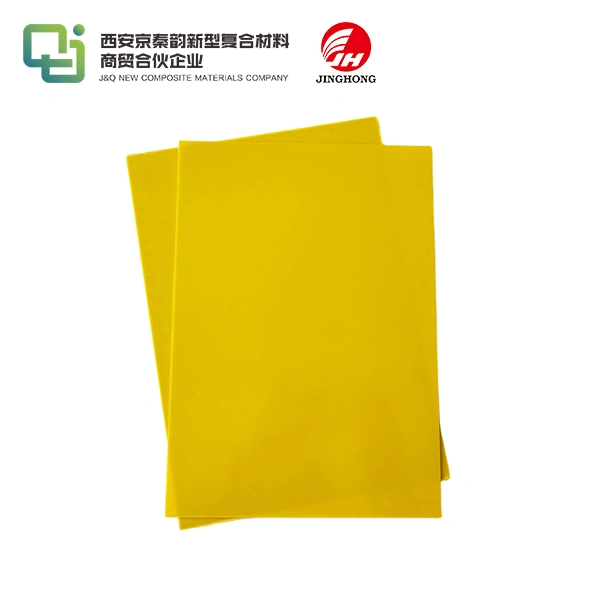
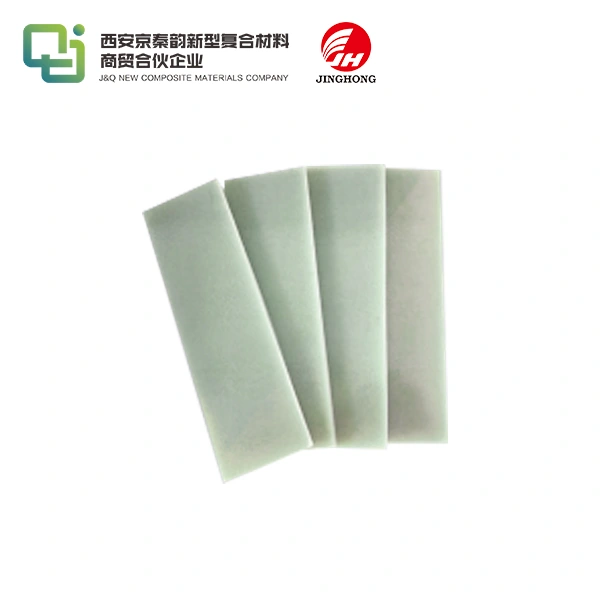
FR4 vs G10 vs G11: Epoxy Fiberglass Insulation Sheet Comparison
2026-03-05 17:00:36
To get the best performance from epoxy fiberglass insulation materials for commercial uses, it's important to know the differences between FR4, G10, and G11. FR4 is great for electronics because it doesn't catch fire and has a UL94 V-0 grade thanks to the bromine added to it. G10 has better mechanical strength than other materials on the market without using flame retardants. It also has better tensile strength and resistance to wetness for high-voltage uses. G11 works great in hot places because it has better thermal stability up to 180°C. This makes it perfect for industries like aircraft and automotive that need stable dimensions in harsh conditions.
Understanding Epoxy Fiberglass Insulation Materials: Industry Overview and Applications
What Are Epoxy Fiberglass Composite Materials?
Epoxy fiberglass composite materials are a high-tech type of thermosetting laminates made up of weave glass cloth layers and epoxy resin binders. These materials are cured under high pressure and high temperature, which makes them dense and solid enough to meet strict industry standards. The glass fiber support gives the material great mechanical strength, and the epoxy matrix makes it better at resisting chemicals and electrical current.
In the production process, epoxy resins are mixed with continuous filament glass cloth and then the whole thing is put through controlled cycles of heat and pressure. This process gets rid of any empty spaces and makes sure that the resin is spread evenly throughout the glass fiber structure. The laminate that is made has qualities that neither part could get by itself. This makes materials that are stronger and lighter than many metal alternatives.
Key Industries Driving Demand for High-Performance Insulation Sheets
Modern industries depend more and more on high-tech insulation materials to keep up with changing performance standards. For circuit board uses, the electronics industry needs materials with precise dielectric qualities and stable dimensions. Power companies that make and distribute electricity need protection that can withstand high voltages and keep its shape for long periods of time.
New lightweight, high-strength materials that work effectively in a wide range of temperatures are developed for use in aerospace. For electric car battery systems and power electronics, the auto industry is looking for materials that are both electrically insulating and resistant to flames. Manufacturers of industrial machines use these materials to make structural insulation parts that need to be able to withstand mechanical stress while still keeping electricity from flowing.
Critical Performance Requirements in Modern Industrial Applications
In modern industrial settings, insulation materials have to meet strict performance standards. Electrical qualities like loss tangent, dielectric strength, and volume resistivity have a direct effect on how well and how reliably a system works. The temperature ranges and stability of a material are determined by its thermal properties, such as its glass transition temperature, thermal conductivity, and rate of thermal expansion.
Tensile strength, flexural modulus, and impact resistance are some of the mechanical qualities that make sure a structure stays strong under operational loads. Chemical resistance keeps the surroundings safe from damage caused by cleaners, oils, and solvents. When making something, things like how easy it is to machine, how smooth the surface is, and how much room there is for error in the measurements are all things that affect how quickly and well the part is made.
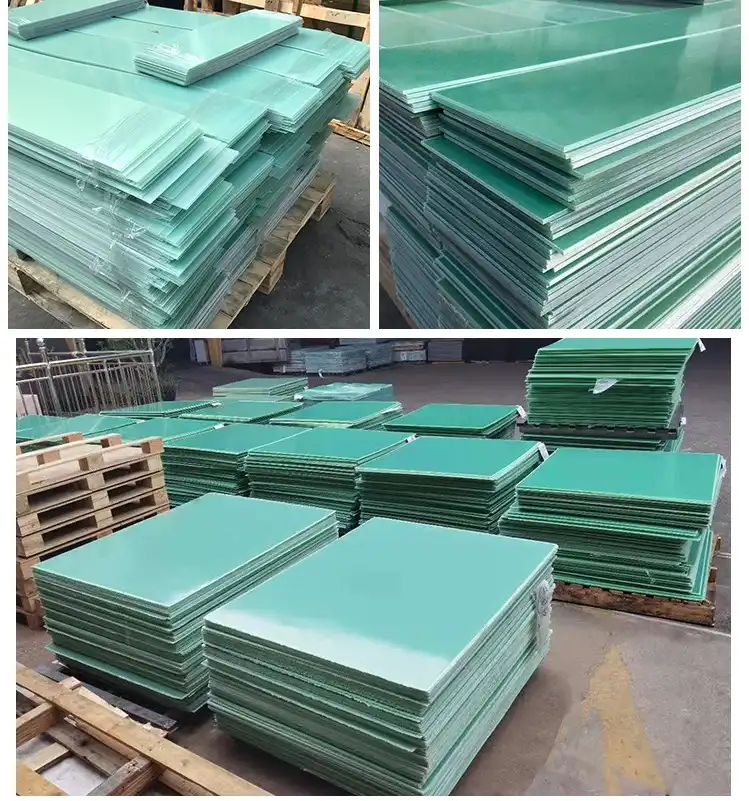
FR4 Epoxy Fiberglass Sheets: Properties, Specifications, and Performance Analysis
FR4 Material Composition and Manufacturing Standards (IPC-4101 Compliance)
Many people know that FR4 is the best flame-resistant epoxy fiberglass laminate. It is made according to the rules in IPC-4101 for electrical uses. The material is made of woven E-glass cloth that has been mixed with tetrafunctional epoxy resin that has flame retardants based on bromine. This mixture meets the UL94 V-0 flame retardancy standard and still has great electrical qualities.
Strict quality control rules are followed during the production process to make sure that the resin content is always the same, the thickness is always the same, and there aren't many holes. For copper cladding uses, the surface needs to be treated in a way that makes it stick better while still keeping the electrical performance. Standard thickness tolerances run from ±10% for most uses to ±0.05mm for high-precision electronics that need to keep exact measurements.
Electrical Properties: Dielectric Strength and Insulation Resistance
The dielectric strength of FR4 is usually between 20 and 25 kV/mm perpendicular to the lamination lines, which means it is a great electrical insulator. It can be used for high-frequency uses because the dielectric constant stays the same at about 4.5 GHz from DC to several GHz. Under standard test settings, the volume resistivity is higher than 10^14 ohm-cm, which means that the electrical isolation is reliable.
Surface resistivity values always go above 10^13 ohms, which makes sure that there aren't many leakage currents at the surfaces between components. At 1 MHz, the dissipation factor stays below 0.02, which means there is low signal loss, which is important for high-speed digital circuits. These electrical qualities stay stable at temperatures ranging from -55°C to +125°C, which means they can be used reliably in a wide range of settings.
Thermal Performance: Glass Transition Temperature and Heat Deflection
The glass transition temperature (Tg) of regular FR4 is usually between 130°C and 140°C. This is the highest temperature that can be used continuously without changing its shape. Under a 1.82 MPa load, the heat deflection temperature hits about 125°C, which shows that the material can keep its shape under thermal and mechanical stress.
It has a thermal conductivity of about 0.3 W/mK, which means it can moderately remove heat and is good for most electrical uses. The thermal expansion coefficient changes direction. It is 14–17 ppm/°C in the X–Y plane and 50–70 ppm/°C in the Z-plane. To keep stress-related breakdowns from happening, this unevenness needs to be carefully thought out during thermal cycling.
Mechanical Characteristics: Flexural Strength and Impact Resistance
FR4 has strong mechanical properties, with flexural strengths between 380 and 450 MPa, based on the type of glass fabric and resin used. Tensile strength is usually higher than 310 MPa in the warp direction, which is enough to support the structure for mounting parts and thermal expansion pressures.
Charpy impact tests shows that the impact resistance is between 40 and 60 kJ/m², which means that it is good at resisting shock loading. The material is very good at resisting wear when loaded and unloaded many times. This means it can be used in places where temperatures change or where there is mechanical vibration. These mechanical qualities make it possible for demanding electronic assemblies to work reliably.
Flame Retardancy: UL94 V-0 Rating and Safety Compliance
Adding bromine-based flame retardants to FR4 makes it possible for it to get the UL94 V-0 rating, which means it will put out itself when it comes in contact with an ignition source. Limiting oxygen index (LOI) numbers usually go above 28%, which means that the substance can't burn for a long time in environments with lots of oxygen.
According to tests done according to IEC 60695 standards, there is very little flame spread and smoke production when exposed to electrical arcing. Because of these safety features, FR4 meets the requirements of foreign electrical safety standards such as UL, CSA, and VDE. The flame retardant qualities stay the same over the life of the material, making sure that it is safe for a long time.
G10 Epoxy Fiberglass Sheets: Technical Specifications and Industrial Applications
G10 Material Standards and NEMA Grade Classifications
G10 is a high-performance epoxy fiberglass laminate made according to NEMA G-10 standards. It was made before FR4 and wasn't flame-resistant. The substance is made of continuous filament glass cloth that has been mixed with high-quality epoxy glue and then cured at a controlled temperature and pressure. Compared to flame-retardant versions, this composition has better mechanical qualities.
The NEMA G-10 specifications set strict rules for electrical, thermal, and mechanical properties. These rules make sure that all makers' products work the same way. Because it doesn't have any halogenated flame retardants, it is stronger and doesn't soak up as much water as FR4. Compliance with military specifications MIL-I-24768/GEE for aerospace and defense uses needing the highest reliability standards is part of quality certifications.
Superior Mechanical Properties: High Strength-to-Weight Ratio Analysis
G10 has great mechanical properties. Its tensile strength can reach 400–450 MPa, which is higher than many aluminum alloys while keeping its mass much lower. The strength-to-weight ratio is close to 300 kN m/kg, which makes it a good choice for aerospace and automotive uses that need to be light.
The flexural strength is always higher than 450 MPa, and the modulus is around 20 GPa. This means that the material is very stiff and can be used in structural applications. The material's compressive strength is 350 MPa, which means it can hold heavy loads without deforming. These mechanical qualities stay the same at temperatures ranging from very cold (cryogenic) to very hot (+130°C), which makes them useful in harsh environments.
Electrical Insulation Performance in High-Voltage Applications
G10 has great electrical insulation qualities, with dielectric strengths between 25 and 35 kV/mm, which is 15-20% better than FR4. Volume resistivity always goes above 10^15 ohm-cm, which makes it perfect for high-voltage uses that need great electrical isolation. The dielectric constant stays the same between 4.2 and 4.6 GHz over a wide range of frequencies.
According to ASTM D495 testing, arc resistance values that are higher than 180 seconds show better performance in high-voltage switching uses. The tracking resistance meets the standards of CTI Category III, which means it will work reliably in dirty environments. Because it has these electrical properties, G10 is perfect for high-voltage test tools, transformer insulation, and switchgear parts.
Chemical Resistance and Environmental Durability
G10 has great chemical resistance to a wide range of commercial chemicals, solvents, and pollutants in the environment. Water absorption stays below 0.1% after 24 hours of immersion, which keeps the electrical qualities and shape stability in damp places. Hydraulic fluids, lubricating oils, and standard cleaning solvents can't break down the material.
For long-term outdoor use, UV protection needs protective coatings, since epoxy resins can turn yellow or chalk when exposed to UV light for a long time. However, UV radiation doesn't change the way the structure works. Chemical compatibility with acids and bases changes depending on the concentration and temperature. For important uses in harsh chemical environments, special tests are needed.
Machining Properties and Fabrication Considerations
Because it is made of rough glass fibers and is very strong, G10 needs to be machined using special methods. It becomes necessary to use tools with carbide or diamond tips in order to get a good surface finish and tool life. Cutting speeds are usually between 100 and 300 m/min, and feed rates are changed to keep fibers from pulling out or delaminating.
During machining, dust extraction devices are required to keep the work area clean and protect workers from glass fiber particles. When the right methods are used, the material can be machined to have very smooth surfaces, which lets precise parts with close tolerances be made. To avoid exit burrs and keep the quality of the hole throughout thick sections, drilling processes need tools that are sharp and well-designed.
G11 Epoxy Fiberglass Sheets: High-Temperature Performance and Specialized Uses
G11 Enhanced Thermal Properties and Temperature Resistance
G11 is a high-tech epoxy fiberglass laminate that was made to work at high temperatures. It can withstand constant temperatures of up to 180°C. Specialized epoxy resin formulas with higher cross-link density and better thermal stability are what make the thermal performance better. The glass transition temperature (Tg) is usually between 170°C and 180°C, which is much higher than what G10 can handle.
When the structure is loaded, the heat deflection temperature hits 150°C, which keeps the structure's integrity under both thermal and mechanical stress. The material doesn't break down much when exposed to high temperatures for a long time, which makes it good for use in industrial heating and power systems. Studies of thermal aging show that mechanical qualities stay the same after thousands of hours at normal working temperatures.
Improved Electrical Performance Under Elevated Temperature Conditions
G11 keeps its great electrical qualities at high temperatures, where most materials lose a lot of their strength. Even at 150°C, the dielectric strength stays above 20 kV/mm, which makes sure that electrical separation works well in hot places. At 180°C, the volume resistivity is higher than 10^12 ohm-cm, which means it is good enough for high-temperature electrical uses.
The dielectric constant doesn't change much with temperature; it changes by less than 10% over the working temperature range. The dissipation factor goes up a little with temperature, but it stays below what is acceptable for most uses. Because these electrical properties are stable, they allow motor windings, transformer cores, and power circuits that work at high temperatures to work reliably.
Dimensional Stability in Extreme Operating Environments
G11 is more stable in terms of its dimensions when subjected to temperature cycling and mechanical stress. The coefficient of thermal expansion stays low and stable across the working temperature range. This keeps thermal stress to a minimum in parts made of different materials. The material is very resistant to thermal shock; it can handle big changes in temperature without breaking or delaminating.
Even at high temperatures, the material doesn't absorb much moisture, so it doesn't change size or lose its properties in wet, high-temperature places. Long-term creep resistance makes sure that the dimensions stay accurate even when the material is loaded continuously at room temperature. Because of these qualities, G11 is perfect for making precise parts for aircraft and automotive uses that need to stay the same size across wide temperature ranges.
Cost-Performance Analysis for High-Temperature Applications
Although G11 is more expensive than normal grades, the extra money is worth it in situations where high temperatures need to be handled. The cost of materials is usually 30–40% higher than G10, but this extra cost is often worth it when you look at the benefits for the whole system, like less cooling needed, easier thermal management, and better stability.
The longer service life at high temperatures cuts down on the cost of replacements and downtime for repair in important situations. Higher working temperatures may make it easier to change the way something is designed, which could lead to better system performance and lower costs in other parts. A study of the total cost of ownership often shows that G11 is better than other materials for uses above 130°C, where other materials would need to be actively cooled or replaced often.
Comprehensive Comparison: FR4 vs G10 vs G11 Performance Metrics
Electrical Properties Comparison: Dielectric Constant and Loss Tangent
When you compare the electrical properties of these three materials, you can see that they all have different performance traits that make them good for different uses. At room temperature, FR4 has a dielectric constant of 4.4 to 4.8 and doesn't change much with frequency up to several GHz. G10 has values that are a little lower, between 4.2 and 4.6, while G11's values are between 4.3 and 4.7 across a wider temperature range.
G10 has the lowest numbers (0.012–0.018) on the loss tangent scale, followed by FR4 at 0.018–0.025 and G11 at 0.015–0.022. In high-frequency uses where signal integrity is very important, these differences become important. A study of temperature stability shows that G11 has the most stable electrical properties across its entire working range, while FR4 experiences rising losses above 100°C.
Thermal Performance Analysis: Operating Temperature Ranges
Comparing thermal efficiency makes it clear that the two systems can do different things. For steady service up to 130°C continuous operation, FR4 can go up to 150°C for short periods of time. G10 has the same constant ratings at 130°C, but it keeps its shape better at high and low temperatures. G11 allows constant operation up to 180°C and keeps its properties very well.
FR4 has a glass transition temperature of 130–140°C, G10 has a temperature of 130–145°C, and G11 has a temperature of 170-180°C. These numbers directly relate to the highest temperatures that the service can handle and its ability to go through heat cycles. All three materials have the same thermal conductivity, which is between 0.3 and 0.4 W/mK. This means that they all have similar heat dissipation properties for thermal management formulas.
Mechanical Strength Comparison: Tensile and Flexural Properties
An analysis of the mechanical properties of these materials shows that they work in very different ways. At room temperature, G10 has the best mechanical qualities. Its tensile strength is over 450 MPa and its flexural strength is over 480 MPa. FR4 is next, with a tensile strength of 380 to 420 MPa and a bending strength of 415 to 450 MPa. G11 has values in the middle, but it keeps its properties better at higher temperatures.
G10 and G11 do better than FR4 in impact resistance tests because they don't have any flame retardant additives that can act as stress concentrators. For uses at room temperature, G10 has better fatigue performance under cyclic loading, while G11 does better under cycling conditions at higher temperatures. Based on the load factors and environmental needs, these mechanical properties help choose the right material.
Cost Analysis and Value Proposition for Different Applications
Economic research shows that the cost-performance relationships for each material are different. FR4 is the least expensive choice for common electronics uses, and its price is used as a standard to compare other options. G10 usually costs 15–25% more than FR4, but its better mechanical qualities and chemical resistance make it worth the extra cost in tough situations.
G11 costs the most, usually 35–50% more than FR4, but it has special high-temperature properties that other types don't have. Different materials have different volume pricing, wait times, and availability. Because it is made so widely, FR4 has the best supply chain benefits. To choose the best material, a total cost study must look at performance benefits, service life, and system-level impacts.
Manufacturing Scalability and Lead Time Considerations
Production scalability changes a lot between these materials depending on how they are used and how complicated they are to make. FR4 has established supply lines and many global suppliers, which means it is always available and has competitive lead times that are usually between 2 and 4 weeks for standard specifications. Depending on the needs, custom specifications may make wait times 6 to 8 weeks longer.
The availability of G10 relies on how much demand there is in the industry. Standard grades usually have lead times of 3 to 6 weeks. For special thicknesses or custom specs, delivery may take 8 to 12 weeks. G11 is the most specialized choice, but it also has the longest lead times—usually 6–10 weeks for standard specifications and up to 16 weeks for custom formulations.
Conclusion
The selection between FR4, G10, and G11 epoxy fiberglass materials requires careful consideration of application-specific requirements including temperature resistance, electrical properties, and regulatory compliance. FR4 serves electronics applications requiring flame retardancy and cost-effectiveness. G10 excels in high-voltage applications demanding superior mechanical strength and electrical performance. G11 addresses high-temperature industrial applications where standard materials cannot perform reliably. Understanding these distinctions enables optimal material selection for diverse industrial requirements, ensuring reliable performance and cost-effective solutions across electronics, aerospace, automotive, and power generation sectors.
FAQ
What is the main difference between FR4, G10, and G11 in terms of temperature resistance?
Temperature resistance represents the most significant performance differentiator among these three materials. FR4 operates reliably up to 130°C continuous service with a glass transition temperature around 135°C. G10 offers similar temperature ratings but with superior mechanical property retention at elevated temperatures. G11 provides the highest temperature capability with continuous operation up to 180°C and glass transition temperatures exceeding 170°C, making it suitable for demanding high-temperature applications in aerospace and automotive sectors.
Can these materials be used interchangeably in electrical applications?
Material interchangeability depends on specific application requirements and regulatory constraints. FR4's flame retardant properties make it mandatory for many electronics applications requiring UL compliance. G10 offers superior electrical properties but lacks flame retardancy, limiting use in applications where fire safety is paramount. G11 provides excellent electrical performance at elevated temperatures but commands premium pricing. Careful evaluation of electrical, thermal, and safety requirements determines appropriate material selection.
How do I determine the right thickness and grade for my specific application?
Thickness selection involves balancing mechanical requirements, electrical properties, and manufacturing constraints. Electrical applications require sufficient thickness to meet dielectric strength requirements while minimizing parasitic capacitance. Mechanical applications need adequate thickness to support design loads without excessive weight. Manufacturing considerations include machining requirements, surface finish needs, and dimensional tolerance capabilities. Consultation with material suppliers and application engineers helps optimize thickness selection for specific requirements.
Ready to Source High-Quality Epoxy Fiberglass Insulation Sheets?
J&Q brings over two decades of expertise in manufacturing premium G10 and epoxy fiberglass insulation materials for demanding industrial applications. Our technical team provides comprehensive application engineering support to help you select the optimal material grade, thickness, and specifications for your specific requirements. Whether you need G10 sheets for high-voltage electrical equipment or specialized G11 materials for aerospace applications, our experienced engineers guide you through the selection process. Contact us at info@jhd-material.com to discuss your custom specification needs and receive detailed technical data sheets for your application.
References
National Electrical Manufacturers Association. "NEMA LI 1-1998: Industrial Laminating Thermosetting Products." NEMA Standards Publication, 1998.
Institute for Interconnecting and Packaging Electronic Circuits. "IPC-4101E: Specification for Base Materials for Rigid and Multilayer Printed Boards." IPC International, 2017.
American Society for Testing and Materials. "ASTM D229-14: Standard Test Methods for Rigid Sheet and Plate Materials Used for Electrical Insulation." ASTM International, 2014.
Military Specification MIL-I-24768/GEE. "Insulation Sheet, Electrical, Glass-Cloth, Thermosetting Resin." Department of Defense, 2009.
Underwriters Laboratories. "UL94: Standard for Safety of Flammability of Plastic Materials for Parts in Devices and Appliances." UL Standards, 2013.
International Electrotechnical Commission. "IEC 60893-1: Insulating Materials - Industrial Rigid Laminated Sheets Based on Thermosetting Resins." IEC Publications, 2004.