Glass Epoxy Sheet Supplier Selection: Tolerances and Material Grades
2026-10-23 17:27:08
Choosing the right glass epoxy sheet supplier is one of the most consequential decisions an engineering or procurement team can make. These materials — classified under NEMA standards as G10, G11, FR4, and FR5 — form the structural and electrical backbone of PCBs, switchgear, transformer insulation, and motor components. Getting the grade wrong or accepting loose tolerances can lead to assembly failures, compliance rejections, or costly downtime. This guide walks you through what actually matters when evaluating suppliers, from material grades and thickness tolerances to certifications and long-term partnership value.
Understanding Glass Epoxy Sheets: Properties and Material Grades
Core Material Properties
A glass epoxy sheet is a high-pressure thermosetting laminate made from continuous-filament woven glass cloth impregnated with an epoxy resin binder. Its performance profile is defined by:
- Flexural strength: Typically exceeding 340 MPa (lengthwise), making it suitable for load-bearing insulation applications.
- Dielectric strength: Approximately 40–50 kV parallel to the laminate surface, per IEC 60893 standards.
- Water absorption: Less than 0.1–0.2% after 24 hours, which prevents delamination and electrical leakage in humid environments.
These properties make epoxy glass laminates the go-to material where phenolic or polyester laminates fall short — particularly in high-humidity or high-vibration conditions.
Common Material Grades Explained
Grade selection directly affects performance, and it's worth understanding the differences before placing any order:
- G10 / FR4: The most widely used grade. FR4 adds UL94 V-0 flame retardancy to G10's baseline properties. Glass transition temperature (Tg) sits around 130°C for standard FR4. Ideal for PCBs, electrical insulation panels, and switchgear components.
- G11 / FR5: Higher Tg grades (up to 180°C) suited for applications requiring thermal stability under sustained heat, such as transformer coil barriers and motor insulation in power-intensive environments.
For most electrical and electronics manufacturers, FR4 is the standard starting point. For power sector or automotive applications demanding higher temperature stability, G11 or FR5 grades are the better fit.
Thickness Tolerances: Why They Matter
Consistent thickness is non-negotiable in precision applications. Standard thickness tolerances for epoxy glass laminates typically follow NEMA LI-1 or IEC 60893 specifications:
| Nominal Thickness | Typical Tolerance |
|---|---|
| 0.5 mm – 1.0 mm | ±0.10 mm |
| 1.0 mm – 3.0 mm | ±0.15 mm |
| 3.0 mm – 6.0 mm | ±0.20 mm |
| 6.0 mm and above | ±0.30 mm |
Even small deviations outside these ranges for a Glass Epoxy Sheet can affect PCB stackup accuracy, mechanical fit of insulation spacers, or arc barrier performance in switchgear assemblies.
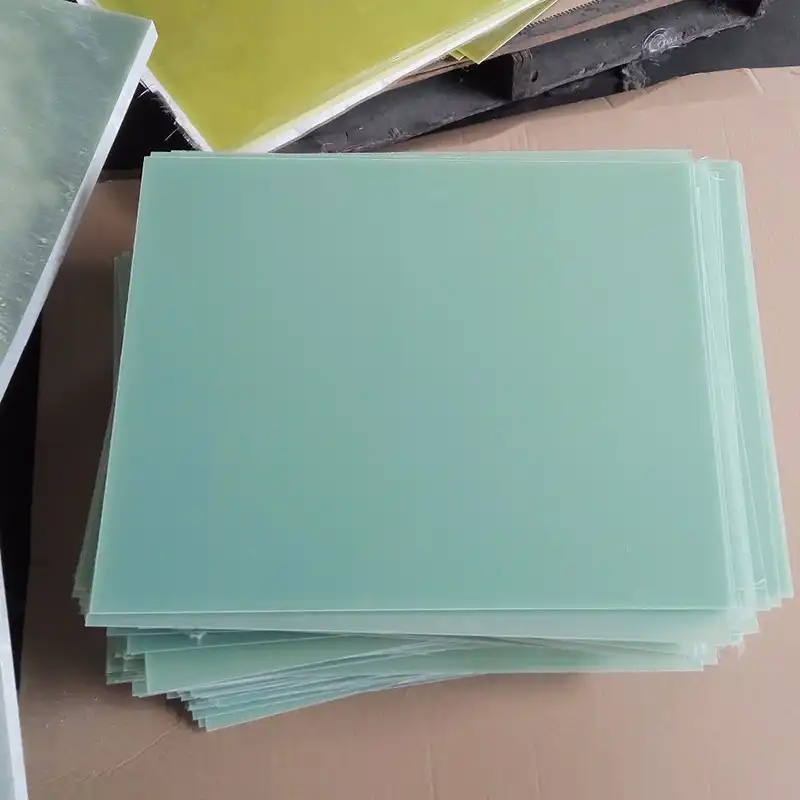
Key Factors in Supplier Selection for Glass Epoxy Sheets
Quality Certifications and Compliance
You can trust a service company if they have the right licenses for your business. To buy things in the industry, they must meet at least three standards: UL approval for flame resistance, RoHS compliance for limits on dangerous substances, and ISO 9001 quality management certification. Buyers in the power sector and tier-1 suppliers to the car industry may need more proof of compliance for regulatory audits. For example, ASTM D709 or MIL-I-24768 material test records are one way to do this.
Tolerance Control in Custom Orders
Not being able to hold tight tolerances between runs is just as important for CNC-machined parts as it is for custom-cut sheets. When you talk to them, ask them how they make sure the panels are flat, don't bend too much, and are the same thickness all the way across. Companies that make appliances and OEM machinery often have trouble with batch-to-batch differences when they do mass production. It is a good idea to ask for sample inspection results before you place a big order.
Product Grade Range and Portfolio Depth
You have to find other ways to get what you need when a supplier only has a few items. The right seller should offer a variety of NEMA grades, including G10, FR4, G11, and FR5, along with materials that work well with them, like Bakelite sheets and phenolic cotton sheets. With this range, engineering teams can buy from a single supplier for a number of different project needs. So, less work needs to be done on the back end, and everything in the supply chain will work with everything else.
Comparing Glass Epoxy Sheets with Alternative Materials
Glass Epoxy vs. Phenolic and Bakelite
You can get phenolic cotton laminates and Bakelite sheets for less money, and they work fine for low-stress conditions. But they soak up a lot more water than epoxy glass laminates, which makes them less dielectric over time. It is always better to use epoxy glass laminates over phenolic choices in damp places or when you need reliable electrical insulation for a long time, like in generator coil insulation.
Glass Epoxy vs. Aluminum and Engineering Plastics
Aluminum moves heat around better than most metals, but it doesn't keep electricity out. Plastics used in engineering, like PEEK and nylon, are good at resisting chemicals, but they're not as strong or able to handle high temperatures as G11 or FR5 types. Glass laminates made of epoxy are useful because they are strong enough to be used as structural spacers, insulating enough to be used as high-voltage barriers, and simple enough to machine that they can be used for CNC production runs.
Selecting the Right Grade for Your Application
This is a quick guide on how to match scores to job applications: FR4: PCB covers, electrical insulation panels, and switchgear support frames
- FR4: PCB substrates, electrical insulation panels, switchgear support structures
- G11 / FR5: Transformer coil barriers, motor insulation at elevated temperatures, automotive battery pack separators
- G10: General-purpose mechanical and electrical insulation where flame retardancy is not a primary requirement
These variations for a Glass Epoxy Sheet help procurement teams and R&D engineers avoid being too specific (which could cause mistakes) or too vague (which could cause too much money to be spent).
Procurement Considerations: Price, Ordering, and Delivery
Pricing Factors to Understand
The price of epoxy glass laminate depends on the kind of material, how thick the sheet is, how big the panel is, and how many sheets are bought. FR4 sheets in standard thicknesses are usually the cheapest choice. G11 and FR5 grades cost more than others because their resin systems work better. It costs more to process custom-cut or CNC-machined orders, but you usually don't need as many workers. It's better to talk to your provider about the full cost of ownership when you buy something than just the price per unit.
MOQs and Custom Specifications
Many buyers in the business world need CNC shapes or measures that aren't standard. Their minimum order quantities (MOQs) shouldn't be too high, and they should be able to work with different sheet sizes and standards. For the assembly line to work well, companies that make a lot of home appliances need to make sure that the sheet sizes are the same across large batches. So long as a seller is willing to be open on MOQ for small R&D or sample orders, it means they want to build long-term relationships.
Delivery, Lead Times, and Logistics
How clear the wait time is is one of the most important things to look for in a dealer. When suppliers handle their own operations, they clearly have an advantage. They can react faster to pressing orders, offer better real-time tracking, and have fewer places where goods can be handed off, and there is a chance of damage or delay. Putting different kinds of materials into one package saves money on freight costs and makes customs paperwork easier for teams that buy things all over the world.
Building Trust: Choosing the Right Glass Epoxy Sheet Supplier
Evaluating Reputation and Certifications
First, make sure you have IDs that can be checked. Make sure you have their ISO 9001 certificates, UL recognition files, and RoHS compliance declarations before you do business with them. Compare the seller's quality papers with the NEMA or IEC standards that your product needs. A supplier who gives proactive documentation without being asked to does so as a sign of process maturity.
Technical Support and After-Sales Service
When it comes to technical complexity, true supply partners are not the same as transactional providers. Beyond the statement, suppliers who can suggest grade upgrades based on how you work, give you advice on CNC machining, or fix problems with tolerances after delivery are really helpful. Professionals who buy things for the power industry and R&D engineers who work on cars need to keep this in mind because they have to deal with long project cycles and changing material needs.
Long-Term Partnership Value
When a business has a long-term relationship with a single approved source, they can get better prices because they know they will be buying the same amount of goods over and over again. They can also get access to new grades of materials as they become available. When suppliers have been exporting for more than ten years and have built up a strong logistics network, they can better meet the needs of buyers all over the world without having to stop service.
Conclusion
To find the best epoxy Glass Epoxy Sheet provider, you need to do more than just look at prices. A procurement project's success depends on many things, such as the grade of the materials being used, the security of the tolerances, the depth of the licensing, and the dependability of the transportation. Working with a seller who knows both about technology and has exported goods before lowers risk and makes products work better overall. This is always the case, whether you need FR4 sheets to make PCBs, G11 grades to insulate transformers, or custom-cut panels for car battery barriers.
FAQ
What are the standard thickness tolerances for epoxy glass laminates?
NEMA LI-1 and IEC 60893 rules are used to set the limits. This is the normal range for sheets that are 1 mm to 3 mm thick: ±0.15 mm. You can get better standards with precision CNC machining, but you should check with your seller first.
How does material grade affect electrical insulation performance?
It is better for electrical strength at higher temperatures for higher types of FR4, like G11 and FR5. Change to a better Tg grade if the temperature stays above 130°C for a long time. This will keep the insulation working well.
What documentation should I request from a supplier?
Ask for at least ISO 9001 certification, UL recognition files, RoHS compliance statements, and material test results that use ASTM D709 or IEC 60893 as a guide. For use in cars or power tools, ask for inspection records that are specific to the batch.
Can suppliers accommodate custom sheet dimensions?
Yes, you can change the size of the sheets and make shapes with a CNC machine. Make sure you know the minimum order number (MOQ) and size limits before you place an order.
Is FR4 suitable for outdoor or high-humidity environments?
That's why FR4 works better in damp places than phenolic laminates: it only soaks up about 0.2% of water. On the other hand, G11 or versions with special coatings may be better for long-term use outside or in cold places.
Partner with J&Q for Certified Glass Epoxy Sheet Solutions
For more than 20 years, J&Q has been making insulating products, and for more than 10 years, they have shipped goods all over the world. Our company makes Glass Epoxy Sheet, and you can trust us. Our grades are FR4, G10, G11, and FR5, and we have all the paperwork and tolerances that are needed to be in line with the rules. Every time we send something anywhere in the world, our own logistics team makes sure it gets there on time. Kindly send an email to info@jhd-material.com or visit jhd-material.com to get a price.
References
1. National Electrical Manufacturers Association (NEMA). NEMA LI-1: Industrial Laminated Thermosetting Products. NEMA, 2020.
2. International Electrotechnical Commission. IEC 60893: Specifications for Industrial Rigid Laminated Sheets Based on Thermosetting Resins. IEC, 2019.
3. ASTM International. ASTM D709: Standard Specification for Laminated Thermosetting Materials. ASTM, 2021.
4. Harper, C.A. Handbook of Plastics Technologies. McGraw-Hill, 2006.
5. Coombs, C.F. Printed Circuits Handbook, 6th Edition. McGraw-Hill, 2007.
6. Sax, N.I., & Lewis, R.J. Dangerous Properties of Industrial Materials, 8th Edition. Van Nostrand Reinhold, 1992.