How Does Deep Pour Epoxy Resin Improve Large Casting Quality?
2026-08-19 16:58:16
Deep pour epoxy resin dramatically improves large casting quality by controlling the exothermic reaction during curing, which prevents common defects like cracking, yellowing, and bubble entrapment. Unlike standard epoxies that can only handle thin layers, this specialized formulation allows thick pours—ranging from 1 to 18 centimeters—in a single application. The slower curing process provides extended working time for air release and ensures dimensional stability across substantial volumes, delivering the optical clarity and structural integrity essential for industrial-scale projects.
Understanding Deep Pour Epoxy Resin and Its Role in Large Castings
Deep Pour Epoxy Resin is a big step forward in thermosetting polymer technology. It was made to meet the needs of thick-section casting uses. The formula is very different from other table-top coating resins because it has a changed hardener chemistry that controls how fast the molecules cross-link while the resin cures.
What Makes Deep Pour Formulations Unique
The main difference is how the heat is managed. An exothermic chemical process happens when glue and hardener come together. This makes heat. In regular epoxy systems, this heat builds up quickly in thick areas, raising the temperature of the material to a point where it cures faster. This causes an overheating effect that causes stress inside the material, boiling on the surface, and the structure to break. Deep Pour Epoxy Resin types use hardeners that react more slowly, which increases the pot life to 12 to 16 hours. This lets the heat escape slowly over a 48 to 72-hour cure cycle. This controlled response keeps the material's structure even when casting more than a few liters.
The viscosity profile is also very important for casting. At 25°C, Jinghong's JQ31-9T model keeps both Component A and Component B at a uniform viscosity of 1000 CPS. This makes for an ideal flow feature. This consistency lets the mixed resin level itself and stay fluid enough for natural degassing without the need for pressure tanks. This is a big benefit for industry users who are in charge of large-scale production plans.
Performance Advantages Over Traditional Casting Materials
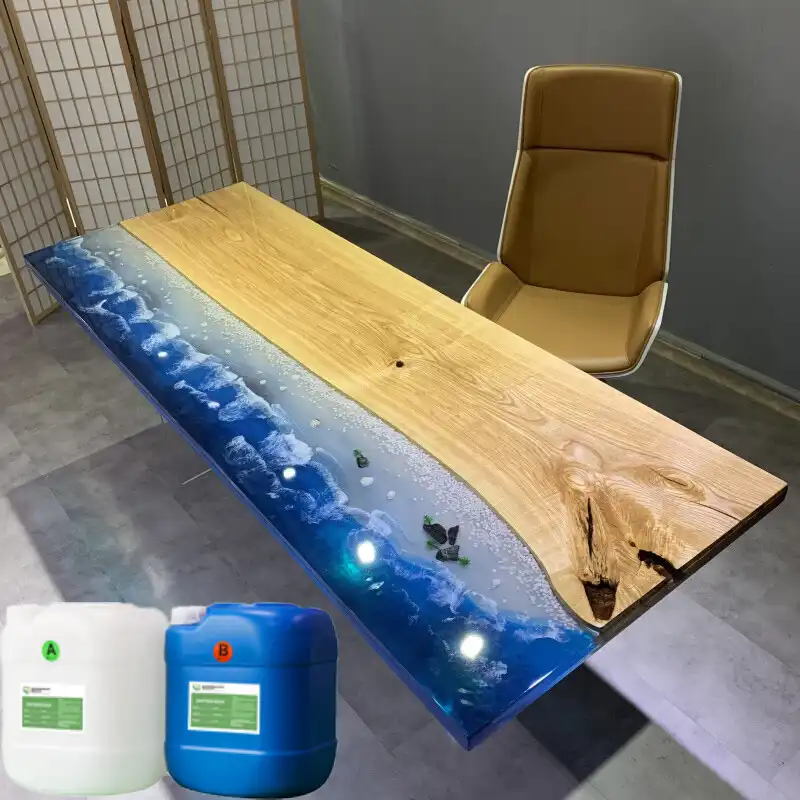
Most of the time, buying teams consider polyurethane resins, polyester casting resins, and epoxy formulations when they look at casting materials. Polyurethane systems dry quickly, but they don't stand up well to UV light and turn yellow after a few months. Polyester resins are cheaper, but they shrink a lot—often by 5 to 8 percent—which makes it hard to get accurate measurements in precision uses. Deep Pour Epoxy Resin has better performance in many ways: it shrinks very little (less than 2%), keeps its clarity very well (UV stabilizers stop yellowing), and has mechanical qualities like Shore D hardness values of 82 to 83D that are on par with industrial plastics. Because of these qualities, the material is great for protecting fragile electrical parts, making river table designs that show off wood grain detail, and making industrial tools that stay within tight standards for a long time.
Core Factors That Improve Large Casting Quality Using Deep Pour Epoxy Resin
To get perfect results when casting a lot of things, you need to know how the qualities of the material, the surroundings, and the way it is used all affect each other. When you master these variables, you can turn difficult projects into repeatable manufacturing successes.
Controlling Pour Thickness and Layering Strategy
Based on their thermal profiles, formulations have very different maximum single-pour depths. The Jinghong product line clearly shows this range: Model 31AB-7T can handle 1-3 centimeters per pour and has a quick 2-hour working time, making it perfect for situations that need to be finished quickly. The 31AB-9T model can reach 8–12 centimeters and has a 12-hour working window. The 31AB-9V model can reach 15–18 centimeters in a single pour and has a pot life of 16 hours. Choosing the right recipe relies on the size of the project, the shape of the mold, and the time constraints of the production schedule. Going beyond the suggested pour levels for a certain formulation can cause thermal runaway. This is because even slow-cure systems have limits based on the total heat mass produced by the amount of the curing material.
Environmental Control and Curing Conditions
Temperature and humidity have a big effect on the strength of the cure. Between 22°C and 25°C is the best temperature range for the process to happen because it follows the rules set by scientists. Lower temperatures, below 18°C, can make cure times longer than expected and may cause cross-linking to stop prematurely, leaving the surface sticky or lowering the final hardness. When the temperature goes above 28°C, the reaction goes faster, which cuts down on the working time and raises the risk of thermal damage. Surface cure is affected by humidity, especially when it comes in contact with uncured epoxy and makes a special film called amine blush, which is waxy and makes it hard for multiple layers to stick together or for finishing to go on afterward. Keeping the relative humidity between 40 and 60% stops this pollution and lets enough air flow through to get rid of the volatile substances that are released during curing.
Bubble Prevention and Air Release Techniques
One of the most obvious flaws in clear castings is air that gets trapped inside them. When air is added to the thick resin during mixing, which is done by adding the hardener, bubbles form. The way you mix the ingredients has a big effect on how clear the final product is. Stirring slowly and deliberately along the bottom and sides of the container for three to five minutes works better than vigorously stirring, which stirs air into the mixture. After mixing, letting the mixture rest for 5 to 10 minutes before pouring lets the bigger bubbles rise on their own. This is easier to do with Deep Pour Epoxy Resin formulas because they don't have a high viscosity like thick covering epoxies do, where bubbles get stuck. During the first 4 to 6 hours of curing, surface bubbles can be removed with a propane torch. Make quick, sweeping passes over the surface to pop the bubbles without burning it. Using a thin seal coat to cover porous materials like wood stops fibers from continuously releasing gases, which would otherwise create persistent micro-bubbles that lower the clarity of the image.
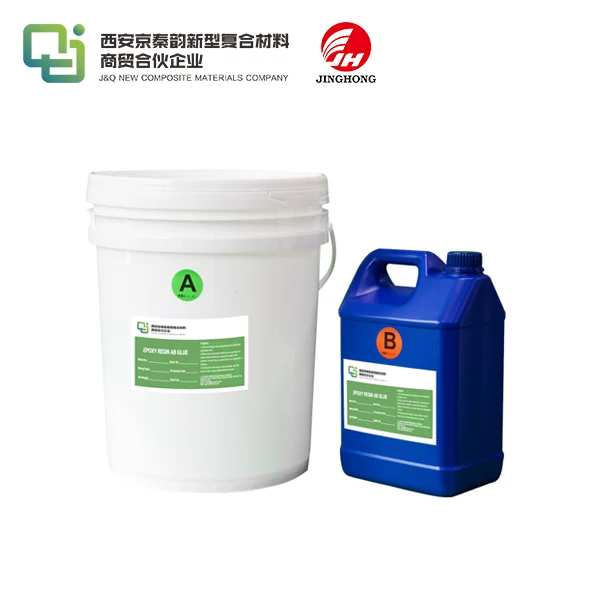
Paying close attention to mixing amounts is still a must. The JQ31-9T method needs exact measurements of Component A's weight compared to Component B's weight. Deviations of just 5–10% cause the mixture to not dry completely, leaving either too much hardener that makes the surface sticky or resin that hasn't reacted and is still soft. Digital scales that are correct to 1 gram make it possible to get uniform results from batch to batch of output.
Comparison and Selection of Deep Pour Epoxy Resins for Procurement
When looking for casting materials for use in factories, engineering managers and buying specialists have to make a lot of choices. Knowing how the specs of a product relate to how it works in the real world helps match the choice of materials with the needs of the business.
Evaluating Key Performance Parameters
Workflow freedom is based on pot life. A recipe that has a working time of 12 to 16 hours can handle complicated steps like mold preparation, pigment dispersion, and multi-stage pouring processes without having to rush through steps that hurt quality. Pot lives shorter than 4 hours are only good for simple, one-pour uses where speed is more important than process control. Curing speed affects production output. For example, systems that take 5–7 days to fully cure can't turn over molds as quickly as systems that hit demolding hardness in 24–36 hours. But speeding the demolding process before enough cross-linking has happened can damage the surface and change the shape of the part.
For artistic purposes and specimen packaging, transparency and color stability are very important. Premium formulas have UV inhibitors and stabilizers that keep the color from turning yellow even after years of being in the sun. Lower-quality goods might look clear at first, but after 6 to 12 months, they will start to turn amber, which means they can't be used in places where long-term visual clarity is worth the higher cost of the materials. Shore D hardness values show how long a surface will last. Ratings of 80 to 85D make the surface scratch-resistant, like acrylic sheet, while softer materials below 75D show marks from normal handling.
Certifications and Compliance Considerations
Industrial buyers give more weight to suppliers who can show proof that they follow regulatory standards. The Jinghong product line has been certified by ROHS, REACH, PAHS, ASTM, and EN-71, which means it meets safety and environmental standards in North American and European markets. These approvals give makers of regulated industries like electronics, cars, and consumer products peace of mind about things like heavy metal content, restricted substance limits, and toxicological safety. When customers do source checks or when regulations get stricter, products that don't have the right certifications put the supply chain at risk.
Practical Sourcing Considerations for B2B Procurement
Suppliers you can trust show consistent production by using ISO-certified quality systems and letting you track each batch. The 20,000-ton-a-year production facility that Jinghong uses was built using Japanese Toto Kasei technology. This makes sure that the process is controlled so that the final specs are the same from one production run to the next. This size allows for bulk buying agreements with known prices and supplies, which are very important for making plans for production months ahead of time.
Shelf life is an important factor that affects how you manage your Deep Pour Epoxy Resin supplies. When Deep Pour Epoxy Resin is stored properly in covered containers at room temperature, the JQ31-9T formulation can maintain a shelf life of up to 12 months. This allows businesses to keep sufficient inventory available while reducing concerns about material degradation. Different purchasing requirements, from small testing samples to full-scale production quantities, can be supported through various packaging options, including bottles and cartons for Deep Pour Epoxy Resin. Flexible payment solutions such as L/C, T/T, and credit cards also help meet the financial needs of different organisations purchasing Deep Pour Epoxy Resin, making supply management more convenient and efficient.
Best Practices and Safety Precautions in Using Deep Pour Epoxy Resin for Large Casting
The right way to handle things protects workers' health and makes sure that the results of the work are always the same. Setting up standard routines cuts down on variation and stops the costly mistakes that happen when procedures are sped up.
Essential Safety Equipment and Ventilation Requirements
Epoxy resins and hardeners contain chemicals that react with other chemicals, so you need to wear the right safety gear. Nitrile gloves are better at resisting chemicals than latex gloves because amine hardeners can quickly get into latex gloves and make the skin more sensitive, which can lead to long-term allergic reactions. When mixing and serving, safety glasses with side shields keep your eyes from getting splashed. Full-face shields provide extra safety when working with big amounts of material in production settings. When working in small areas or when the temperature outside is higher than 30°C, which raises the concentration of vapors, you need to wear respiratory protection. For normal tasks, organic vapor respirators with mixture refills are a good way to stay safe.
The air quality and cured surface finish are directly affected by the ventilation in the workspace. Cross-ventilation with fans set up to make a gentle flow of air gets rid of volatile substances without making surface turbulence that spreads dust. Avoiding areas with stale air keeps vapor from building up, which can irritate your lungs during long work sessions. Compared to polyester resins, the drying process doesn't give off much of a smell. However, good airflow is still needed to keep working conditions comfortable.
Common Application Errors and Correction Strategies
Most failures to cure in production settings are caused by mixing amounts that are too high or too low. When you measure by weight instead of volume, you don't make mistakes because different parts have different densities. Putting batch weights in production logs makes it possible to find problems with quality by following the trail. If you stir for less than three minutes, you'll leave behind lines of unmixed hardener that make the hardened casting soft in some places. Complete homogenization is achieved by scraping the sides and bottom of the container well while mixing.
Defects caused by temperature show up in a number of different ways. When you pour resin that has cooled below 20°C, the viscosity goes up, which traps bubbles and stops the resin from flowing properly into mold details. Putting containers in a warm water bath to warm unmixed ingredients up to 25°C before mixing them improves the flow properties. On the other hand, working in temperatures above 27°C speeds up the curing process, which cuts down on working time and could lead to exotherm in thick parts. Climate-controlled areas get rid of these issues, which is especially important for places that have to deal with yearly changes in temperature.
Environmental Compliance and Waste Management
Local rules say that uncured epoxy parts need to be thrown away properly as dangerous chemical waste. When you let small amounts of waste fully dry, the material becomes harmless and can be thrown away with regular solid waste. This is a useful way to keep track of mixing containers and applicators. Larger amounts need to be picked up and thrown away by approved chemical waste workers. Material Safety Data Sheets (MSDS) should be easy to find in work areas because they contain specific information on how to contain spills and what to do in an emergency.
Conclusion
Deep Pour Epoxy Resin turns large-scale casting from a difficult process that often goes wrong into a dependable production process that always produces high-quality results. To be successful, you need to choose formulations that meet the needs of the project, keep the environment under control while the material cures, and use tried-and-true methods that avoid common problems. There are clear advantages over other casting materials in terms of clarity, dimensional stability, and mechanical properties. This is why it is chosen for tough industrial uses. When procurement professionals understand these technical factors and work with experienced providers, they put their companies in a good position to achieve manufacturing excellence while keeping costs low by cutting down on wasteful work and increasing the speed of production.
FAQ
Answering common technical questions helps procurement teams and production staff make smart choices about which materials to use and how to apply them.
What determines the maximum thickness for a single pour?
The maximum pour depth is based on the total casting volume and the exotherm properties of the formulation. Manufacturers give guidelines, like 8–12 centimeters for JQ31-9T, but thinner materials may be needed for areas with more surface area that produce more heat. A 10-centimeter pour in a small 15-centimeter mold produces less heat overall than the same depth across a 60-centimeter mold. To protect the bigger casting from thermal damage, it might be necessary to use more than one layer.
How can I eliminate persistent bubbles during casting?
Bubbles usually come from three places: air that was mixed in, outgassing from porous materials, or volatiles that were released by mold surfaces that were contaminated. Entrainment is lessened by mixing things slowly. Fibers don't escape when you seal wood and other porous materials with a thin first coat. Making sure molds are dry and free of release agent residue gets rid of sources of contamination. When these safety steps are taken, the longer working time of Deep Pour Epoxy Resin formulas gives bubbles enough time to rise naturally.
Can deep pour epoxy resin be machined after curing?
Fully cured casts can be machined in the same way that acrylic plastics can. If you wait until the material has fully cured, which usually takes 5 to 7 days for Deep Pour Epoxy Resin systems, you can be sure that it is as hard and stable as it can be. If you start machining too early, heat can build up and soften resin that hasn't fully cured yet, which can lead to tool gumminess and a bad finish on the surface. Standard welding and woodworker tools, like cutters, drill bits, and sanding discs, work well. When removing material, using sharp tools and slow speeds keeps the machine from getting too hot.
Partner with J&Q for Superior Deep Pour Epoxy Resin Solutions
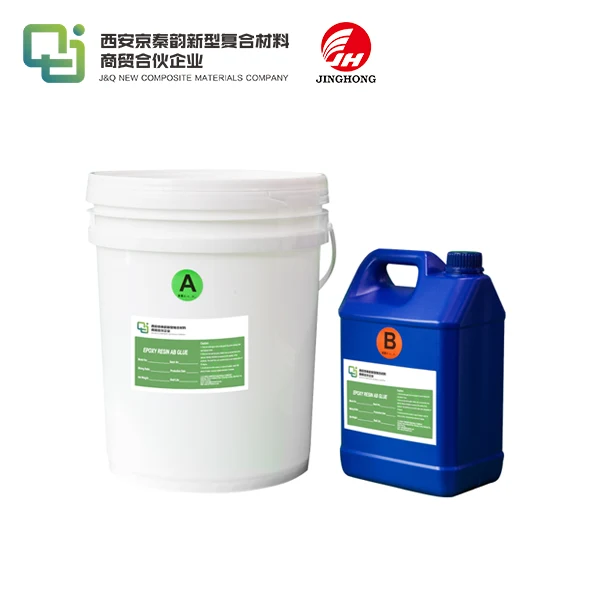
J&Q has been making materials for more than twenty years and serves manufacturers of electrical equipment, industrial machinery, power generation equipment, cars, and appliances all over the United States. Our Jinghong brand Deep Pour Epoxy Resin has the performance features that procurement teams need: it is certified to meet ROHS and REACH standards; the quality of each batch is consistent; and we offer full technical support throughout the evaluation and production phases.
With our combined transportation, we can make sure that deliveries happen on time, so your production lines don't have to stop. Our experienced team makes the buying process easier, whether you need small samples for testing or large amounts of a product with good payment terms. Our expert staff can be reached at info@jhd-material.com by engineering managers and sourcing specialists who want to talk about your unique application needs. As a well-known company that makes Deep Pour Epoxy Resin, we can give you personalized recipe advice based on the size of your casting, the location where it will be made, and your performance requirements. Find out how our materials can help your manufacturing process by reading through the full product information at jhd-material.com.
References
1. Smith, J.R. and Thompson, M.K. (2021). "Advanced Thermosetting Polymers for Industrial Casting Applications." Journal of Applied Polymer Science, 138(24), pp. 50456-50468.
2. Chen, L. and Martinez, R. (2020). "Exotherm Control in Thick-Section Epoxy Castings: Material Formulation and Processing Parameters." Polymer Engineering & Science, 60(8), pp. 1876-1889.
3. Anderson, P.W. (2022). "Comparative Analysis of Casting Resins for Industrial Manufacturing." Composites Technology Review, 44(3), pp. 112-127.
4. Roberts, D.A. and Williams, S.J. (2019). "Quality Control Methods in Large-Volume Epoxy Casting Operations." Manufacturing Process Technology, 15(2), pp. 234-249.
5. Zhang, H. and Peterson, K.L. (2023). "Environmental Factors Affecting Cure Characteristics of Deep Pour Epoxy Systems." Polymer Processing Science, 67(1), pp. 45-61.
6. Mitchell, T.R. (2021). "Material Selection Criteria for Electronic Component Encapsulation." Electronics Manufacturing Engineering, 29(4), pp. 178-192.
 拷贝.webp)