
How Does G10 ESD Epoxy Board Prevent Static Damage During Assembly?
2026-09-21 17:28:52
Static electricity is one of the most underestimated threats in electronics manufacturing. A single electrostatic discharge event, often invisible and silent, can permanently damage microchips, PCBs, and sensitive ICs before a product ever reaches a customer. G10 ESD Epoxy Board addresses this problem directly. By integrating carbon-based conductive agents into a woven glass-epoxy matrix, this material maintains a controlled surface resistivity between 10⁵ and 10⁹ Ohms. This dissipative range prevents charge buildup without creating hard shorts, giving assembly environments a reliable, mechanical-grade ESD barrier across fixtures, pallets, and test carriers.
Understanding G10 ESD Epoxy Board and Static Damage
What Makes This Material Different from Standard G10?
Standard G10 doesn't conduct electricity at all. It keeps static charges on its surface, which can lead to dangerous discharges near sensitive parts. The base epoxy resin in G10 ESD Epoxy Board is changed with volumetric carbon fills. This changes the material from insulating to dissipating static electricity. This is not a coating; the ESD property goes all the way through the board.
How Static Electricity Forms During Assembly?
People moving boxes, boards sliding across surfaces, and robotic arms picking up parts all cause static electricity to build up in a normal SMT or PCB manufacturing line. The ESD Association (ESDA) says that discharge events as low as 100 volts can hurt current semiconductor devices in many ways that the user can't see.
Key Material Properties That Matter
The board still has the bending strength of normal G10, which is more than 45,000 PSI, and it also has stable dissipative resistance that meets ANSI/ESD S20.20 standards. The highest temperature at which heat resistance can work continuously is about 130°C, and short-term changes of up to 180°C are allowed. Chemical resistance and low moisture absorption are two more reasons why it can be used in cleanrooms and washlines.
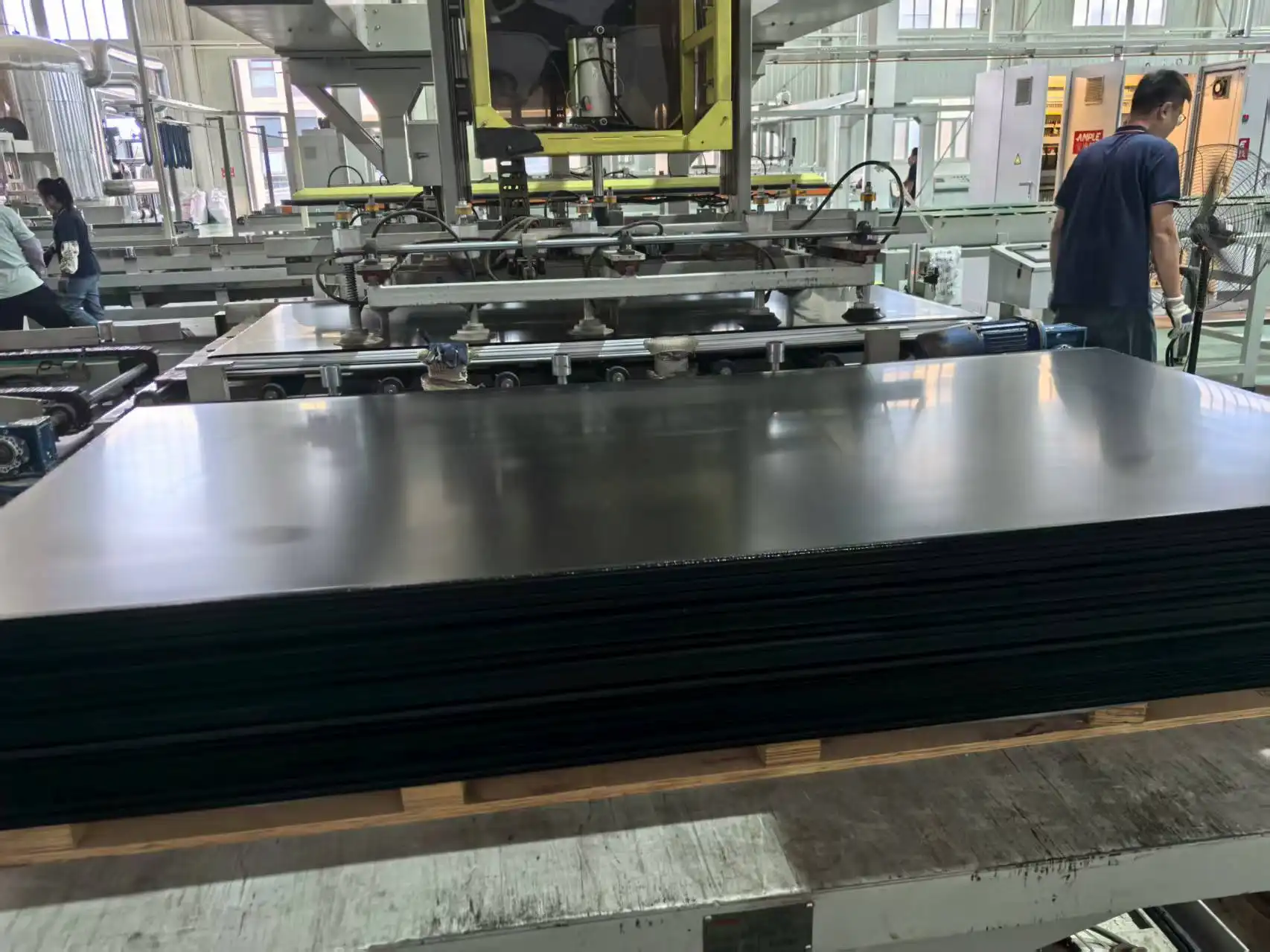
The Working Principle of G10 ESD Epoxy Board in Preventing Static Damage
Controlled Conductivity as the Core Mechanism
To protect against ESD, the board has an exact resistance window that is neither fully conducting nor fully insulative. Charges that build up on the board surface are slowly released, usually within milliseconds. This stops the voltage spike that damages components. When carbon-filled systems are used, this process works no matter how humid the air is, but surfactant-based systems don't work in dry settings.
Performance Compared to Non-ESD Boards
Surface resistance of standard FR4 boards is higher than 10³ Ohms, which means they actively gather charge. G10 ESD Epoxy Boards, on the other hand, keep resistance in the 10⁶–10⁹ Ohm range. In large-scale SMT production, moving from normal G10 to ESD-grade material has been shown to cut the number of ESD-related defects by 30 to 60%, according to process data published in IPC industry journals.
A Real-World Production Scenario
Someone who makes medium-sized PCBs and has three wave solder lines switched from using regular glass-epoxy pallets to using G10 ESD Epoxy Board carriers. After 90 days, field return rates for assembled boards dropped by 40%, and test failures inside the board that were caused by latent ESD damage went down significantly. The change didn't require any extra training for operators or changes to the way they work.
Advantages of Using G10 ESD Epoxy Board in Electronics Assembly
This material does more than just protect against static electricity. It also has a number of production-level benefits that make it worth using in high-demand industrial settings.
Here are the main benefits you should think about:
- Thermal stability for soldering processes: Standard wave and reflow soldering temperatures won't hurt the board. It works well for lead-free processes that need short-term peaks near 180°C and doesn't warp or delaminate. This means it can be used for SMT boxes and wash carts in lead-free assembly lines.
- CNC machinability without ESD loss: Since the dissipative feature is volumetric, drilling or cutting does not affect how well ESD works. Tough fixtures are made with carbide-tipped tools that remove dust with a vacuum, so the user isn't exposed to rough glass dust and the protective properties of the board aren't lost.
- Lower total cost of ownership: G10 ESD Epoxy Boards last longer and work the same way every time than metal parts (which can cause hard shorts) or coated boards (which lose their ESD safety over time). Over time, they save money because they need less rework and don't break down as often in the field.
These benefits directly lead to fewer line stops, more consistent quality output, and lower costs related to defects. These are issues that engineering managers and procurement teams keep a close eye on.
Procurement and Supplier Considerations for G10 ESD Epoxy Boards
Certifications to Require Before Buying
Before making a deal with a seller, you should always ask for proof. RoHS compliance, ISO 9001 quality system registration, and a Certificate of Conformance (CoC) with batch-specific resistivity values are some of the most important certificates. If a supplier can't give resistivity data that is tied to a specific lot, the G10 ESD Epoxy Board may not work the same way with ESD across different production runs.
Customization and Lead Time Planning
Suppliers you can trust offer unique sheet sizes, thicknesses, and shapes that have already been machined to fit current fixture designs. G10 ESD Epoxy Board: To make sure you don't run out of supplies, you need to make sure your production schedule fits with lead times, which are usually two to four weeks for standard sizes and longer for custom CNC work.
Logistics and After-Sales Support
If you're in the U.S. and buying from international suppliers, the total landed cost is affected by freight terms, packaging standards, and customs documentation. Sourcing risk is lower when suppliers have a well-established logistics system and specialized technical support. After-sales services like help with cutting and testing materials are more useful than just the price of the material itself.
Best Practices for Handling and Using G10 ESD Epoxy Board
Safe Cutting and Drilling Techniques
When dry cutting, it's best to use tools with carbide or diamond tips. Always use a strong cleaner to get rid of the dust. The glass fibers in the dust make sharp particles that damage equipment and can be dangerous to breathe in. If liquid coolants are used, make sure the board is completely dry before checking its resistivity. Surface moisture can change results for a short time.
Installation and Grounding Practices
Follow ANSI/ESD S20.20 rules when using the board as a fastener plate or SMT pallet to make sure proper grounding connections are maintained. Even a material that doesn't hold static needs a way to send electricity to ground for it to work. Users should have wrist straps on and work at stations that are grounded.
Disposal and Environmental Responsibility
G10 ESD Epoxy Board is a thermoset composite, which means it can't be recycled in a melt. Glass-reinforced plastics should be thrown away according to the city rules for hazardous waste. Some manufacturers will take back broken pieces as long as the materials are thrown away properly. By using RoHS-compliant materials from the start, you can avoid environmental problems when the product is no longer needed.
Conclusion
Static damage during assembly is a problem in production that can be avoided. It has stable dissipative resistivity, mechanical strength, thermal longevity, and CNC accuracy all in one composite. This is what G10 ESD Epoxy Board is all about. This material consistently lowers ESD risk without making the process more difficult for engineering managers and procurement specialists who are looking for fixtures and structural insulation for electronics lines. Choosing a recognized provider with quality records that can be tracked and helpful technical support can mean the difference between a reliable supply chain and costs that keep going up because of defects.
FAQ
Is G10 ESD Epoxy Board suitable for all PCB assembly types?
It works well as an ICT test device, for SMT, and for wave soldering. For lead-free reflow that lasts above 180°C, you might want to look into higher-temperature ESD options. It always works the same way for normal tasks.
How do I verify the ESD properties of a board I've received?
Ask for a CoC with surface and volume resistivity data that are specific to the batch. A surface resistivity meter (per ANSI/ESD STM11.11) is used by a third party to confirm that the material is in the dissipative range.
What is the difference between a G10 ESD board and an FR4 ESD board?
Standard FR4 is a version of G10 that doesn't catch fire and has an insulating resistivity above 10¹² Ohms. FR4 ESD is a modified version that works like G10 ESD Epoxy Board in terms of dissipation. The main difference is the amount of flame-retardant chemicals and the temperature needs of the product, not the ESD performance level.
Does humidity affect ESD performance?
No matter how humid it is, carbon-filled G10 ESD Epoxy Boards always work the same way. Surfactant-based or coating-only goods may not work as well in low-humidity areas; this is a known way that high-quality materials are different from low-quality ones.
Why does my board read as an insulator after delivery?
This usually means that the surface treatment has worn off or that the conductive filler wasn't spread out evenly during production. Always demand documentation of the specific resistivity of a lot before accepting material.
Partner with J&Q for Dependable G10 ESD Epoxy Board Supply
J&Q has been making insulated sheets for more than 20 years and has been doing business internationally for more than 10 years. We are a reliable source for G10 ESD Epoxy Board, and we offer custom sizes, CNC cutting, RoHS-compliant materials, and all-in-one shipping through our own freight network. You can email our technical team at info@jhd-material.com or go to jhd-material.com to get samples, prices, or help with sourcing.
References
1. ESD Association (ESDA). Fundamentals of Electrostatic Discharge: A Series of Technical Briefs. ESDA, 2020.
2. IPC. IPC-A-610: Acceptability of Electronic Assemblies. IPC, 2020.
3. ANSI/ESD S20.20. Protection of Electrical and Electronic Parts, Assemblies and Equipment. ESD Association, 2021.
4. NEMA. NEMA LI 1: Industrial Laminating Thermosetting Products. National Electrical Manufacturers Association, 2017.
5. Ott, Henry W. Electromagnetic Compatibility Engineering. Wiley, 2009.
6. Dangelmayer, G. T. ESD Program Management: A Realistic Approach. Springer, 1999.
