
Where Is 3021 Phenolic Paper Sheet Used in Industrial Manufacturing?
2026-09-21 17:28:49
If you work in electrical engineering, heavy machinery, or power distribution, you have likely come across phenolic laminate materials in your sourcing decisions. 3021 phenolic paper sheet is a rigid thermosetting laminate made from kraft paper impregnated with phenolic resin, then cured under heat and pressure. It meets Class E (120°C) insulation standards and is widely used across electrical equipment, transformers, switchgear panels, motor components, and mechanical spacers. Its combination of moderate dielectric strength, good machinability, and low moisture absorption makes it a dependable choice for engineers who need consistent insulation performance at a reasonable material cost.
Understanding 3021 Phenolic Paper Sheet: Composition and Key Properties
What Is It Made Of?
3021 phenolic paper laminate is made by adding phenolic glue to insulating kraft paper and then hot pressing and baking the layers together to make a single sheet. With this method, a dense, even sheet with a density of 1.35–1.45 g/cm³ is made. The end item comes in common sizes like 1030x2070 mm and 1220x2200 mm, and you can choose a thickness between 3 mm and 100 mm.
Core Electrical and Mechanical Performance
In normal conditions, the material has an insulation resistance of 10⁷ Ω and a dielectric strength of 10–12 kV/mm (tested in oil, crossing direction). The minimum tensile strength perpendicular to the laminations is 115 MPa, and the minimum impact strength (Notched Charpy, parallel) is ≥12 kJ/m². Based on these numbers, it can be used for low- to medium-voltage insulation jobs that need to ensure reliable electrical separation.
Why Engineers Choose It?
Here are the main technology benefits that engineers always depend on:
- Good machinability: It can be cut, drilled, and milled with standard CNC equipment, reducing processing time on the shop floor.
- Low moisture absorption: The resin matrix resists moderate humidity, keeping dielectric properties stable in real operating conditions.
- Resistance to transformer oil: Unlike non-impregnated cellulose insulators, this laminate maintains structural integrity when submerged in insulating oil environments.
- Cost efficiency: Among phenolic laminates, the paper-based variant carries the lowest material cost while still meeting Class E insulation requirements.
All of these benefits help with the most common problems in production, like insulation that breaks down too soon, hard-to-machine parts, and limited budgets that make it hard to choose the right materials.
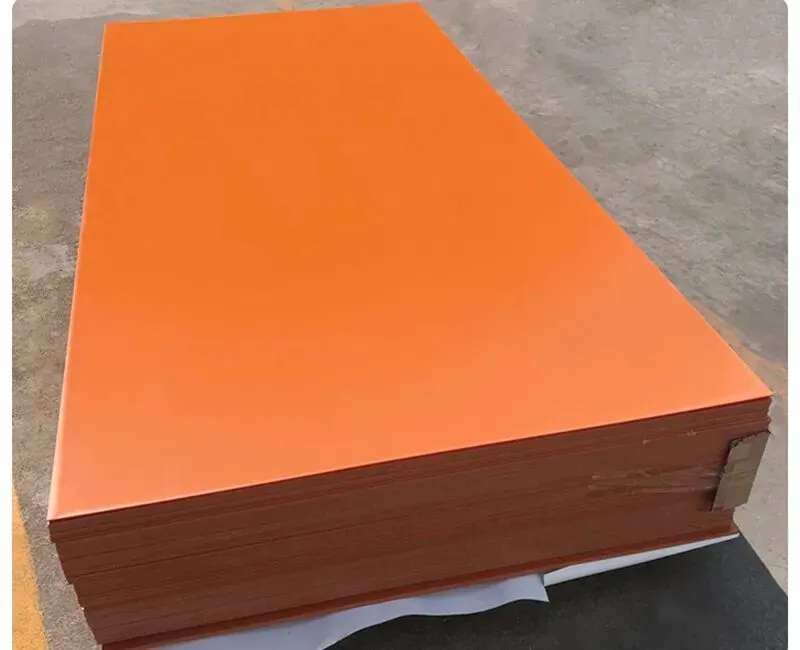
Industrial Applications: Where and Why Is 3021 Phenolic Paper Sheet Used?
Electrical and Electronics Manufacturing
Phenolic paper laminated sheet is used to make electrical tools like insulating washers, bushings, panel boards, and circuit parts. 3021 Phenolic Paper Sheet It is used by transformer makers for coil barriers and oil-immersed insulation parts because it stays chemically stable in transformer oil. It is also used as a backup board material in PCB drilling, which needs to be able to keep its shape under repeated mechanical stress.
Industrial Machinery and Power Equipment
This material is used by people who build machines for mechanical spacers, gaskets, and wear pads that need to be strong against compression and not conduct electricity. Because it has a tensile strength of more than 115 MPa, it can be used in load-bearing situations where ceramics would be too fragile, and fiberglass laminates would be too expensive. Companies that distribute electricity use it for arc barriers and insulator frames in switchgear boxes, where it can withstand temperatures up to 120°C and still work properly.
Automotive and Home Appliance Sectors
Sheets made from phenolic paper are used by makers of auto parts for heat-resistant parts and insulation pads in battery modules and motor housings. Because the material can keep its exact dimensions after CNC machining, it is appealing to tier-1 suppliers who have to keep track of strict size requirements. Manufacturers of home appliances also use it in motor brackets and thermal separation frames because it has stable batch quality and can be used with high-volume production lines.
Comparing 3021 Phenolic Paper Sheet with Alternative Materials
3021 vs. FR4 Fiberglass Sheet
Because it is stronger and doesn't absorb water as well, FR4 is the most common material used for PCB substrates. However, 3021 phenolic paper laminate works well enough for oil-soaked insulation parts, switchgear spacers, and transformer barriers, and it costs a lot less. When engineers are making a lot of electrical equipment, they often choose 3021 because it has a lower cost per unit of insulation without lowering the Class E temperature grade.
3021 vs. 3025 Cotton Phenolic Sheet
The 3025 grade is stronger because it uses cotton fabric instead of paper to reinforce it. However, 3021 values dielectric properties more than impact toughness. This makes it the best choice for switchgear assemblies where reducing leakage current is more important than absorbing mechanical shock. When there is electrical stress and oil absorption in the working area, 3021 works more reliably.
3021 vs. Epoxy Glass Laminates (3240 Grade)
The tensile qualities of 3240 epoxy glass laminate are better across the board, and it can handle higher temperatures (Class B, 130°C). If you have the money and the temperature needs to be higher than 120°C, the 3240 is the best choice. 3021 Phenolic Paper Sheet: For uses staying within Class E limits, 3021 offers similar insulation performance at a lower purchase price. This is why it is still the usual choice for making transformers and doing basic electrical insulation work.
Procurement Guide for 3021 Phenolic Paper Sheet
Evaluating Supplier Qualifications
Make sure that the supplier you choose has certifications that match IEC 60893-3-4 (PFCP201) or national standards that are similar. Before placing a big order, make sure the sheet meets your needs by asking for material test results that include dielectric strength, flexural strength, and density. Reliable suppliers give you all the paperwork you need, which makes the quality approval process easier inside your company.
Order Specifications and Customization
Standard sheet sizes are 1030 mm x 2070 mm and 1220 mm x 2200 mm. There is a 15 mm thickness range for sheet sizes. Cut-to-size cutting is offered by many makers. This cuts down on waste on your production line and speeds up the preparation process. When you place an order, be sure to be clear about the diameter range (3–100 mm), color (orange or black), and any surface finish needs.
Logistics and Lead Time Planning
Lead times depend on how customized the item is and how many orders there are. Suppliers who handle their own operations can cut down on arrival times and the costs of coordinating shipping. Setting up a blanket order or consignment deal with a trusted seller can help business-to-business buyers who are in charge of ongoing production schedules make sure they always have the materials they need without having to pay too much for storage.
Handling and Processing 3021 Phenolic Paper Sheet in the Manufacturing Process
Cutting and Machining Practices
Carbide-tipped tools work well with phenolic paper laminate. Routing, cutting, and sawing are all standard CNC processes. Keep feed rates reasonable to keep sheet edges from delaminating, and use dust extraction equipment while cutting because phenolic dust is dangerous to breathe in and needs to be protected properly according to standard safety rules for workshops.
Storage Conditions
Sheets should be kept flat on pallets in a dry warehouse with a roof. If you don't want to cause warpage, don't stack big loads on top of each other. Long-term exposure to strong sunshine or places with a lot of humidity can change the way a surface looks and how stable its dimensions are.
Installation Tips
If you want to use the material as an insulating spacer or shield, make sure that the sides that touch each other are clean and free of any metal particles. Allow enough time for the sheet to mix with the insulating oil in oil-immersed applications before turning on the assembly.
Conclusion
In industrial production, 3021 Phenolic Paper Sheet has been used for decades because it is a good solution for a certain issue: it is cheap, easy to work with, doesn't absorb oil, and meets Class E thermal standards. There are many electrical and mechanical uses for this phenolic laminate, such as transformer coil barriers, switchgear panels, and motor insulation frames. It works reliably in all of these situations. When procurement teams know the exact property profile of a material, they can make better choices about where to get it and avoid over-specifying more expensive materials when 3021 will do the job.
FAQ
What thickness options are available for 3021 phenolic paper sheet?
Thicknesses often run from 3 mm to 100 mm. Most sheets are 1030 mm x 2070 mm or 1220 mm x 2200 mm, and there is a 15 mm error range. Many makers offer cut-to-size choices that can be customized.
What is the maximum continuous operating temperature?
This laminate is rated Class E, which means it can work continuously at temperatures up to 120°C. It's not suggested for uses above this temperature; for higher heat needs, 3240 epoxy glass laminate (Class B, 130°C) is much better.
Can it be used in transformer oil environments?
Yes. One clear benefit over cellulose insulators that aren't impregnated is that it stays stable in transformer oil. It doesn't absorb oil well enough to maintain the dielectric integrity of assemblies that are submerged in oil.
Is it suitable for CNC machining?
Yes, phenolic paper laminate is one of the thermoset materials that can be worked with more easily. You don't need any special tools to drill, route, or cut with standard carbide tools.
What colors are available?
The most common colors are orange and black. The color doesn't change how well the electrical or mechanical parts work; they are chosen based on how they look or what the customer wants.
Get a Quote for 3021 Phenolic Paper Sheet from J&Q
J&Q has been making soundproofing sheets for more than 20 years and has been trading with other countries for more than 10 years. As a reputable 3021 Phenolic Paper Sheet provider, we make sure that the quality of each batch is the same, provide full certification paperwork, and run our own transportation network to ensure fast delivery to the US and other countries. To get a unique price right away, email your requirements to info@jhd-material.com or go to jhd-material.com.
References
1. IEC 60893-3-4: Industrial Rigid Laminated Sheets Based on Thermosetting Resins — Specification for Phenolic Paper Laminated Sheets. International Electrotechnical Commission, 2003.
2. NEMA Standards Publication LI 1: Industrial Laminating Thermosetting Products. National Electrical Manufacturers Association, 2020.
3. GB/T 1303.1: Laminated Sheets of Thermosetting Resins for Electrical Purposes — Part 1: Definitions, Designations and General Requirements. Standardization Administration of China, 2017.
4. Brydson, J. A. Plastics Materials, 7th ed. Butterworth-Heinemann, 1999.
5. Harper, C. A. Handbook of Plastics Technologies. McGraw-Hill, 2006.
6. Electrical Insulation for Rotating Machines: Design, Evaluation, Aging, Testing, and Repair. Stone, G. C. et al. IEEE Press / Wiley, 2004.
