The Performance of FR4 Board is Different from 3240 Epoxy Fiberglass Sheet
2026-05-07 16:36:55
The main difference between FR4 board and 3240 epoxy fibreglass sheet is how well they resist fire and what applications they are best for. FR4 board is the best material for printed circuit boards and high-voltage switches because it meets UL94 V-0 flame-retardant standards and can put out fires on its own. While the 3240 epoxy sheet is very strong mechanically and electrically, it is not approved to be flame resistant. This makes it better for structural uses like mechanical gaps and motor parts where fire safety is less important than load-bearing capacity.
Understanding FR4 Board and 3240 Epoxy Fiberglass Sheet
Material Composition and Core Properties
The base of both materials is the same: high-pressure, high-temperature continuous thread glass cloth that is filled with thermosetting epoxy glue. The production process makes laminates that are thick, don't have pores, and are very stable in terms of their shape. But FR4 board has brominated flame retardants in its glue system, which changes the way it reacts to heat when it comes in contact with sources of fire. Because of this chemical change, the material can put out its own fire within 10 seconds of the flame being put out. This meets the high safety standards needed in electrical systems.
Pure epoxy resin, without any halogenated chemicals, is used to make the 3240 epoxy fibreglass sheet. This makes its dielectric loss slightly better at high frequencies, but in most industrial settings, the difference isn't very important. The glass cloth support in both materials gives them tensile strength of more than 300 MPa. However, the weave design and glass-to-resin ratio can be different from one maker to the next, which has a direct effect on how easy they are to machine and how well the surface finishes after CNC processing.
Typical Industrial Applications
FR4 board is the most common type of board used in electronics. It is the base for layered printed circuit boards that are used in everything from household electronics to car engine control units. Its ability to resist flames keeps catastrophic failures from happening in tightly packed electrical circuits where it can be hard to get rid of heat. FR4 is used a lot in power distribution equipment for busbar supports and phase barriers, which need to be able to withstand prolonged burning in case of an arc flash.
Industrial gear uses the 3240 epoxy sheet because it is strong enough to protect against electricity and has a hard structure. Machine builders use these sheets to make gear flats, wear plates, and mounting frames that can handle mechanical shock and keep electricity from leaking out. Manufacturers of transformers like 3240 for supporting coil windings and building frames, but they often choose FR4 grades when following regulations is more important than saving money.
Manufacturing Processes and Quality Variability
The accuracy of production relies a lot on controlling the press temperature, the time of the fix cycle, and how similar each batch of raw materials is. Reputable makers keep temperature changes during lamination to within ±5°C. This keeps glass transition temperatures the same from one production run to the next. Most of the time, the hardening process takes 90 to 120 minutes at 150 to 170°C and pressures above 1000 PSI. This gets rid of any volatiles and fully crosslinks the epoxy matrix.
The most obvious signs of quality diversity for 3240 epoxy fiberglass sheet are differences in width and surface flatness. Standard industrial grades allow a width range of ±10%, but tighter tolerances are needed for precision uses. The end qualities are affected by the amount of wetness used during production. Too much moisture can cause gaps and delamination. Leading providers use storage and pre-drying methods that control humidity before laminating, which lowers the number of defects in final sheets to less than 0.5%.
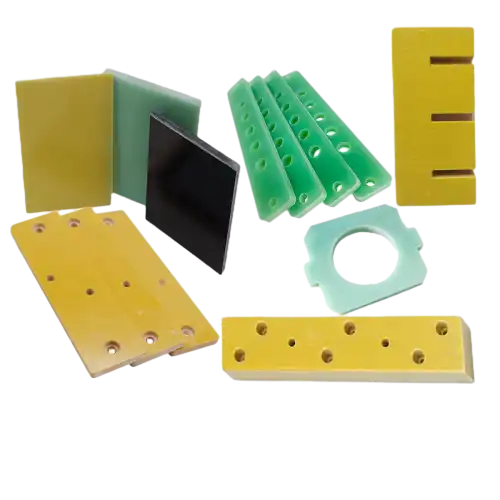
Core Performance Comparison Between FR4 and 3240 Epoxy Fiberglass Sheet
Electrical Insulation Capabilities
The dielectric strengths of both materials show that they work about the same in normal test settings. For a thickness of 1 mm, FR4 board usually has a breakdown voltage of 30 to 35 kV/mm, while 3240 epoxy sheets get 28 to 32 kV/mm. In most real-world situations, the difference is so small that it doesn't matter statistically. Both materials have volume resistivitys higher than 10^14 ohm-cm, which means they insulate very well, even in places with a lot of moisture, where many organic insulators fail.
Values of dielectric constants show bigger differences. At 1 MHz, the FR4 board measures 4.4 to 4.8, and its loss factor is about 0.02. The dielectric values of the 3240 epoxy fibreglass sheet are 4.2 to 4.6 Hz lower at the same frequency, which means that the signal quality is slightly better in RF uses. For less signal loss, engineers working on high-speed digital circuits or radio parts might choose 3240, but special low-Dk FR4 types now make this difference less clear.
Long-term insulation efficiency is directly affected by how much water is absorbed. Both materials are very resistant to water; after 24 hours of soaking, they had absorbed less than 0.2% by weight. Because of this, they are much better than paper-phenolic options that can soak up to 5% water, which can cause them to grow and lose their electrical properties. This resistance to wetness keeps the insulation in good shape for decades in warm areas or sea settings.
Temperature Tolerance and Thermal Behavior
The glass transition temperature (Tg) tells us when epoxy structures start to soften and spread. The Tg numbers for standard FR4 board are 130 to 140°C, which is good for most electronics that work at temperatures below 105°C all the time. High-Tg versions raise this limit to 170-180°C, which allows lead-free soldering and uses under the hood of cars. The thermal performance of the 3240 epoxy sheet is similar to that of normal FR4, but makers may change the resin formulations to meet specific thermal cycle needs.
When the temperature changes, thermal expansion factors affect how stable the dimensions are. In the XY plane, both materials increase by about 14–16 ppm/°C below their Tg and then jump to 60–70 ppm/°C above this point. This break causes stress in parts that are heated and cooled over and over, which could lead to PCB warping or delamination in structures that weren't built well. For machinery parts that use 3240 sheets, this growth in precision structures needs to be taken into account.
The biggest difference in efficiency is seen in flame protection. The UL94 V-0 rating means that the FR4 board puts out the fire within 10 seconds and doesn't leave any burning drips. Since the 3240 epoxy fibreglass sheet doesn't have any flame retardants, it will keep burning after being lit, which is dangerous in public buildings and electrical shelters. This one trait often defines the choice of material, even if there are other performance benefits.
Mechanical Strength and Customization Options
Flexural strength tests show that both materials have strong mechanical properties. FR4 board gives off 415–450 MPa in the warp direction and 380–420 MPa in the fill direction because of the way the weave is orientated. The 3240 epoxy sheet matches or slightly beats these values. Some formulas can hit 480 MPa by choosing the right glass cloth. Because of this strength, thin pieces can span long lengths without deformation, which lowers the weight of the unit when it comes to shipping.
Both materials have a compressive strength of more than 400 MPa perpendicular to the joint plane. This means they can handle high holding forces in busbar systems and mechanical fasteners. Shear strength of about 200 MPa allows for strong threaded inserts and mechanical connection without the chance of breaking. Due to the flimsy nature of the material, the edges must be carefully rounded to avoid stress clusters. This is because sharp points allow cracks to spread when the material is hit.
You can get sheets as thin as 0.2 mm for bendable PCB stiffeners or blocks that are 100 mm or more thick for precise cutting. Standard stock widths are 0.8 mm, 1.6 mm, 3.2 mm, and other sizes that match popular design needs. For specific uses, custom width orders are possible, but wait times are 2 to 4 weeks longer than normal supplies. Large-format cutting and panelization needs can be met in production settings with widths of up to 1050mm x 2100mm.
Practical Considerations for Procurement and Application
Aligning Material Properties with Project Parameters
Environmental risk study helps choose between FR4 and 3240 materials. Even though it might cost more, FR4 board has to be used for projects that will be directly exposed to flames, like electrical equipment that is rated for arc flash protection. 3240 epoxy sheets can be used in indoor machinery uses that don't need to worry about fire hazards and get the same electrical performance at lower material costs. No matter what base material is used, outdoor applications need UV-resistant surface treatments because long-term exposure to sunlight damages concrete surfaces.
Regulatory compliance systems are very different between markets and businesses. In North America, electrical equipment usually needs to be UL-approved, and FR4 types with long approval records are strongly preferred. European markets put a lot of emphasis on REACH and RoHS compliance, which can be achieved with the right plastic choice for both materials. For automotive uses, production settings must be IATF 16949 approved. This means that suppliers can only be bigger companies with strong quality management systems.
When thinking about dielectric loss, the operating voltage and frequency play a role. For uses above 100 MHz, materials with lower dissipation factors work better. This could mean that 3240 epoxy sheets work better in radio bases or radar parts. Power frequency uses (50–60 Hz) don't show big differences in how well different materials work. This means that when buying something, people should focus on how well it works mechanically and how resistant it is to flames instead of how it works electrically.
Cost Analysis and Supply Chain Planning
Material prices take into account the cost of raw materials, the difficulty of making the product, and the cost of approval. Due to flame safe chemicals and UL approval upkeep costs, FR4 board usually costs 15–25% more than similar 3240 epoxy sheets. When buyers order full sheets (usually 50 to 100 sheets), they can get tier pricing that cuts the price difference down to 10 to 12 percent. When you sign an annual contract with a commitment to a certain amount, you can get extra savings and be given priority when there are problems in the supply chain.
To handle lead times for 3240 epoxy fiberglass sheet well, you need to know how to keep track of supplies and how production processes work. Standard FR4 widths can be shipped from stock within three to five business days from reputable sources who keep a lot of stock on hand. Custom standards lead to production runs that take three to four weeks because makers place orders in batches to get the most out of their presses. International sending by ocean freight takes an extra two to three weeks, but delivery can be sped up to five to seven days with air freight, but it costs a lot more. Buyers should keep enough of key production materials on hand to last for 60 to 90 days.
There are more perks to buying in bulk than just lower unit prices. When full boxes are shipped together, the cost of freight per sheet is 30–40% less than when orders are placed for smaller amounts. When sellers know how often orders will come in, they can plan their production more efficiently, which improves quality and lowers the cost of rush orders. Long-term relationships often lead to services that add value, such as sale stocking programs, vendor-managed stock, and direct access to technical support.
Supplier Evaluation and Certification
A manufacturing capability review starts with looking at how much can be made and how up-to-date the equipment is. When compared to older single-opening systems, suppliers who use multi-opening presses with automatic temperature control offer better thickness accuracy. When you have CNC machining skills in-house, you can offer a service that adds value. However, for complicated shapes, specialised machining suppliers can often achieve tighter standards. Quality licenses like ISO 9001, ISO 14001, and standards relevant to the business show that management is committed to a structured approach.
Testing equipment shows how confident the seller is in the uniformity of the product. Routine tests for electrical strength, bending strength, and flame resistance done in-house show that quality control is being done proactively. Performance claims can be checked independently with third-party approval papers from UL, TÜV, or similar organisations. Traceability systems that keep track of lots of raw materials all the way through to finished goods make it possible to quickly find the root cause of problems in the field, which lowers the risk of liability.
As companies set stricter environmental goals, sustainability practices have a bigger impact on the purchases they make. When suppliers use closed-loop liquid recovery, they make less toxic trash, which helps buyers meet their sustainable goals. Using renewable energy in manufacturing reduces the carbon footprint of products, which is important for businesses that have to report Scope 3 pollution. Conflict resource compliance and ethical sources can be checked by showing the whole supply chain, including where the glass fibre and plastic come from.
Conclusion
Which material to use—FR4 board or 3240 epoxy fibreglass sheet—really relies on fire safety needs, rules that must be followed, and specific performance goals. Because it doesn't catch fire, FR4 is an important material for electrical tools and PCBs where safety rules require them to do so. The 3240 epoxy sheet has the same level of electrical insulation and industrial strength, so it can be used in structure applications where flame protection is not as important. Instead of just looking at the unit price, procurement teams should look at the total cost of ownership, which includes legal compliance risks. This will protect the company's long-term dependability and responsibility.
FAQ
What width range should I give for uses that need to be exact?
Standard industrial types have a width range of about 10%, which is fine for standard electrical insulation and mechanical gaps. For precise uses like test tools and tight-tolerance parts, you need better specs of ±5% or less, which are available at small cost rises. Check the measurement methods used by the seller. Some measure at sheet centers, while others average several places, which can change how consistent the final part is.
Can these materials stand up to being outside all the time?
Long-term UV exposure breaks down concrete surfaces, causing chalking and light discolouration within one to two years if they are not covered. Performance loss is still very small and mostly just looks bad. UV-resistant topcoats or barrier protection are good for outdoor installs. Moisture and temperature changes don't bother the materials because they are naturally resistant to the environment.
How can I be sure that what sellers say about flame retardancy is true?
Ask for UL approval proof that the material is recognised, with the file number E-XXXXX format. This can be checked in UL's online database. Without independent test results, certificates of approval aren't very useful on their own. Reliable sellers give you test data for each batch when you ask for it, which shows that they check the quality of their products on a regular basis instead of just once for approval.
Partner with J&Q for Premium FR4 Board Solutions
J&Q uses more than 20 years of experience making things and 10 years of experience trading internationally to provide approved FR4 board and epoxy laminates that meet the strictest industrial standards. Because we have specialised transportation operations as part of our vertical integration, we were able to improve delivery plans and cut wait times by 30% compared to the average in the industry. Engineering managers and procurement experts can use technical advice services to help them choose materials that meet the needs of their specific applications and figure out how to comply with UL standards and make customisations. As a well-known FR4 board provider, we work with electrical manufacturers, power equipment manufacturers, and car parts makers all over North America. We keep a large collection of standard sizes and can also make boards to your exact specifications. Email our expert team at info@jhd-material.com to talk about the needs of your project, get material certifications, or look into volume pricing models that fit your buying cycle.
References
Institute of Electrical and Electronics Engineers (IEEE), "Standard for Qualification and Characterization of Printed Wiring Board Laminates," IEEE 802.3, 2021 Edition.
National Electrical Manufacturers Association (NEMA), "Industrial Laminating Thermosetting Products," NEMA LI 1-2020 Standard Specifications.
Underwriters Laboratories Inc., "Tests for Flammability of Plastic Materials for Parts in Devices and Appliances," UL 94 Standard for Safety, 2018.
American Society for Testing and Materials (ASTM), "Standard Test Method for Dielectric Breakdown Voltage and Dielectric Strength of Solid Electrical Insulating Materials," ASTM D149-20.
IPC Association Connecting Electronics Industries, "Performance Specification for Base Materials for Rigid and Multilayer Printed Boards," IPC-4101D, 2022 Revision.
Materials Research Society Bulletin, "Thermal Management in High-Performance Polymer Composites for Electronics Applications," Volume 48, Issue 3, March 2023, pp. 287-301.
_1740986340093.webp)