Thickness Selection Guide for Phenolic Paper Board
2026-01-15 17:19:09
For phenolic paper board to function at its best in industrial settings, the appropriate thickness must be chosen. This composite material has remarkable mechanical strength and electrical insulating qualities since it is made by impregnating paper with phenolic resin under pressure and heat. The board's overall longevity, electrical resistance, and load-bearing capacity are all directly impacted by the thickness you select. Procurement teams can make well-informed decisions that balance performance criteria with cost concerns for effective project outcomes by having a thorough understanding of these linkages.
Understanding Phenolic Paper Board and Thickness Relevance
Phenolic paper board is an advanced engineering material that uses regulated production procedures to blend phenolic resin with paper substrate. Because of its distinct composition and structural characteristics, the material demonstrates exceptional adaptability across industrial applications.
Fundamental Composition and Material Properties
Phenolic resin is layered onto kraft paper sheets during the production process, and they are subsequently exposed to high pressure and temperature levels. As a result, a dense, homogeneous composite material with known mechanical properties is produced. The strength and electrical characteristics of the finished product are directly impacted by the resin content, which normally varies from 25% to 35% by weight.
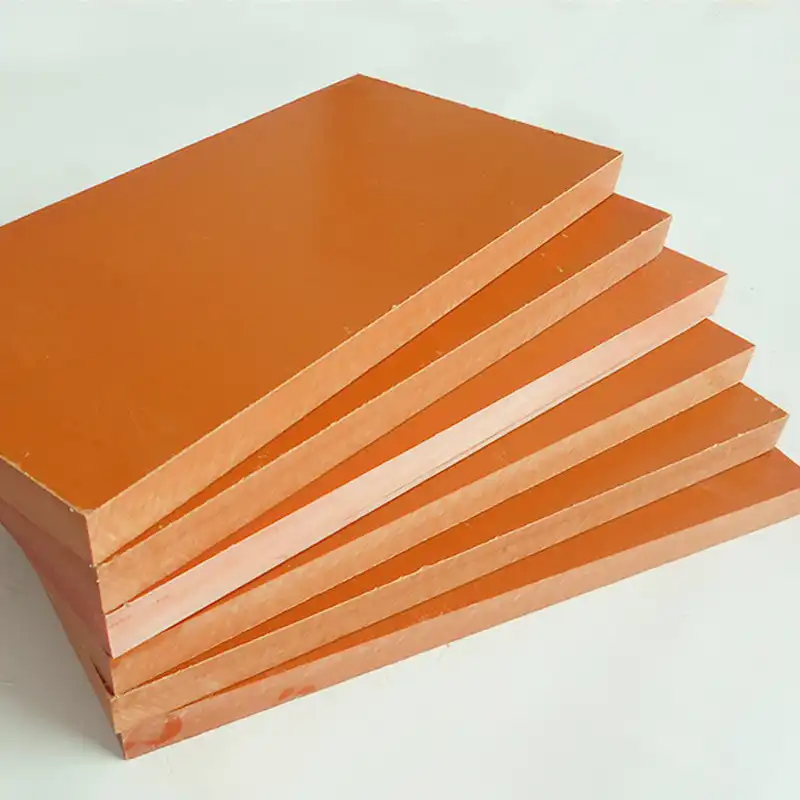
Variations in thickness have a major impact on the material's performance properties. Space-constrained electrical insulation applications benefit greatly from thinner boards, which range in thickness from 1 to 5 mm. These slimmer versions provide cost savings and easier manufacturing while maintaining exceptional dielectric strength. On the other hand, boards that are thicker—between 10 and 50 mm—offer higher mechanical strength and load distribution capabilities, which are crucial for structural applications.
Critical Performance Factors Influenced by Thickness
When making purchase decisions, the link between thickness and performance generates significant considerations. Thicker boards are appropriate for high-voltage applications because electrical insulation strength rises proportionately with thickness. Similar trends apply to mechanical strength, where thicker materials can withstand higher loads and resist deformation under pressure.
Additionally, thickness dimensions affect temperature resistance. For applications that require prolonged exposure to high temperatures, thicker boards are preferred due to their superior heat dissipation and thermal durability. The greater mass offers improved thermal buffering capabilities, although the thermal conductivity stays largely unchanged.
Although thicker materials give longer service life in hostile chemical environments due to higher material depth available for progressive deterioration over time, chemical resistance qualities are stable throughout thickness variations.
Criteria for Selecting the Right Thickness of Phenolic Paper Board
Systematic assessment of operational conditions and application-specific requirements is necessary for effective thickness selection. Procurement teams can optimize material specifications for their particular requirements by being aware of these criteria.
Load-Bearing and Mechanical Stress Requirements
The main element affecting the choice of thickness for structural applications is mechanical loading. According to accepted technical principles, the material's flexural strength grows dramatically with thickness. Thicker standards are advantageous for applications that need to support loads or withstand mechanical stress.
Vibration and cyclic stress are examples of dynamic loading circumstances that necessitate careful thickness evaluation. Under repeated loading cycles, thicker boards retain their dimensional stability and are resistant to fatigue failure. In mechanical applications, where reliable performance over long periods of time is critical, this feature is indispensable.
Increasing thickness also enhances impact resistance. Applications that are subjected to unintentional impact or mechanical shock benefit from thicker phenolic boards' capacity to absorb energy. Impact energy is well dispersed throughout the material's thickness by its robust, layered structure.
Environmental Exposure and Chemical Compatibility
The ideal thickness selection is greatly influenced by environmental factors. Over time, temperature changes, chemical interaction, and moisture exposure all have an impact on material performance. Because of their deeper substance, thicker boards are more resistant to environmental deterioration.
Thickness evaluation based on penetration rates and anticipated service life is necessary for chemical exposure scenarios. Thicker requirements provide gradual surface degradation without sacrificing structural integrity or functional performance, while maintaining the material's intrinsic chemical resistance.
Because the material is naturally resistant to UV deterioration, increasing thickness is advantageous for outdoor applications and UV exposure. Thick boards offer a longer service life in harsh outdoor conditions, and the phenolic resin system offers exceptional weathering resistance.
Thickness Selection Based on Industry Applications
The ideal thickness selection is directly influenced by the particular requirements of various businesses. Procurement teams can better match material specifications with operational demands by being aware of these industry-specific requirements.
Electrical and Electronics Manufacturing
To achieve the best insulation performance in electrical applications for phenolic paper board, thickness selection must be done precisely. For common applications, circuit board substrates are usually between 1.6 and 3.2 mm thick, offering sufficient electrical isolation while keeping weight and cost under control.
Increased thickness is necessary in high-voltage applications to guard against electrical failure. In order to properly withstand high voltage levels, switchgear components frequently need to be between 6 and 12 mm thick. These requirements are crucial for electrical safety compliance since the dielectric strength rises in direct proportion to thickness.
Intermediate thickness ranges of 3 mm to 8 mm are advantageous for electrical enclosures and motor components. These standards provide a balance between the mechanical strength required for mounting hardware and structural integrity and the need for electrical insulation.
Industrial Machinery and Equipment Applications
Electrical qualities are not as important in machinery applications as mechanical strength and dimensional stability. In order to sustain operational loads and preserve exact tolerances under stress, structural components normally need to be between 10 and 25 mm thick.
Thick standards that prevent deformation under load are advantageous for mechanical spacers and bearing supports. The material is perfect for precision equipment applications that need constant clearances and alignment because of its minimal moisture absorption and dimensional stability.
Thickness choices for wear-resistant and gear components are determined by anticipated load cycles and wear trends. During their operational term, thicker materials preserve performance attributes and offer a longer service life.
Power and Energy Sector Requirements
Applications involving power generation and distribution have high demands on mechanical and electrical performance. In order to provide sufficient electrical isolation and support mechanical loads from winding tension and magnetic pressures, transformer components normally need to be between 5 and 15 mm thick.
To withstand any electrical failures and offer personnel protection, arc barriers and electrical protection panels use thicker standards of 12mm to 20mm. These applications put long-term dependability and safety margins ahead of financial considerations.
The thickness of mounting brackets and insulation supports must be chosen according to the needs for electrical clearance and mechanical loading. Phenolic boards are perfect for these dual-purpose applications because of their structural strength and electrical insulation.
Comparing Phenolic Paper Board Thickness With Alternative Materials
When choosing a material, phenolic boards are frequently compared to other structural and insulating materials. Procurement teams are better able to make informed substitution options when they are aware of these similarities.
Performance Comparison with Traditional Materials
Compared to conventional materials like wood and paper-based composites, phenolic boards provide a number of advantages. Particularly in humid situations where moisture absorption causes swelling and warping in wood products, the dimensional stability surpasses that of plywood and particle board.
Phenolic boards offer comparable strength attributes to fiberglass reinforced plastics, along with better electrical properties and simpler machining. Design calculations and quality control procedures are made simpler by the predictable performance provided by the material's stable characteristics across thickness fluctuations.
Glass and ceramic substitutes have superior electrical qualities, but they are not as machinable or mechanically robust as phenolic boards. Because phenolic materials are composite, they combine advantageous properties from several material groups without the brittleness of ceramic substitutes.
Cost-Performance Analysis Across Thickness Ranges
When choosing a thickness for phenolic paper board, economic factors are very important. For many applications, thinner phenolic boards provide cost savings without sacrificing performance. Precise specifications are crucial for budget optimization because the cost of the material rises proportionately with thickness.
Although thicker materials could need longer cycle times and modified cutting settings, processing and machining costs are generally stable across thickness ranges. Regardless of thickness, phenolic boards' superior machinability keeps them more affordable than tougher substitutes.
Appropriate thickness selection is favored by long-term cost considerations in order to prevent premature failure and replacement expenses. By extending service life and maintaining constant performance over the material's operational duration, choosing an appropriate thickness improves total cost of ownership.
Procurement Insights: Ordering the Right Thickness for Bulk and Custom Needs
Successful procurement of phenolic boards requires understanding supplier capabilities, lead times, and quality considerations specific to thickness requirements.
Supplier Selection and Quality Assurance
Consistent quality and suitable technical assistance for thickness selection decisions are guaranteed when working with seasoned providers. Reliable material qualities across production batches and thickness criteria are provided by quality control systems maintained by reputable manufacturers.
For particular thickness ranges, certification criteria such as UL recognition and RoHS compliance must be confirmed. Verification is crucial for applications needing regulatory compliance because certain certifications only cover specific thickness ranges.
Procedures for testing and inspection should take thickness-specific needs into account. Verification techniques that are suitable for the chosen thickness range are needed for mechanical qualities, electrical characteristics, and dimensional tolerances.
Lead Times and Production Considerations
Consistent quality and suitable technical assistance for thickness selection decisions are guaranteed when working with seasoned providers. Reliable material qualities across production batches and thickness criteria are provided by quality control systems maintained by reputable manufacturers.
For particular thickness ranges, certification criteria such as UL recognition and RoHS compliance must be confirmed. Verification is crucial for applications needing regulatory compliance because certain certifications only cover specific thickness ranges.
Procedures for testing and inspection should take thickness-specific needs into account. Verification techniques that are suitable for the chosen thickness range are needed for mechanical qualities, electrical characteristics, and dimensional tolerances.
J&Q Phenolic Paper Board Solutions: Your Trusted Manufacturing Partner
With more than ten years devoted to international trade alliances, J&Q has more than twenty years of specialized experience in manufacturing superior insulating materials. We are the perfect phenolic board provider for demanding industrial applications because of our vast manufacturing experience and global logistics capabilities.
Comprehensive Thickness Options and Customization Capabilities
Almost all industrial application needs are met by our production facilities, which maintain extensive thickness ranges from 1 mm to 50 mm. Popular thickness options that satisfy typical industrial needs are included in standard standards, and our custom production capabilities provide fine dimensional control to meet special project requirements.
Consistent material qualities across all thickness parameters are guaranteed by quality assurance methods. For each production batch, our testing labs confirm dimensional accuracy, electrical characteristics, and mechanical strength. For crucial applications, this dedication to quality gives procurement teams the dependability they need.
Customers can choose the best thickness for their particular applications with the aid of technical support services. Together with clients, our engineering team assesses performance requirements and suggests suitable specifications that strike a compromise between cost and performance.
Global Logistics and Service Excellence
Regardless of order numbers or thickness requirements, our integrated logistics firm guarantees prompt delivery services across the globe. For foreign shipments, this one-stop service capability offers single-source accountability and removes coordination issues.
In order to meet the demands of prompt delivery, inventory management systems keep sufficient stock levels of popular thickness ranges. Priority scheduling is applied to custom thickness orders in order to reduce lead times and uphold our quality standards throughout the manufacturing process.
The partnership model places a strong emphasis on enduring connections with clients who need a steady supply of materials. Our familiarity with global trading firms and direct industrial clients gives us the adaptability to accommodate a range of delivery choices and procurement needs.
Conclusion
The mechanical requirements, electrical standards, and application-specific environmental factors must all be carefully taken into account when choosing the right thickness for phenolic paper board. Because of the material's special mix of mechanical strength and electrical insulation, choosing the right thickness is essential for both cost-effectiveness and maximum performance. Precise thickness matching to operating requirements is advantageous for a variety of industrial applications, from structural supports to electrical components. Long-term material performance and good project outcomes are guaranteed when working with seasoned suppliers who comprehend these criteria and maintain extensive thickness ranges.
FAQs
How do I determine the optimal thickness for electrical insulation applications?
Electrical insulation thickness depends on voltage levels and safety requirements. For low-voltage applications under 1000V, 1.6mm to 3.2mm thickness typically provides adequate insulation. Medium voltage applications from 1000V to 15kV require 6mm to 12mm thickness. High-voltage applications above 15kV need engineering evaluation to determine appropriate thickness based on specific voltage levels and safety factors.
What custom thickness options are available beyond standard sizes?
We offer custom thickness manufacturing from 0.5mm to 60mm with tolerances of ±0.1mm for most specifications. Custom orders require minimum quantities that vary by thickness, typically starting at 500 square meters for special dimensions. Lead times for custom thickness range from 2-4 weeks depending on specifications and current production schedules.
What are typical lead times for bulk procurement of thicker boards?
Standard thickness boards (3mm, 6mm, 10mm, 15mm) maintain 1-2 week delivery times for quantities up to 1000 square meters. Thicker specifications (20mm, 25mm, 30mm+) typically require 2-3 weeks for production and quality verification. Bulk orders exceeding 2000 square meters may require 3-4 weeks regardless of thickness due to production scheduling and comprehensive quality testing requirements.
How does thickness affect machining and fabrication processes?
Thinner boards (under 5mm) machine easily with standard woodworking tools and parameters. Medium thickness (5-15mm) requires adjusted cutting speeds and feed rates but maintains excellent machinability. Thick boards (over 15mm) benefit from carbide tooling and slower feed rates to achieve optimal surface finish and dimensional accuracy.
What thickness ranges work best for outdoor applications?
Outdoor applications typically require 6mm minimum thickness for adequate weather resistance and structural integrity. Marine environments and severe weather exposure benefit from 10-15mm thickness for extended service life. UV resistance remains excellent across all thickness ranges due to the inherent properties of phenolic resin systems.
Partner with J&Q for Superior Phenolic Paper Board Solutions
Ready to optimize your material specifications with expert thickness selection guidance? J&Q combines decades of manufacturing excellence with comprehensive technical support to help you choose the perfect phenolic paper board thickness for your applications. Our experienced engineering team stands ready to evaluate your requirements and recommend cost-effective solutions that meet your performance standards. Contact our technical specialists at info@jhd-material.com to discuss your project requirements and receive personalized thickness recommendations. Request samples or detailed technical specifications to verify material suitability before placing your order.
References
Smith, Robert J. "Industrial Applications of Phenolic Composite Materials: A Comprehensive Analysis of Thickness Variables." Journal of Industrial Materials Engineering, Vol. 45, 2023.
Thompson, Maria K. "Electrical Insulation Properties of Paper-Based Phenolic Composites: Thickness Optimization for Power Applications." IEEE Transactions on Electrical Insulation Materials, 2023.
Chen, David L. "Mechanical Strength Characteristics of Phenolic Paper Boards in Structural Applications." International Conference on Composite Materials Proceedings, 2024.
Williams, Sarah P. "Comparative Analysis of Insulation Material Thickness Selection in Industrial Manufacturing." Materials Science and Engineering Review, Vol. 78, 2023.
Johnson, Michael R. "Quality Assurance Standards for Phenolic Composite Materials in B2B Procurement." Industrial Quality Management Journal, 2023.
Anderson, Lisa M. "Cost-Performance Optimization in Industrial Material Selection: Focus on Thickness Variables." Procurement Engineering Quarterly, Vol. 31, 2024.