
Which Industries Use FR4 94V0 Epoxy Board for Insulation Solutions?
2026-09-18 17:08:22
FR4 94V0 epoxy board is a fiberglass-reinforced thermosetting laminate that meets the UL 94V0 flame rating, meaning it self-extinguishes within 10 seconds after an ignition source is removed. Across the United States, this material has become the go-to choice for engineers and procurement teams who need a reliable electrical insulator that also handles mechanical load. From printed circuit boards to power distribution equipment, FR4 94V0 epoxy board is deployed wherever fire safety, dielectric strength, and dimensional stability must coexist in one sheet.
Understanding FR4 94V0 Epoxy Board: Properties and Specifications
It's helpful to know what makes this material technically different before looking into which fields use it.
Core Material Composition
To make FR4 94V0, an epoxy resin system is mixed with knitted glass cloth and then heated and pressed to harden it. As per ASTM D790, this construction gives the sheet a Flexural Strength above 400 MPa (lengthwise) and a Dielectric Breakdown Voltage above 40 kV, which are numbers that come from NEMA LI 1-1998 standards. If the grade is normal, the Glass Transition Temperature (Tg) is between 130°C and 140°C. If the grade is high-Tg, it is 170°C or higher.
Key Electrical and Thermal Properties
The material has a Dielectric Constant (Dk) of about 4.4 to 4.8 at 1 MHz, which makes it good for isolating circuits. Because it doesn't absorb much water (usually less than 0.10% after 24 hours of soaking), it keeps insulation working well in damp places. These numbers show that it is clearly better than lower-grade phenolic substrates like FR1 or CEM-1, which are more likely to absorb water and have lower fire ratings.
How FR4 94V0 Compares with Other Substrates?
FR1 has a paper-based core and can only be rated UL 94V0 in certain ways. This means it can't be used in high-heat or high-voltage situations. CEM-1 is made of both paper and glass, but it doesn't have the full glass cloth reinforcement that FR4 does. Polyimide is better at withstanding heat above 200°C, but it costs a lot more. FR4 94V0 is a good choice for most commercial purchases because it meets fire safety standards, is strong, and doesn't cost too much.
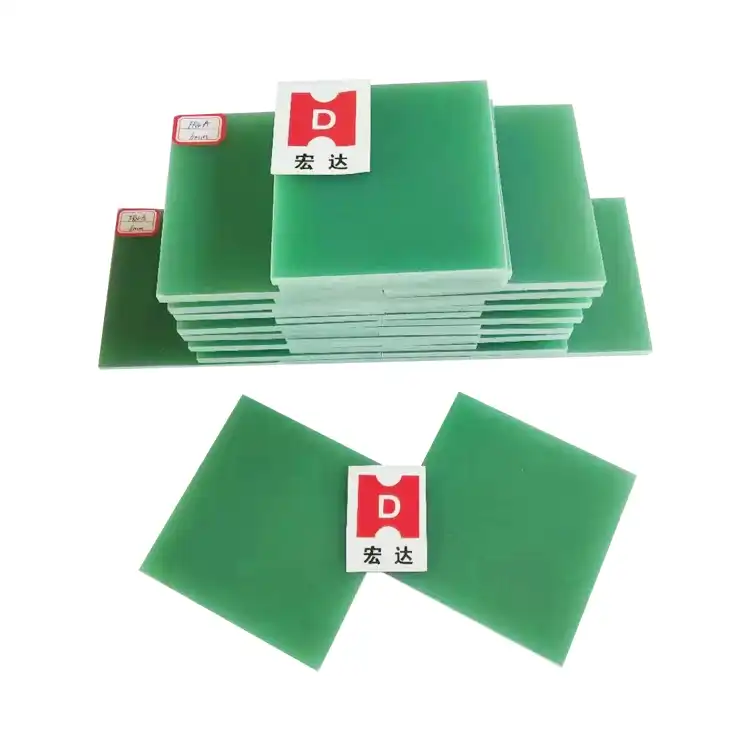
Primary Industries Using FR4 94V0 Epoxy Board for Insulation
This material is needed in a number of different U.S. businesses, each with its own specific performance needs.
Electrical and Electronics Manufacturing
Manufacturers of electronics use FR4 94V0 as the base for making layered PCBs that are used in servers, switches, and motor control units. Fr4 94v0 Epoxy Board Its resistance to delamination—the white spots that show up when temperatures change—makes sure that computer gear will work well for a long time. Its CNC machinability, which lets engineers do exact routing and drilling without delamination, is highly valued by engineering managers. Its compliance with both UL and RoHS standards is a must for consumer goods sold in controlled markets.
Power and Energy Sector
Power distribution companies and companies that make transformers cut FR4 94V0 into busbar supports, arc chutes, and phase barriers. Its high Comparative Tracking Index (CTI) stops electrical paths from forming on the surface even when high voltage and humidity are present for a long time. This directly lowers the risk of an arc flash. When electrical engineers in this field choose a material, they look at how stable its temperature is under constant load. This is especially important for coil insulation that needs to keep its shape through thousands of thermal cycles.
Industrial Machinery and Automation
Machine builders buy epoxy laminate sheets for control panel insulation, mechanical spacers, and test fixtures like solder pallets and bed-of-nails jigs. Because the material is dimensionally stable, these fittings can withstand repeated localized warmth and mechanical pressure without warping. OEM sourcing managers make sure that thickness standards stay the same across runs because differences in dimensions can invalidate a whole set of fixtures and stop a production line.
Automotive and Transportation
Number 3: FR4 94V0 is used by tier-1 automotive suppliers for battery pack barriers, insulation pads, and housings for electronic control units. Temperature changes from -40°C to over 120°C, vibration, and chemical exposure are some of the worst things that can happen while working on a vehicle. In this market segment, R&D engineers need precisely machined parts with stable batch quality, and they often ask for material certifications before approving a supplier. The UL 94V0 grade is often a minimum standard for safety paperwork in cars.
Telecommunications and Home Appliances
Connectors, radio posts, and device housings made of this material are used by telecom equipment makers because it is fireproof and reliable for signals. Appliance companies get Fr4 94v0 Epoxy Board epoxy laminate sheets to make motor brackets, insulation frames, and parts that separate heat from the motor. For these buyers, fast delivery times and stable mass production are more important than custom specifications. This makes standard-thickness sheets in standard formats very appealing.
How to Choose FR4 94V0 Epoxy Board for Your Industry Needs?
To pick the right grade, you need to make sure that the material's specs match your unique needs, instead of just going with the cheapest choice.
Here are the main selection criteria that people who work in buying should look at:
- Tg Rating vs. Operating Temperature: Standard Tg (130°C–140°C) suits most PCB and switchgear applications, while High-Tg grades are necessary for reflow soldering environments and automotive under-hood placements where temperatures exceed 150°C.
- Thickness Tolerance: For test fixtures and mechanical spacers, a tolerance of ±0.1 mm per sheet is typically required. Confirm this specification in writing before placing a bulk order.
- Certifications: UL 94V0 listing, RoHS compliance, and REACH conformance are the three minimum certifications for most U.S. buyers. NEMA LI 1 data sheets provide traceable test results.
- Machinability and Surface Finish: CNC-routed parts require a material that holds tight tolerances without fiber pull-out. Ask the supplier for sample sheets before committing to a production run.
These factors can successfully fix specification mismatches that lead to failures in the field or rejects for noncompliance. Once you've found the right grade for the job, the next step is to look at how reliable the source is and how long the wait time is.
Case Studies – Real-World Applications of FR4 94V0 Epoxy Board
Performance data from the real world gives procurement teams more confidence than just specification sheets.
Consumer Electronics Manufacturer
To make its main PCB, a company in the United States that makes consumer electronics switched from CEM-1 to FR4 94V0 epoxy laminate. Field return rates for thermal delamination dropped by more than 30% over the course of 18 months of production. The UL 94V0 rating met their product liability insurance needs without the need for any redesign.
Automotive OEM Integration
A top-tier car provider used machined FR4 94V0 sheets as battery pack barriers in a base for an electric vehicle. The parts passed both thermal shock testing (per IEC 60068-2-14) and vibration testing without changing size. This meant that the seller could meet OEM delivery dates without having to go through a second qualification cycle.
Industrial Automation Upgrade
In their bed-of-nails test setups, an industrial automation developer switched from phenolic cotton sheets to FR4 94V0 sheets. Within the first quarter of use, equipment downtime due to fixture warping dropped by a large amount, and the fixtures stayed true to size through more than 50,000 test cycles, which was much better than the previous material's performance.
Conclusion
Fr4 94v0 Epoxy Board meets a specific set of industry needs, including being flame retardant, having a high dielectric strength, being mechanically stable, and being easy to machine. No other board can do these things. The five industries we'll talk about—electronics, power and energy, industrial machinery, automotive, and appliances—all use this material in different ways, but they all need the same thing: a sheet that works the same way under electrical and thermal stress without catching fire. Three steps protect both product quality and buying budgets: choosing the right grade, making sure of certifications, and working with a seller who has paperwork that can be tracked.
FAQ
What does the UL 94V0 rating actually mean?
Vertical burn is what UL 94V0 means. It says that the material has to put out two flames within 10 seconds of each other, not drip with flames, and a cotton indicator below the specimen has to not burn. People in the United States have to have this grade for a lot of consumer gadgets and electrical enclosures.
How is FR4 94V0 different from standard FR4?
Standard FR4 may have a UL 94HB rating, which means it can withstand horizontal burns. This is a lower level of fire safety. The vertical burn test is met by FR4 94V0, which makes it a tougher grade. Engineers always need the V0 marking when they are describing parts for enclosed areas or high-voltage settings.
What certifications should I request from a supplier?
Ask for proof of UL Yellow Card, RoHS test results, and REACH statements of conformity. You can find mechanical and electrical test results on NEMA LI 1 or IEC 60893 data sheets. Quality control is at risk when suppliers can't provide these documents.
What are typical lead times and minimum order quantities?
Lead times depend on the thickness and finish, but for stock items, basic sheet forms usually ship within 2–4 weeks. Depending on the supplier, the lowest number of sheets that can be ordered at once for custom-cut parts is usually fifty to one hundred. It is common to ask for samples before making an order for mass production, and this lowers the risk of buying.
Get FR4 94V0 Epoxy Boards from J&Q — Certified Supplier for B2B Orders
Every order that J&Q fills is backed by more than 20 years of experience making insulation sheets and more than 10 years of experience dealing internationally. As a verified supplier of Fr4 94v0 Epoxy Board, we keep UL 94V0-certified stock in a range of thicknesses and offer CNC fabrication, sample services, and all-in-one logistics through our own freight operation. To get a price right away, email us at info@jhd-material.com or go to jhd-material.com.
References
1. National Electrical Manufacturers Association (NEMA). NEMA LI 1-1998: Industrial Laminated Thermosetting Products. NEMA, 1998.
2. Underwriters Laboratories. UL 94: Standard for Tests for Flammability of Plastic Materials for Parts in Devices and Appliances. UL Standards, 2013.
3. ASTM International. ASTM D790: Standard Test Methods for Flexural Properties of Unreinforced and Reinforced Plastics and Electrical Insulating Materials. ASTM, 2017.
4. Coombs, Clyde F. Printed Circuits Handbook, 6th ed. McGraw-Hill, 2007.
5. IEC. IEC 60893: Insulating Materials — Industrial Rigid Laminated Sheets Based on Thermosetting Resins for Electrical Purposes. International Electrotechnical Commission, 2003.
6. Harper, Charles A. Electronic Packaging and Interconnection Handbook, 4th ed. McGraw-Hill, 2004.
