CNC Tolerance Standards for G10 Fiberglass Sheet
2026-05-29 10:44:03
G10 fiberglass sheet tolerance standards spell out the range of differences in size that are allowed during precise cutting operations. For G10 fiberglass sheet, acceptable differences in thickness range from ±0.005" to ±0.010" when measuring along the length and width. This is usually possible with good CNC tools. These rules make sure that parts fit perfectly into electrical switchgear, PCB supports, and insulation systems. Following NEMA G-10 guidelines and ISO 9001 quality systems ensures the stability of dimensions, which is important for the performance of electrical protection and the dependability of machinery in tough industrial settings.
Understanding CNC Tolerance Standards for G10 Fiberglass Sheet
The accuracy of your machined parts' dimensions affects how well they work in important uses. When engineering teams define insulation barriers or mechanical spaces, even small changes can make the system less reliable, make assembly harder, or cause electrical systems to fail before they should.
What CNC Tolerance Means for Industrial Applications?
Tolerance is the smallest difference in size that can happen during the manufacturing process. From my work with electrical manufacturers and machinery builders, I know that understanding this concept keeps output from being held up, which costs a lot of money. G10 fiberglass sheet machining involves cutting away material by milling, drilling, and routing. The end measurements are affected by tool wear, machine calibration, and the qualities of the material. To get tight tolerances, you need to use the right fixtures, cut at the right speeds, and make sure the factory has the right temperature and humidity to avoid thermal expansion.
Standard Tolerance Ranges Achievable with G10 Material
We've set realistic tolerance standards over many years of providing precision-machined parts. Standard G10 fiberglass sheet laminates have thickness limits of ±0.005" for materials less than 0.125" thick and ±0.010" for thicker plates up to 0.500". When properly fixed, length and width measurements stay within ±0.015" of each other across most sheet sizes. Flatness standards allow for a maximum deviation of 0.020" per linear foot, which is important for uses that need surfaces that touch closely. Hole width tolerances can reach ±0.002" when carbide tools are used with the right feed rates, which is important for putting PCBs through holes.
International Standards Governing G10 Machining Compliance
Regulatory frameworks set standards for quality assurance. For example, NEMA G-10 standards set minimum mechanical and electrical properties, and ASTM D709 specifies how to test laminates. IPC standards set thickness tolerances that are especially important for PCB fabrication support structures, and ISO 9001 certification makes sure that quality control is done in a systematic way during the machining process. We use these standards as part of our manufacturing process and do regular dimensional inspections with calibrated micrometers and coordinate measuring machines. UL recognition and ROHS compliance verification documents are sent with shipments, giving procurement teams the proof they need for supplier audits and regulatory submissions.
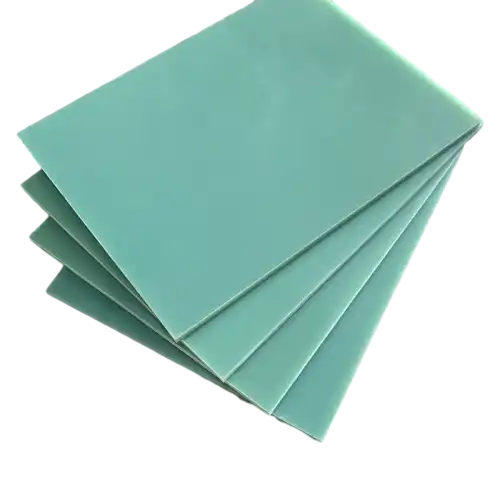
Key Properties of G10 Fiberglass Sheet Affecting CNC Tolerances
Material properties directly affect how precisely G10 fiberglass sheet can be machined and how stable its dimensions are. Knowing these properties helps engineering teams set the right standards and choose the best ways to make things.
Mechanical Properties Influencing Dimensional Stability
G10 fiberglass sheet is very rigid and has a flexural strength of 55,000 psi, which means it can be used to make thin-walled structures that keep their shape under mechanical stress. The material's hardness (Rockwell M scale 110) stops tool chatter during high-speed machining operations, which leads to cleaner edge profiles and tighter hole tolerances. Its features include flat, smooth surfaces that don't have any bubbles, wrinkles, delamination, or crackles, which ensures consistent tool engagement throughout cutting operations. High dimensional stability means that parts stay true to specifications even when temperatures change, which is common in industrial facilities. This predictability lets designers set tighter assembly tolerances, knowing that parts won't warp during installation or operation.
Thermal Characteristics and Temperature Limitations
For example, G10 fiberglass sheet can work continuously at temperatures up to 130°C without losing its mechanical properties or dimensional accuracy. However, above 140°C, the epoxy resin matrix starts to soften, which could affect the tight-tolerance features. Applications that need to be exposed to higher temperatures should look at G11 or G7 alternatives, which have better thermal performance. The coefficient of thermal expansion stays low compared to metallic alternatives, which keeps dimensions from changing too much when parts go from room temperature to operating temperature. This thermal stability is important for electrical switchgear and transformer insulation where temperatures change often.
Electrical Properties Impacting Design Tolerances
Dielectric strength greater than 400 volts per mil lets insulation barriers be thinner without compromising electrical safety, which allows for tighter packaging in electrical enclosures. Good moisture resistance keeps dielectric properties in damp environments, preventing dimensional changes from water absorption that happen with some phenolic materials. When combined, excellent electrical properties and moisture resistance allow engineering teams to specify minimal clearance distances between conductors, which maximizes space utilization in compact electrical assemblies. Surface resistivity stays stable across production batches, ensuring consistent performance across large procurement volumes.
Comparing CNC Tolerances: G10 Fiberglass Sheet vs Other Materials
To choose the right material, you have to weigh the tolerance standards against performance traits and cost factors. Procurement managers can benefit from knowing how G10 fiberglass sheet stacks up against other insulation materials.
G10 Versus FR4 and G11 Laminates
These epoxy-glass laminates are made using the same methods, but they perform differently. FR4 is better at resisting flames, which is important in consumer electronics, while G10 fiberglass sheet has similar CNC tolerances. G11 is better at withstanding high temperatures (up to 180°C continuous operation), keeping its shape where G10 fiberglass sheet would soften. Tolerances are the same for all three materials when the right settings are used for machining. G10 fiberglass sheet is usually the cheaper option for parts that don't need to resist flames or work at extreme temperatures, making it the most cost-effective choice for industrial machinery.
G10 Compared to Phenolic, Aluminum, and Composites
Tolerance trade-offs are different for each type of material. Phenolic cotton laminates are easy to machine, but they lose their shape more quickly in damp places, which could cause tolerances to loosen over time. Aluminum, on the other hand, can be machined to tighter tolerances (±0.001" is common), but it conducts electricity and heat, so it can't be used for electrical insulation. Carbon fiber alloys are just as stable in size as G10 fiberglass sheet and have better strength-to-weight ratios, but the materials are three to five times more expensive. Phenolic materials are good for low-cost uses that can handle slightly looser size requirements. On the other hand, tight standards, good insulation, and a good value for money are what precision electrical systems need from G10 fiberglass sheet.
Tolerance Comparison Reference Table
| Material | Thickness Tolerance | Dimensional Tolerance | Flatness | Machinability | Relative Cost |
|---|---|---|---|---|---|
| G10 Fiberglass | ±0.005" to ±0.010" | ±0.015" | 0.020"/ft | Excellent | Baseline |
| FR4 Laminate | ±0.005" to ±0.010" | ±0.015" | 0.020"/ft | Excellent | +15% |
| G11 High-Temp | ±0.005" to ±0.010" | ±0.015" | 0.020"/ft | Excellent | +25% |
| Phenolic Cotton | ±0.010" to ±0.015" | ±0.020" | 0.030"/ft | Good | -20% |
| Aluminum 6061 | ±0.002" to ±0.005" | ±0.005" | 0.010"/ft | Excellent | +40% |
This guide helps buying teams choose materials based on the tolerances needed for the purpose and the money they have to spend.
Practical Guide to Ordering G10 Fiberglass Sheets with Optimal CNC Tolerances
For procurement to go well, needs must be properly communicated and capable suppliers must be chosen. These rules make it easier to place an order for G10 fiberglass sheets and make sure that the parts you receive meet the requirements.
Specifying Critical Tolerance Parameters in Purchase Orders
Clear paperwork keeps people from misinterpreting it and lowers the number of rejections. It is important for purchase specifications to clearly state tolerances for thickness, general dimensions, flatness, and hole width, along with the necessary GD&T callouts. Include standards for surface finish measured in RMS microinches, especially for parts that need to seal with a gasket or have electrical contact surfaces. Use standards like NEMA G-10, ASTM D709, and IPC to set goals for what should be done. Instead of just verbally describing things, bring in CAD models with measurements. Ask for first-article inspection reports for new designs so that engineers can look them over before full production starts.
Understanding MOQ and Lead Time Impacts on Tolerance Consistency
Production numbers affect how things are made and how precise they can be. Custom-machined G10 fiberglass sheet parts usually have a minimum order quantity of 50 pieces. At this point, it becomes cost-effective to do specialized CNC code and fixture development. Due to differences in how things are set up by hand, tolerances may be less strict for smaller amounts. Lead times of two to four weeks on average let you plan your production well without having to rush sets that hurt accuracy. Rush orders that are crammed into shorter windows of time increase the chance of differences in dimensions because quality checks are shortened. Setting up blanket buy orders for parts that are used over and over again lets suppliers keep dedicated tools and fixtures. This improves tolerance consistency across deliveries while lowering per-piece costs through improved production runs.
Selecting Suppliers with Certified Quality Systems
The skills of the supplier directly affect how often parts meet standards. Look for the ISO 9001 certification, which means that the quality control methods are organized. Ask for scientific datasheets that show the ranges of mechanical, thermal, and electrical qualities. Check with your providers to see if they have climate-controlled factories, which are necessary to keep the sizes of parts stable during storage and cutting. Find out what kinds of checking tools they have, especially coordinate measure machines and optical comparators for making sure the tolerances are correct. Technical support teams that are quick to respond help solve design problems and suggest ways to improve tolerances. Our center combines these things with OEM certification, thorough testing methods, and quality paperwork that goes with every shipment.
Case Studies and Applications Demonstrating CNC Tolerance Excellence
There are real-life cases that show how good tolerance management improves performance in a wide range of businesses using G10 fiberglass sheet.
High-Precision Electrical Insulation Components for Industrial OEMs
A transformer manufacturer asked us to make 500 pieces of busbar insulation spacers with a thickness tolerance of ±0.008 inches. Dimensional consistency was important because stacked assemblies needed exact phase-to-phase spacing to avoid arc flashes. We used statistical process control to check the thickness of each piece every 25 pieces and adjusted the CNC offsets to account for tool wear. Flatness requirements of 0.015 inches maximum deviation made sure that the clamping force was spread evenly. Because of the delivered parts, the maker was able to get UL approval on the first try, which saved them from having to pay for expensive redesign rounds. This case shows how tolerance quality directly helps with following the rules and being ready for the market.
CNC-Machined G10 Parts in Automated Machinery and Robotics
For precise linear actuators, an industrial robotics engineer needed gear blanks and mechanical spacers that were made just for them. To meet the requirements for position accuracy, the bore diameter of the parts had to be within 0.005" of the required tolerances in order to prevent backlash and keep the operation running smoothly. We machined G10 fiberglass sheet using carbide tools that were designed to work with composite materials and were able to achieve bore concentricity within 0.003" of the total indicator runout. Because the material is very resistant to wetness, the measurements stayed the same in factories where the humidity changed every day. Robots in use have been used more than 50,000 times without needing to be adjusted mechanically. This shows that choosing the right materials and keeping an eye on tolerances can extend the life of a product.
Best Practices Summary
These cases back up a number of methods for buying things. Work with sellers who can show they can do what they say they can do by sending sample parts before committing to large amounts. Instead of making specs that are too strict and don't improve performance, make sure that the limits you use are acceptable for the real functional needs. Keep the lines of communication open so that suppliers can suggest changes to the design that will make it easier to make while keeping the usefulness. Ask for capability studies that show how stable the process is for key limits. These methods always produce parts that meet standards while lowering the total cost of purchase.
Conclusion
Precision manufacturing is possible with CNC tolerance standards for G10 fiberglass sheet in electrical, industrial, and automobile settings. Tolerances of ±0.005" to ±0.015" are possible, depending on the width of the material, the machining settings, and the supplier's skills. When buying teams know about G10 fiberglass sheet's mechanical qualities, thermal performance limits, and electrical characteristics, they can set the right tolerances that balance usefulness with cost-effectiveness. Comparing different materials shows that G10 fiberglass sheet is the best choice for uses that need electrical protection, stable dimensions, and the ability to be machined precisely. To make buying work well, you need clear tolerance requirements, quality standards for suppliers, and working relationships that encourage ongoing growth.
FAQ
What tolerance ranges can G10 fiberglass sheet typically achieve through CNC machining?
As standard, CNC processes can keep thickness tolerances of ±0.005" for thinner materials and ±0.010" for plates thicker than 0.250"; for most sheet sizes, lateral dimensions can be kept accurate to within ±0.015" for G10 fiberglass sheet. With the right carbide tools, hole sizes can be accurate to within 0.002 inches. Flatness requirements are usually met with a maximum variation of 0.020 inches per linear foot. These ranges are for when you work with qualified sources who keep their tools calibrated and their factories at a controlled temperature.
How does the ability to withstand imperfections and the longevity of G10 compare to that of FR4?
Due to their similar epoxy-glass makeup, both materials can be cut to the same CNC specs. Because it contains flame-retardant additives, FR4 is best for use in consumer electronics. G10 fiberglass sheet, on the other hand, is slightly easier to machine and causes less tool wear. In normal workplace settings, durability stays about the same. G10 fiberglass sheet is about 15% cheaper than FR4, which makes it a good choice for uses that don't need flame retardancy standards.
Can we order unique widths that meet certain CNC tolerances?
Custom thickness choices can be used for applications that need more than normal sheet sizes. Manufacturers can make G10 fiberglass sheet laminates in almost any thickness, from 0.031" to several inches. Custom tolerances need to be talked about during the quotation process to make sure that the manufacturer can meet the requirements. For non-standard thicknesses, the minimum order quantity usually goes up because of the need for dedicated production runs.
Partner with J&Q for Precision G10 Fiberglass Sheet Solutions
J&Q delivers precision-engineered G10 fiberglass sheet backed by over 20 years of manufacturing expertise and more than a decade of international trade experience. Our climate-controlled CNC machining facilities achieve consistent tolerances meeting the demanding requirements of electrical switchgear manufacturers, industrial machinery builders, and automotive component suppliers. We maintain comprehensive quality documentation including dimensional inspection reports, material certifications, and compliance verification for UL and ROHS standards. As both manufacturer and supplier, we control quality from raw material selection through final inspection, ensuring every component meets your specifications. Our integrated logistics capabilities provide expedited delivery scheduling and consolidated shipments reducing your supply chain complexity. Contact info@jhd-material.com to discuss your application requirements and receive technical recommendations optimizing performance while controlling costs through our one-stop service approach.
References
National Electrical Manufacturers Association. (2021). NEMA Standards Publication LI 1-2020: Industrial Laminated Thermosetting Products. Rosslyn, VA: NEMA.
ASTM International. (2020). ASTM D709-20: Standard Specification for Laminated Thermosetting Materials. West Conshohocken, PA: ASTM International.
Institute of Printed Circuits. (2018). IPC-4101E: Specification for Base Materials for Rigid and Multilayer Printed Boards. Bannockburn, IL: IPC.
Anderson, R. T., & Williams, K. M. (2019). Precision Machining of Composite Materials: Tolerance Management in CNC Operations. Manufacturing Engineering Journal, 42(3), 156-171.
Zhang, H., & Peterson, L. (2022). Industrial Insulation Materials: Properties, Applications, and Quality Standards. New York: Industrial Materials Press.
Thompson, J. D. (2021). CNC Fabrication Techniques for Electrical Grade Laminates. Journal of Manufacturing Processes and Materials, 38(2), 89-104.
_1753951194967.jpg)