How to Select Deep Pour Epoxy Resin for Industrial Casting?
2026-08-18 10:33:15
Selecting the right thick-pour casting resin for industrial applications demands careful evaluation of technical specifications, curing characteristics, and supplier reliability. Deep Pour Epoxy Resin stands out as a specialized two-component thermosetting polymer engineered specifically for casting applications requiring layer depths between 1 and 7 inches per pour. Unlike conventional coating epoxies that cure rapidly in thin films, this formulation features a modified hardener system that controls exothermic reactions, preventing heat-induced defects such as cracking, yellowing, or bubble formation. Industrial buyers—from electrical engineers specifying encapsulation materials to procurement managers sourcing bulk volumes—should prioritize formulations offering controlled cure times, verified dielectric properties, and consistent batch quality to meet stringent manufacturing standards.
Understanding Deep Pour Epoxy Resin: Definition and Key Characteristics
What Makes Industrial Casting Resin Different?
Deep Pour Epoxy Resin is a special kind of thermosetting polymer system that was made to deal with the problems that come up with volume casting. The main difference is that its reaction window is longer. Standard tabletop epoxies harden very quickly, creating a lot of heat that can be a problem in thick sections. This Deep Pour Epoxy Resin uses a harderener chemistry that reacts more slowly. It slowly loses its exothermic heat over 24 to 72 hours, based on the recipe and the temperature outside. The Jinghong JQ31-9T model, which has a 2:1 mixing ratio, shows this idea with a working time of 12 hours and a final cure time of 48 hours at 25°C. This managed curing cycle keeps the clearness of the material while reaching Shore D hardness levels of about 82D, which gives it the power needed for industrial uses.
Critical Performance Characteristics
The technical performance of Deep Pour Epoxy Resins has a direct effect on how well the product is made. Chemical resistance keeps embedded parts from breaking down in the environment, and low shrinkage rates (usually less than 2% volumetric change) make sure that measurements are correct in precision applications. The heat displacement temperature tells us how far finished parts can work. Electrical makers care a lot about dielectric strength because these plastics are often used to protect sensitive electronics. In quality control processes, the fact that quality formulations are clear makes it possible to see what's inside the capsules. Material certifications like ROHS, REACH, and ASTM compliance show that the product meets international safety and environmental standards. This meets the needs of regulations in all global supply chains.
Industrial Applications Beyond Decorative Uses
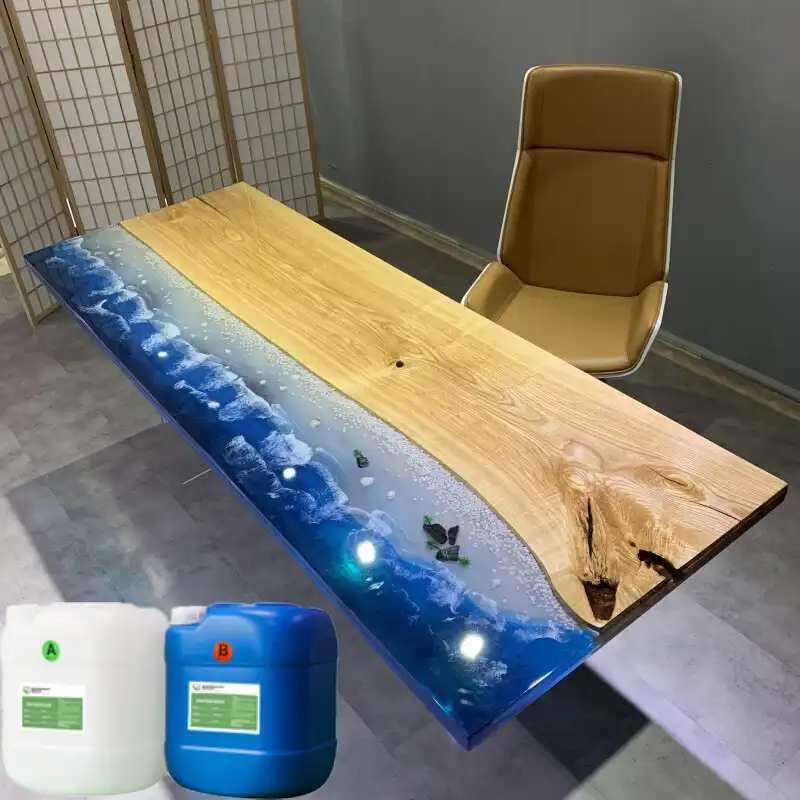
Deep Pour Epoxy Resin has become popular because of decorative river tables, but they are also used in industry for practical reasons. Electrical encapsulation keeps dust, water, and mechanical shocks away from circuit boards, transformers, and high-voltage parts. For study sites to keep specimens safe, they need resins that don't turn yellow after years of UV exposure. Deep Pour Epoxy Resins are used in manufacturing tooling to make custom jigs, fixtures, and alignment guides that can withstand repeated thermal cycling. These materials are used in the aircraft and automobile industries to pot sensors and control units that need to be resistant to vibration and stable at high temperatures. For each application, there are specific performance requirements that help with the choice of material.
Critical Selection Criteria for Deep Pour Epoxy Resin in Industrial Casting
Pour Thickness and Layering Requirements
Failures can be avoided by knowing the maximum pour depth per layer. The Jinghong product line shows this idea with three different versions that can handle different amounts of pours: the 31AB-7T can handle pours from 1 to 3 cm, the 31AB-9T can handle thicknesses from 8 to 12 cm, and the 31AB-9V can handle single pours from 15 to 18 cm. These differences come from the fact that different hardeners respond in different ways. When you try to go deeper than what is allowed, you set off runaway exotherms. This is when the buildup of heat speeds up the curing reaction, which can lead to smoking, cracking, or the failure of the whole part. When an industrial casting project needs a higher total thickness, it should use sequential pours with cooling breaks in between. This way, each layer can fully cure before the next one is added. This step-by-step method keeps the temperature under control while building to any desired end thickness.
Curing Time and Temperature Management
Temperature has a big effect on how cures work. For Deep Pour Epoxy Resin applications, temperatures below 18°C may make working times longer, but they may also stop cross-linking completely, leaving surfaces that are sticky or with lower tensile properties. When temperatures are above 30°C, processes speed up, pot life shortens, and the risk of exotherms goes up. The best settings for casting are stable temperatures between 20°C and 25°C and mild humidity levels. At 25°C, the 1000cps viscosity of both parts of the JQ31-9T formulation allows enough flow to let bubbles escape while keeping its shape in vertical applications. To make sure that the results of each production batch are the same, factories should set up climate-controlled casting areas that are monitored for temperature. Knowing that the useful time drops rapidly with higher mix volumes (often 30 minutes for 100g batches) helps workers plan their work more efficiently.
Safety and Handling Protocols
Care must be taken when handling uncured plastic parts. For some people, skin contact can make them more sensitive, so nitrile gloves and safety glasses are common. Having enough airflow gets rid of small amounts of volatile compounds that are released when mixing and curing. How the goods are stored affects how long they last; the 12-month guarantee for Jinghong products is based on sealed packages kept at room temperature and out of direct sunlight. To keep moisture from getting into containers that have only been partially used, they should be purged with inert gas or sealed with very little headspace. Scratching the sides of the container and rolling the material from bottom to top are good ways to make sure that all the parts are fully mixed. If you don't mix the resin completely, it will leave behind streaks of uncured resin that affect its mechanical qualities and look.
Customization with Pigments and Additives
Tinted resins are useful in a lot of industrial settings. Pigments that are opaque can hide parts that are embedded or be used to make colour-coded identification systems. Transparent colours keep things clear while making things stand out. However, the additions must work with the chemistry of the glue. Some pigments, especially water-based ones, add water to the paint that stops it from curing or makes it cloudy. To keep the mechanical properties, manufacturers usually say that the amount of pigment should not be more than 5% by weight. Aluminium oxide and other functional fillers make the material more thermally conductive, while sand absorbs heat and lowers exotherms. Testing proposed additives on small batches before full-scale production stops expensive waste of materials and delays in the schedule.
Comparing Deep Pour Epoxy Resin with Alternative Materials
Deep Pour Versus Standard Coating Epoxy
There is more than just a difference in marketing terms between Deep Pour Epoxy Resins and surface coating formulations. Coating epoxies work best for thin-film application, with layers that are usually no more than 3 mm thick. They also fix quickly, so projects can be finished quickly. For outdoor uses, their recipe puts surface hardness and UV safety at the top of the list. Deep Pour Epoxy Resins give up fast curing in exchange for better heat control, which lets each layer be much thicker. This makes a big difference in how efficiently large parts are enclosed or large amounts are made. In bulk applications, Deep Pour Epoxy Resins are often better because they have a lower cost per unit volume. However, coating epoxies are still better for protecting surfaces because they self-level and have a hard finish.
Polyurethane Casting Alternatives
Polyurethane materials have unique properties that make them useful in certain situations. Most of the time, they dry faster than Deep Pour Epoxy Resin systems and are more flexible when they're done. This elasticity lets them absorb shock and pressure, which is useful in automobile uses. Polyurethanes, on the other hand, tend to be less resistant to chemicals, especially acids and solvents. Because they turn yellow when exposed to UV light, they can't be used outside. Because the fix is sensitive to moisture, the climate needs to be controlled more strictly. Deep Pour Epoxy Resin systems are better for electrical uses where insulation performance and long-term reliability are more important than flexibility. This is because Deep Pour Epoxy Resin systems have better dielectric properties and physical stability.
Price-Performance Analysis
The cost of materials is only one part of the overall economics of a job. It's possible that cheaper Deep Pour Epoxy Resin formulations need more than one pour, while more expensive ones can be finished with just one. This can change the cost of labour and the time it takes to make the product. Formulations with longer working times cut down on waste from batches that have already gone bad. This is especially helpful in training situations or sets that are complicated. To get a true cost comparison, you have to take into account repair dependability. Defects that need to be fixed greatly raise the effective material costs. Established names that perform the same from batch to batch reduce quality differences, which lowers the need for inspections and the number of products that are rejected. Building relationships with dependable suppliers gives you access to technical support that keeps you from making mistakes that cost a lot of money during the initial implementation.
Procurement Considerations for Industrial Buyers
Evaluating Supplier Capabilities
Choosing a supplier is more than just comparing prices. Production capacity affects how reliably orders are filled; makers with specialised facilities and high output levels keep their inventory on hand all the time. J&Q's business, which is supported by factories that make 20,000 tonnes of goods a year and have plans to grow to 100,000 tonnes, shows the size needed for a reliable industrial supply chain. When solving application problems, technical knowledge is important. Suppliers who have formulation chemists and application experts can be very helpful. ISO-certified quality management systems make sure that process controls keep the quality of the product consistent. Suppliers that have been around for a while usually keep samples on hand so that new Deep Pour Epoxy Resin recipes can be quickly tested before large orders are made.
Volume Pricing and MOQ Considerations
When you buy in bulk, you can usually save a lot of money per unit, but the minimum order amounts need to match your storage needs and how fast you use the goods. When kept properly, Deep Pour Epoxy Resins keep certain properties throughout their shelf life. This makes bigger purchases cost-effective for places that store things in a climate-controlled environment. The terms of payment affect cash flow. Letters of credit, wire transfers, and credit cards are some of the options that give businesses the freedom to match their own purchasing policies. Different types of packaging weigh the cost per unit against the ease of handling. For example, big drums are cheaper per kilogram but need special tools for dispensing, while smaller packages are easier to handle but cost more.
Logistics and Lead Time Management
Unreliable supply chains can keep production from stopping. It's usually faster to get Deep Pour Epoxy Resin from domestic providers, but they may have to import base resins. On the other hand, working directly with manufacturers can save you money, but the wait times are longer. When businesses handle their own logistics, as J&Q does with its integrated service model, they depend less on outside carriers. Buyers can better plan their orders when they know about production processes. For example, custom Deep Pour Epoxy Resin formulations usually need longer lead times than standard goods. Setting up the right amount of safety stock based on changes in supply and rates of consumption guards against sudden rises in demand or problems with supply.
Best Practices for Using Deep Pour Epoxy Resin in Industrial Casting
Precision in Mixing and Application
It is very important to use the right mixing ratios for the cure to work. For JQ31-9T, the 2:1 weight ratio needs to be measured exactly, since the specific gravities of the parts are different (1.15 for Part A and 0.97 for Part B), and volumetric mixing can lead to mistakes. Digital scales that can read down to 1 gram are very accurate. The way you mix affects the results. Folding slowly and carefully for at least three minutes makes sure that all the parts are mixed together and prevents air from getting in. By scraping the walls and edges of the container, you keep unmixed materials from getting into the batch. Moving the mixed Deep Pour Epoxy Resin to a clean second container and mixing it again gets rid of the leftover lines. Vacuum degassing gets rid of the trapped air, but the low viscosity and long working time of good formulations let bubbles escape naturally in many situations.
Environmental Control During Cure
Setting up the best settings for curing Deep Pour Epoxy Resins makes them work better. Keeping the temperatures stable during the cure cycle stops thermal stress that can lead to cracks at the edges of layers. The quality of the surface finish is affected by the amount of moisture present. Too much moisture can lead to amine blush, a waxy film on the surface that makes it difficult for later coats to stick. Keeping the area free of dust during the long cure period keeps the sticky Deep Pour Epoxy Resin surface from getting dirty. Some operators build temporary shelters around big castings to keep controlled microclimates without having to heat or cool the whole facility. Using embedded thermocouples to check exotherm temperatures lets you know early on when temperatures are getting too high, so you can stop the damage before it's too late.
Troubleshooting Common Issues
Most casting problems can be solved with experience. Bubbles that won't go away are usually a sign of contaminated substrates releasing gases during curing. To stop this from happening, seal porous materials with thin Deep Pour Epoxy Resin coats before the main pours. Surfaces that aren't fully cured and are tacky are generally caused by wrong mixing ratios, materials that are too old, or not enough cure temperature. Discolouration or yellowing is a sign of too much exotherm or UV exposure. Temperature differences cause different cure rates across the surface, which causes waves and ripples on the surface. Cracking can be caused by too thick a layer, not enough curing time before adding more layers, or heat shock from sudden changes in temperature. By keeping specific records of the process, you can find links between variables and results, which builds institutional knowledge and raises the success rate.
Conclusion
When choosing the right Deep Pour Epoxy Resin for commercial uses, you have to balance technical performance with the ease of purchase. By knowing the differences in formulations, such as cure profiles, maximum pour levels, and mechanical qualities, you can match materials to the needs of your application. Suppliers should be judged on their production capacity, expert help, and the dependability of their supply chains. This will make sure that materials are always available and applications work well. Using the right working methods, environmental controls, and mixing routines will help Deep Pour Epoxy Resins work better and have fewer problems. Spending money on good materials and tried-and-true methods pays off in the form of less work that needs to be redone, more consistent production yields, and more reliable parts.
FAQ
What determines maximum pour thickness for epoxy casting?
The hardener's reaction character determines the thickest layer that can be poured. Systems that cure more slowly get rid of exothermic heat over longer periods of time, which lets you make bigger single drops. The JQ31-9V Deep Pour Epoxy Resin formula can work in depths of 15 to 18 cm because it has a 16-hour working time, which means that heat is generated over a longer period of time. Going deeper than what is allowed focuses heat generation, which could lead to thermal runaway reactions that break or change the colour of the casting.
How does ambient temperature affect cure time?
The temperature has a direct effect on the speed of a response. For every 10°C rise, reaction rates almost double, cutting in half the working time and speeding up the curing process. On the other hand, lower temperatures make working times longer, but if they drop below 15°C, cross-linking may not be possible at all. The 25°C starting point for the 48-hour cure cycle is the best temperature for a balance between workability and full healing for Deep Pour Epoxy Resin.
Can casting resins be machined after they have hardened?
When Deep Pour Epoxy Resins are fully hardened, they are easy to work with steel tools. They can be scraped, cut, turned, and drilled to get exact sizes and smooth surfaces. But drilling shouldn't happen until the concrete is completely cured, which is usually seven days after the initial set. This will keep the concrete from gumming up and keep its shape. When forceful cutting is done, cooling stops heat buildup that could soften the material.
Partner with J&Q for Your Deep Pour Epoxy Resin Requirements
J&Q has been in business for over 20 years and has knowledge in both manufacturing and foreign trade. They can help industrial buyers who are looking for trusted Deep Pour Epoxy Resin suppliers. Our Jinghong brand materials are made with tried-and-true formulas and are strictly inspected to make sure they meet global safety standards. They are backed by ROHS, REACH, and ASTM certifications. Our integrated logistics network allows direct delivery from factory to facility, which speeds up the buying process and lowers lead times. Our technical team works with engineering managers and procurement specialists to find the best solutions for your needs, whether they are high-volume encapsulation, precise potting, or custom Deep Pour Epoxy Resin formulations. Electrical manufacturers, machinery builders, and component suppliers are welcome to look into how our Deep Pour Epoxy Resins can help them make production more efficient and improve the reliability of their parts. Email our team at info@jhd-material.com to talk about your specific needs, get detailed data sheets, or set up sample test kits that will show you how well our material works in your real-world application.
References
1. Lee, Henry and Neville, Kris. Handbook of Epoxy Resins. McGraw-Hill Professional, 1967.
2. Petrie, Edward M. Epoxy Adhesive Formulations. McGraw-Hill Education, 2005.
3. May, Clayton A. Epoxy Resins: Chemistry and Technology, Second Edition. CRC Press, 1988.
4. Pham, Hung Q. and Marks, Maurice J. "Epoxy Resins." Ullmann's Encyclopedia of Industrial Chemistry. Wiley-VCH, 2005.
5. Ellis, Bryan. Chemistry and Technology of Epoxy Resins. Springer, 1993.
6. Goodman, Sidney H. Handbook of Thermoset Plastics, Third Edition. William Andrew Publishing, 2014.
_1732777843529.webp)