
How Does Glass Epoxy Sheet Enhance Component Durability?
2026-08-31 17:29:35
Glass epoxy sheet enhances component durability through its unique composite structure of woven fiberglass cloth impregnated with epoxy resin, delivering exceptional mechanical strength, thermal stability, and electrical insulation. This engineered material resists mechanical stress, thermal cycling, and electrical breakdown better than conventional alternatives, extending component lifespans in demanding industrial environments. The material's low moisture absorption and dimensional stability maintain consistent performance even under harsh operating conditions, making it indispensable for electronics manufacturing, power distribution, and industrial machinery applications where reliability is non-negotiable.
Understanding Glass Epoxy Sheet: Composition and Key Properties
The Physical Architecture Behind Superior Performance
Epoxy glass fiber sheet is a high-tech industrial answer made from woven glass cloth with continuous filaments and thermosetting epoxy resin binders. After being cured at high temperatures and pressures, these layers harden into a solid, uniform mass that has amazing strength-to-weight ratios. The structure of the material solves important problems in the industry, like dielectric breakdown and structural warping caused by wetness that happen with cheap materials like phenolic paper laminates.
Critical Technical Parameters That Define Quality
These technical standards set the performance profile of this laminate material. Flexural strength is usually between 45,000 and 70,000 PSI, but it depends on the grade. Dielectric strength is around 500 to 800 Volts/mil. High-quality types like G11 and FR5 keep their structure even at high temperatures; the glass transition temperature can reach 180°C. At 0.1% to 0.2%, water absorption stays very low, which keeps the dimensions stable and the electrical properties stable even in damp places. These factors meet strict requirements set by NEMA LI-1, MIL-I-24768, and IEC 60893.
Flame Retardancy and Safety Compliance
Because it doesn't catch fire, FR4 grade material sticks out among epoxy laminates. The "FR" label means that the product meets the flammability standards of UL94 V-0, which is achieved through brominated epoxy formulations. Because of this safety feature, FR4 has become the standard in the industry, mostly replacing G10, which doesn't resist fire, in electronics applications. The material is the best at keeping electricity away in places with a lot of humidity, where other materials fail. It also doesn't change shape when heated and cooled, which is great for solder reflow.
Manufacturing Process Excellence
In the production process, precise layering methods are used to soak glass cloth in resin in a controlled way before it is compressed using controlled heat and pressure. During this whole manufacturing cycle, quality control makes sure that the thickness tolerances are reliable and that the mechanical properties stay the same. Manufacturers who follow international licensing standards make PCB boards and high-voltage insulation barriers that meet the exact needs of electrical engineering uses.
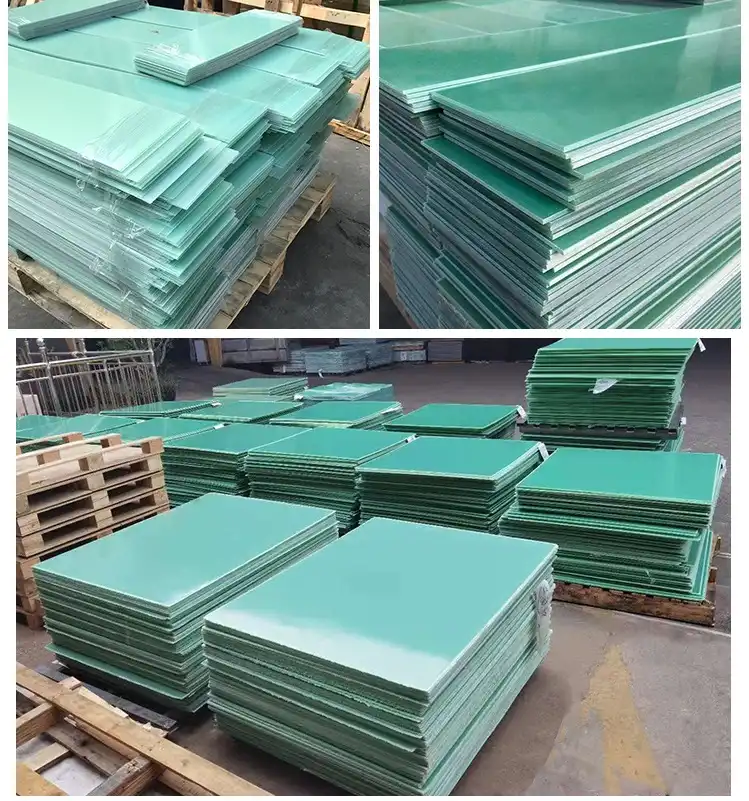
How Glass Epoxy Sheets Improve Component Durability?
Mechanical Resilience Under Stress
Glass Epoxy Sheet is very strong against mechanical loads that would break down weaker materials. The woven glass reinforcement has a high tensile strength that keeps parts from wearing out or deforming when they are bent, vibrated, or hit. This material can be used to make PCB bases that don't crack or warp when they go through repeated thermal expansion processes. Because of this physical stability, machinery parts can keep their precise specs over long periods of time.
Thermal Management Capabilities
Continuous use at high temperatures pushes the limits of materials, but epoxy glass laminates keep structures together when other materials fail. Standard FR4 works reliably at temperatures up to 130°C to 140°C (Class B rating), and high-Tg versions can handle temperatures above 170°C. This thermal stability stops the Z-axis from expanding during lead-free soldering processes and makes sure that parts work reliably in places with a lot of heat. Companies that make transformers and distribute electricity rely on this thermal resistance for coil insulation and arc barriers that have to last for years in hot conditions.
Electrical Insulation Performance
The material has great insulating qualities that keep electrical problems from happening in high-voltage and high-frequency settings. Epoxy glass fiber sheet doesn't absorb water as some other materials do, so it stays insulating even in warm or marine settings. This consistency keeps electrical arcing from happening in switchgear, motor parts, and equipment that distributes power. The stable dielectric constant protects the integrity of signals in high-frequency PCB applications, ensuring that electronics work reliably even in harsh conditions.
Long-Term Environmental Resistance
Chemical resistance to acids and solvents keeps parts from breaking down in the environment. The material doesn't absorb much water, so it doesn't grow or lose its properties, which shortens the life of parts. These features are especially useful in shields for car batteries, industrial equipment that comes in contact with cutting fluids, and device parts that have to deal with changes in humidity and temperature. The overall result makes products last longer while lowering the need for upkeep and sudden failures.
Comparing Performance: Glass Epoxy Sheet vs. Alternative Materials
Mechanical Strength Advantages
Mechanical efficiency becomes a deciding factor when procurement teams look at different material choices. When it comes to flexural strength, epoxy laminates are much better than phenolic sheets, especially when loads are applied over time. Although phenolic cotton sheets work well enough for basic tasks, they are more fragile and don't handle impacts as well. Epoxy-based fiberglass materials are better at keeping their shape and being precise when machined, so standard fiberglass materials can't be used in tight-tolerance situations.
Thermal Stability Comparison
Phenolic materials usually break down at temperatures where Glass Epoxy Sheet keeps working properly. This thermal advantage is very important in situations where the material will be heated and cooled many times or will be exposed to high temperatures all the time. Plastic options might be cheaper at first, but they soften and distort in situations where epoxy glass composites don't. The difference in glass transition temperatures between types of materials has a direct effect on how long parts last in places with a lot of heat.
Cost-Effectiveness Analysis
The initial cost of materials is only one part of the total costs of ownership. Phenolic and plastic sheets may have low prices at first, but their shorter useful lives and higher failure rates make them more expensive to repair and keep up. When engineering managers figure out the total cost of ownership, they find that investments in epoxy laminate give them a better return because the parts last longer, there is less downtime, and there are fewer warranty claims. The material can be cut with a CNC machine, which lowers the cost of production by making cuts that are smoother and tools that last longer when the right carbide or diamond-tipped tools are used.
Application-Specific Selection Guidance
For different manufacturing uses, different material qualities are needed. When making electronics, dielectric strength and flame resistance are very important, so FR4 is the clear choice. The better mechanical properties of G10 or FR4 grades make them ideal for industrial machinery that needs parts that don't wear down easily. Even though they cost more, high-Tg variants are worth it for applications in the power sector that need the best thermal performance. When procurement workers know these application-specific needs, they can match material grades with real performance needs, which improves both longevity and budget allocation.
Procurement Considerations for Glass Epoxy Sheets in B2B Supply Chains
Supplier Evaluation Criteria
Finding reliable sources for materials takes a careful evaluation of the seller. Quality assurance certifications like ISO 9001, UL recognition, and ROHS compliance show that the manufacturing process is controlled and can be tracked. Suppliers whose quality management systems are written down provide consistent batch performance, which is very important in environments with a lot of production. Technical support skills are also important—suppliers who offer material data sheets, cutting guides, and application engineering help are more valuable than those who only offer low prices.
Global Supply Chain Dynamics
There are manufacturing hubs in a number of different areas, and each one has its own benefits. Asian makers offer low prices and the ability to produce a lot of goods at once. European suppliers usually offer specialized grades with high-quality certifications. Finally, suppliers in different areas can offer just-in-time delivery models' benefits because they are closer. Diversifying your relationships with suppliers lowers the risk of breakdowns in the supply chain and keeps prices low through smart bargaining.
Order Volume and Customization
Strategies for getting materials must be in line with what is needed for production. Electronics companies that make a lot of products can save money by ordering in bulk and have established supply deals. If you need a certain thickness, a special grade, or exact pre-cut measurements, you may need to work with providers who offer CNC fabrication services. Lead times vary a lot depending on how complicated the customization is. Standard sheet stock ships quickly, but custom specifications require longer production schedules that depend on being able to accurately predict demand.
Inventory Management Best Practices
It takes a lot of planning for Glass Epoxy Sheet to find the right balance between inventory prices and keeping output going. Even though materials have longer shelf lives than usual, storage room and capital allocation are still things that need to be thought about. When supplier partnerships are built into kanban systems, it's possible to keep inventory low without worrying about running out of items. When introducing new grades or suppliers, engineering change management processes must take material qualification timelines into account. This keeps production from being held up during transitions.
Practical Applications: Real-World Use Cases Demonstrating Durability Enhancement
Electronics Manufacturing Excellence
FR4 resin laminates are most often used for making printed circuit boards (PCBs). The substance is the base that supports copper lines and electrical parts through many thermal cycles during building and system operation. Quality FR4 is used to make circuit boards that don't delaminate or warp when they go through wave soldering, reflow processes, and years of heat cycles. This mechanical and thermal resilience directly means that electronics manufacturers can get longer product warranties and fewer failures in the field.
Power Distribution Reliability
Epoxy insulation sheets are used by transformer makers to separate the coils and block the spark. These sheets must work perfectly for decades. The material's dielectric strength keeps it from breaking during high-voltage changes, and its temperature stability keeps it structurally sound when it's under constant load. When these insulation parts are used in power distribution equipment, failure rates are lower, and maintenance intervals are longer. This makes the equipment more reliable for industrial facilities and electrical utilities.
Industrial Machinery Components
Mechanics use phenolic and epoxy laminates as mechanical spacers, gear parts, and fittings that don't wear out easily. Because the material is dimensionally stable, the spacing and alignment of parts stay the same over the life of the equipment. Properties that are resistant to oils and industrial chemicals stay useful in harsh working conditions. CNC machining lets you make parts with complex shapes and very tight tolerances, which lets designers find the best ways to arrange parts for different load needs.
Automotive Applications
To make battery packs for electric cars, you need materials that can keep electricity from leaking while also managing heat and being strong. The epoxy glass sheets act as walls between cell groups and keep the cells from getting too hot. The fact that the material doesn't catch fire adds important safety features to high-energy battery systems. Precision machining lets automatic assembly processes work with manual ones, which helps keep the quality standards needed for tier-1 car supply chains.
Home Appliance Integration
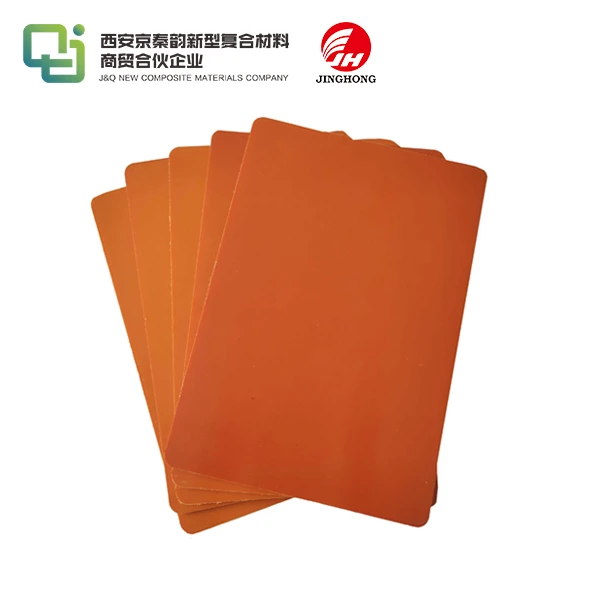
Epoxy and Bakelite sheets are used by appliance makers to make motor brackets, insulation frames, and parts that separate heat. For mass production to work, the material needs to be consistent across big runs, and its dimensions need to stay the same so that it can be put together automatically. Standard grades are cost-effective, and supply chains are reliable, which helps the fast production cycles that are common in consumer appliance markets. Material choice is strategically important because the longevity of a component has a direct effect on warranty costs and the image of a brand.
Conclusion
Glass Epoxy Sheet makes things last longer by improving their mechanical strength, heat stability, and electrical protection. The designed makeup of the material protects against certain failure modes that lower the reliability of the part, such as electrical breakdown, mechanical stress, and environmental degradation. Strategically choosing materials that meet the needs of the application improves both performance and cost-effectiveness. Engineering and procurement professionals can make better decisions that improve product reliability and operational efficiency when they know about technical specifications, supplier capabilities, and industry standards.
FAQ
What thickness should I specify for high-stress PCB applications?
1.6 mm FR4 sheets are commonly used for PCB applications because they are the best balance of mechanical strength and weight. 2.4mm or 3.2mm thicknesses work best in high-stress areas that have a lot of vibration or mechanical loads. The bigger cross-section makes the material more rigid while keeping the right insulating qualities. Looking at the material data sheets to find out specific flexural strength ratings helps match the thickness choices to the load needs that have been calculated.
How does thermal performance compare between FR4 and phenolic alternatives?
At temperatures where phenolic materials start to break down, FR4 keeps its structure intact. FR4 normally works at 130°C to 140°C all the time, but phenolic sheets usually stop working at 120°C. High-Tg FR4 variants have wider operating temperatures than phenolic options, going above 170°C. This thermal advantage lowers the chance of failure in applications that need a lot of heat and helps lead-free soldering processes that need high temperatures.
Can suppliers provide custom-sized sheets for specialized manufacturing?
Reliable makers offer CNC cutting and custom sizing services that are made to fit the needs of each production run. Custom dimensions get rid of extra steps in the manufacturing process, which cuts down on waste and processing time. Custom specs usually have longer lead times than standard stock supply, so you need to plan ahead. Custom sizing usually has minimum order numbers, which means that this choice is most cost-effective for production runs with medium to high volumes.
Partner With J&Q for Premium Glass Epoxy Sheet Solutions
J&Q can help you find the materials you need because they have been making things for over twenty years and have been trading internationally for ten years. Our large selection of FR4, G10, and specialized epoxy glass sheet types meets a wide range of industrial needs, from high-voltage insulation to PCB boards. We have been a seller of Glass Epoxy Sheet for a long time, and our strict quality standards are in line with NEMA, UL, and ROHS standards. Our combined transportation services include custom sizes, precise CNC machining, and flexible arrival times, all in one place. Engineering support teams give you expert advice on how to match the specs of the materials you need with the exact needs of your application. Visit jhd-material.com or email us at info@jhd-material.com to talk about your buying needs and find out how our track record of reliability can help your supply chain.
References
1. Harper, Charles A. Handbook of Materials for Product Design. McGraw-Hill Professional, 2001.
2. National Electrical Manufacturers Association. NEMA LI 1-1998: Industrial Laminated Thermosetting Products. NEMA Standards Publication, 1998.
3. Coombs, Clyde F. Printed Circuits Handbook. McGraw-Hill Education, 7th Edition, 2016.
4. International Electrotechnical Commission. IEC 60893: Insulating Materials - Industrial Rigid Laminated Sheets Based on Thermosetting Resins for Electrical Purposes. IEC Standards, 2019.
5. Lee, Henry and Neville, Kris. Handbook of Epoxy Resins. McGraw-Hill, 1967.
6. Underwriters Laboratories. UL 94: Standard for Safety of Flammability of Plastic Materials for Parts in Devices and Appliances. UL Standards, 2013.
_1755583592640.webp)
